Nice backformation ... last night on Stephen Colbert. (That's assuming Mrs. Verb and I heard it right, but I think we did.)
Awww, come on, you know that anybody who cares about language has to watch him sometimes: He did invent truthiness, after all.
Anyhow, last night one of his guys tells [ease up, now: Even Word Court says that the historical present is OK sometimes!] an elderly woman entering the new Stephen Colbert Museum (you had to be there) "Keep it ruly!"
Thursday, November 30, 2006


Follow up on George Will ...

OK, if you haven't read the last post, read it now, as crucial context for this. Turns out, I gave George Will way too much benefit of the doubt ... as this lays out. According to Talking Points Memo, Will deleted part of the quote (from the Post's own report!) that actually confirms my hunch that the first instance of Webb's 'abuse' of language was in fact clearly an attempt at a topic shift by Webb. Here's the full chunk:
"How's your boy?" Bush asked, referring to Webb's son, a Marine serving in Iraq.Webb tried to change the subject and Bush's reaction makes that pretty clear. Then, Will clipped out a crucial part of the context and then slaps Webb based on the resulting misreading. What does it take for guys like Will to get fired?
"I'd like to get them out of Iraq, Mr. President," Webb responded, echoing a campaign theme.
"That's not what I asked you," Bush said. "How's your boy?"
"An abuser of the English language"
Wow, language still counts for something -- as a political bludgeon, at least. George Will (yup, he's still not dead) has published a scathing attack on the man who defeated George Allen (Racist, Virginia) in today's Washington Post:
And then, this quote from Webb:
Wow, compare those crimes to the inarticulate soup of your typical Bush statement. Or to Allen hurling racial slurs at somebody. I don't think Will has made much of those little incidents.
Jim Webb, Democratic senator-elect from Virginia, has become a pompous poseur and an abuser of the English language before actually becoming a senator.Once I managed to stop laughing at George Will calling somebody pompous, I naturally wondered exactly what the verbal felonies might be. Looks like there were a couple:
When Bush asked Webb, whose son is a Marine in Iraq, "How's your boy?" Webb replied, "I'd like to get them [sic] out of Iraq."Here, Will lets the 'sic' do the talking: It's apparently a mismatch between Bush's question (about a single person) and Webb's answer (with a plural pronoun). Even assuming that a reporter didn't misrepresent a highly reduced pronoun -- 'm could come from him or them, at least in my English -- it's stupid to put a 'sic' here: Webb's intent is presumably to get his son AND OTHERS out. This isn't even necessarily messiness in a tense conversation, but could be a conscious shifting of the ground, taking the focus away from the senator-elect's personal sacrifice (Bush sure doesn't have kin in Iraq) to the more general issue.
And then, this quote from Webb:
America's top tier has grown infinitely richer and more removed over the past 25 years. It is not unfair to say that they are literally living in a different country.Will's gets het up about Webb's use of literally meaning 'completely'. How quaint. He then goes into a serious tirade about Webb using infinitely to mean 'vastly'. These are common patterns in American English, of course, and the evolution of new intensifiers like these is literally (in the old sense), maybe infinitely (in the new sense) unsurprising.
Wow, compare those crimes to the inarticulate soup of your typical Bush statement. Or to Allen hurling racial slurs at somebody. I don't think Will has made much of those little incidents.
Wednesday, November 29, 2006
No comment
... necessary or possible or something: A study found a
correlation between the severity of a person’s psychosis and their preferences for president. The more psychotic the voter, the more likely they were to vote for Bush. ... Bush supporters had significantly less knowledge about current issues, government and politics than those who supported Kerry.
Sunday, November 26, 2006
Sconnie update!
 What I take to be a relatively new term, "Sconnie", has found its way into commercial use. Besides the image at the right, see the earlier post on Sconnie Nation, but there's also now a Sconnie Altbier, brewed in Clear Lake. (I don't have any Sconnie-wear yet, but I'll fix that soon enough.)
This is an interesting thing, but it seems like you get a much clearer sense of the positive identification Wisconsinites have with the term when it shows up in headlines like this:
Progress. Sconnie Style.I just discovered that headline at Progressive Majority Wisconsin, in their post-election roundup. (The Democrats took control of the State Senate and made considerable gains in the Assembly as well.)
Friday, November 24, 2006
What are the rules? -- part II
Barbara Wallraff was kind enough to respond at some length to my post about the metaphorical 'legal authority' of prescriptive rules (see the comment on the last post). She gives the fuller entry from OED which I cited only in part, as well as the American Heritage Dictionary. The former, as I noted earlier, lists the semi-auxiliary best/better (or 'defective auxiliary', as some would call it) as 'colloquial'. The latter -- a source I occasionally use, but didn't happen to have at hand -- is a little more assertive, very much along the lines of the argument of the Word Court column: "In informal speech, people tend to omit had, especially with had better, as in You better do it. In formal contexts and in writing, however, had or its contraction must be preserved: You had better do it or You'd better do it."
I think I now see the issue: Barbara Wallraff's advice seems to involve teaching the kid formal, written style at the age of three. I would assume that the style of language we'd find appropriate and, yes, 'correct' from a little kid can differ somewhat from what we expect in formal contexts and writing.
That mismatch is pretty salient to linguists: Correctness, we would argue, doesn't inhere only in the language of formal situations or certain kinds of written texts. In fact, people who speak standard and a dramatically different variety of the same language generally seem to have a sense of 'correct' language in particular situations. A friend of this blog (if blogs can have friends) is from the South and grew up speaking a dramatically different kind of English from what he uses daily now as a professor. He likes to say that if he went to his family reunion and spoke the way he does around us on campus, he'd be tossed out on his ear. That is, what's socially appropriate at his family reunion includes multiple negation, double modals (might could), and so on. To use formal English there would be ostentatious, at best. The situation is even more dramatic for many African-Americans, of course. This isn't some weird relativistic notion of 'correctness', but just an open acknowledgment that much of the richness of language resides in the range of styles and registers we have access to. I fully appreciate the value of usage guides (and cited Merriam-Webster's yesterday), and I think pretty much all linguists do (Steve Pinker had praise for Wallraff's last book, in fact), but kids can pick that up later, as they develop their range of social activities and contacts, and broaden their stylistic range.
One more little note, while we'll on the topic: Anything involving deletion (you had better > you better) instantly strikes most people as bad, wrong, lazy, etc. That's just a perfectly normal historical process, of course, and our language is filled with fully accepted products of such processes. More interesting here is the syntactic behavior here: semi-auxiliary better/best not only doesn't inflect (like beware, ought, etc.) but it also doesn't allow inversion in questions:
we do ~ do we?
we better ~ *better we?
This is a little piece of the bigger shallow-time-depth history of English, I think, but that's probably a topic for another time ...
I think I now see the issue: Barbara Wallraff's advice seems to involve teaching the kid formal, written style at the age of three. I would assume that the style of language we'd find appropriate and, yes, 'correct' from a little kid can differ somewhat from what we expect in formal contexts and writing.
That mismatch is pretty salient to linguists: Correctness, we would argue, doesn't inhere only in the language of formal situations or certain kinds of written texts. In fact, people who speak standard and a dramatically different variety of the same language generally seem to have a sense of 'correct' language in particular situations. A friend of this blog (if blogs can have friends) is from the South and grew up speaking a dramatically different kind of English from what he uses daily now as a professor. He likes to say that if he went to his family reunion and spoke the way he does around us on campus, he'd be tossed out on his ear. That is, what's socially appropriate at his family reunion includes multiple negation, double modals (might could), and so on. To use formal English there would be ostentatious, at best. The situation is even more dramatic for many African-Americans, of course. This isn't some weird relativistic notion of 'correctness', but just an open acknowledgment that much of the richness of language resides in the range of styles and registers we have access to. I fully appreciate the value of usage guides (and cited Merriam-Webster's yesterday), and I think pretty much all linguists do (Steve Pinker had praise for Wallraff's last book, in fact), but kids can pick that up later, as they develop their range of social activities and contacts, and broaden their stylistic range.
One more little note, while we'll on the topic: Anything involving deletion (you had better > you better) instantly strikes most people as bad, wrong, lazy, etc. That's just a perfectly normal historical process, of course, and our language is filled with fully accepted products of such processes. More interesting here is the syntactic behavior here: semi-auxiliary better/best not only doesn't inflect (like beware, ought, etc.) but it also doesn't allow inversion in questions:
we do ~ do we?
we better ~ *better we?
This is a little piece of the bigger shallow-time-depth history of English, I think, but that's probably a topic for another time ...
Thursday, November 23, 2006
'Correct grammar': What are the rules of this game?
I assume that William Safire, secure in his willful ignorance of the most basic notions about how language works (structurally, cognitively, socially, historically), at least has a clear purpose in what he does: He’s an unabashed elitist, trying to promote what sociolinguists think of as standard language ideology and enforce a certain set of norms. (Rosina Lippi-Green’s excellent English with an Accent is a good place to read up on this.) And he sees it as within his personal purview to declare what’s good and bad, right and wrong. Given how often he does this without checking facts or standard reference sources, we can usually smell the rank Air of Superiority oozing from his pores. (That his constant, simple blunders go uncorrected, unregulated and unpunished by the New York Times has damaged or destroyed the paper’s reputation for some of us.)
A very different case of norm enforcement is Barbara Wallraff’s Word Court, a column and a website that’s decidedly less pretentious than anything Safire would have his name on. Her shtick is that she’s a judge of language disputes, an arbiter of correct grammar. This week’s column in the local paper here runs under the headline: “Better not use phrase ‘we best’”. It’s about a parent bothered by their three-year-old coming home using the construction ‘we best do X’. She asserts that ‘you better’ or ‘you best’ are wrong: “you need ‘had’ – or ‘‘d’, as in ‘I’d’ – for the phrase to be grammatically correct.” Says who?
This form is listed in the standard sources one would consult for such purposes: I checked Merriam-Webster’s 11th Collegiate, which dates it to 1914 and gives the example sentence “you best listen”, calling it a ‘verbal auxiliary’. OED On-line takes it back to 1831 and regards it as colloquial (and surely colloquial English is fine for a three-year-old; the kid can learn a few things before she writes her dissertation) – originally an Americanism. Greenbaum’s 1996 Oxford English Grammar, p. 583, treats it as one of the set of auxiliaries and semi-auxiliaries that don’t inflect (like ought to, must, etc.). The Merriam-Webster's Dictionary of English Usage treats 'better' rather than 'best' and quotes Copperud's American Usage from 1970 already as arguing that the "consensus is that it is not open to serious criticism".
I’m no legal scholar, but isn’t a judge obligated to uphold the law, not create it? Even if we buy into standard language ideology, what’s her basis for this? Are these people so extreme that sources like the ones cited here are regarded as contributing to the downfall of the language? This needs to be overturned on appeal and the judge deserves a reprimand, if not impeachment.
A very different case of norm enforcement is Barbara Wallraff’s Word Court, a column and a website that’s decidedly less pretentious than anything Safire would have his name on. Her shtick is that she’s a judge of language disputes, an arbiter of correct grammar. This week’s column in the local paper here runs under the headline: “Better not use phrase ‘we best’”. It’s about a parent bothered by their three-year-old coming home using the construction ‘we best do X’. She asserts that ‘you better’ or ‘you best’ are wrong: “you need ‘had’ – or ‘‘d’, as in ‘I’d’ – for the phrase to be grammatically correct.” Says who?
This form is listed in the standard sources one would consult for such purposes: I checked Merriam-Webster’s 11th Collegiate, which dates it to 1914 and gives the example sentence “you best listen”, calling it a ‘verbal auxiliary’. OED On-line takes it back to 1831 and regards it as colloquial (and surely colloquial English is fine for a three-year-old; the kid can learn a few things before she writes her dissertation) – originally an Americanism. Greenbaum’s 1996 Oxford English Grammar, p. 583, treats it as one of the set of auxiliaries and semi-auxiliaries that don’t inflect (like ought to, must, etc.). The Merriam-Webster's Dictionary of English Usage treats 'better' rather than 'best' and quotes Copperud's American Usage from 1970 already as arguing that the "consensus is that it is not open to serious criticism".
I’m no legal scholar, but isn’t a judge obligated to uphold the law, not create it? Even if we buy into standard language ideology, what’s her basis for this? Are these people so extreme that sources like the ones cited here are regarded as contributing to the downfall of the language? This needs to be overturned on appeal and the judge deserves a reprimand, if not impeachment.
Tuesday, November 21, 2006
More local language ...
 A Madison cafe, Mother Fool's, has a great tradition -- since 2001 -- of really cool murals on its outside wall. On the weekend, I was in the neighborhood and saw this ....
But, to the question: "Where tense at?" I guess the current answer in formal syntax is "under IP". But tense has moved around a lot in syntactic trees over time, so it's always a question worth thinking about. In the clause at hand, without an explicit verb, it sure ain't on the verb.
Right now, I'm wondering if the local syntactians are using murals to post mid-term questions or something. Wouldn't that be great? Get the kids out of the classroom, present test materials in an engaging and aesthetically pleasing way, etc. Think what this very artist (who doesn't seem to be identified anywhere -- and I think it's a set of people who do these) could do with some Upper Midwestern isoglosses! The Great Vowel Shift! fMRI scans of the brain during production of an irregular verb! My head is spinning ....
Sunday, November 19, 2006
Oh yah hey ...
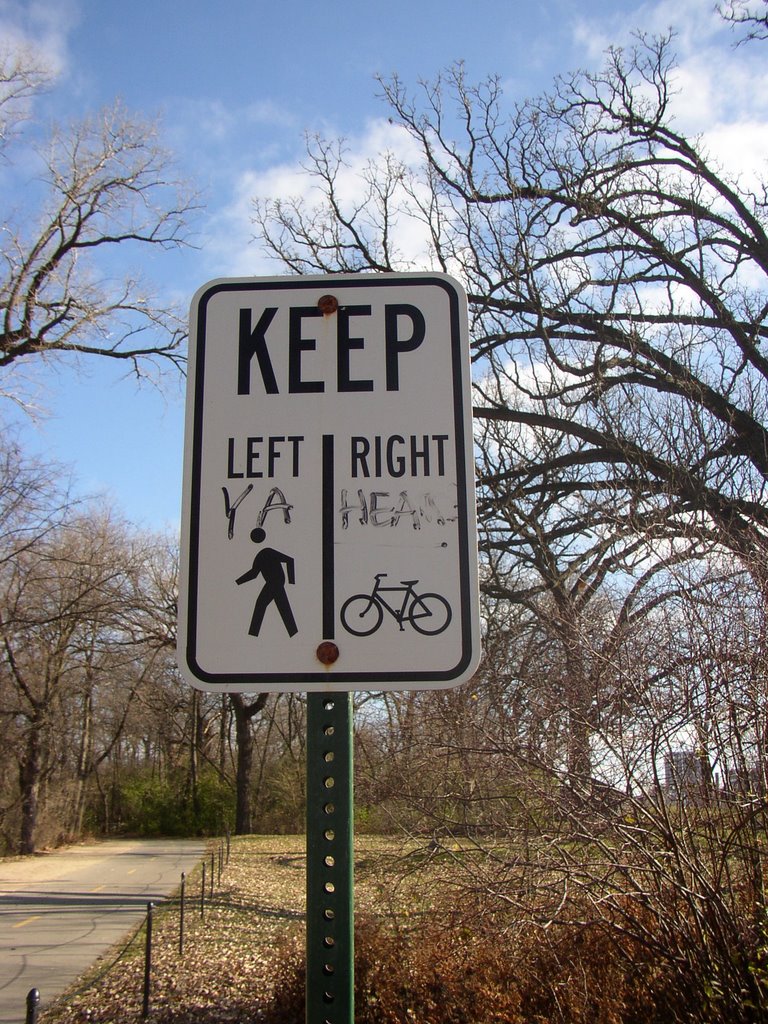 I had heard it said that this existed, but today, I got a picture of it: Upper Midwestern dialect graffiti. It's on the Wisconsin campus in Madison: Ya hea!
Well, OK, the author was not a good speller (though you gotta give'm slack on this -- it ain't in the dictionary). But sadly, maybe it's not dialect graffiti at all: Could be an effort to write 'ya hear?' with a marker that was running out of ink.
I'm sticking with the first version.
Thursday, November 16, 2006
Verbing ...
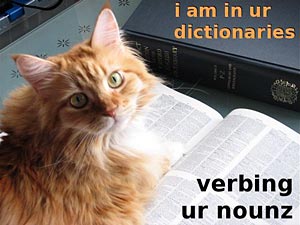
Oh, I will never forget the day when Calvin said to Hobbes that 'verbing weirds language.' The whole extended Verb family was so proud of our role in weirding language, Ma Verb and Pa Verb, all the helping Verbs and the modals, too, Verbs strong, weak and mixed, the world around. How things have changed since that memorable day! 'Verbing' gets 106,000 raw g-hits; and a Language Log poster (Benjamin Zimmer) long ago casually wrote 'Yes, yes, we all know Calvin's dictum that "verbing weirds language."'
But only now -- from Evil Mad Scientist, and with many thanks to an old friend who passed on the link -- do we find an image to go with that fame. (He passed it on as an example of the 'I am in ur X, killin' ur Yz' meme that comes from gamer language.) But don't you love the pic? The venerable OED and that cat with the slightly wild look about it.
Verbally,
Mr. V
Friday, November 10, 2006
Bubblers of two sorts
Like most folks who live in Wisconsin, I own a t-shirt available from the state's Historical Society. On the front, it says 'It's a bubbler!' with a picture of a classic drinking fountain (in fact, of the type that has a 'bubbling valve' designed by Kohler which led to this term). On the back it says something like 'A fountain is where you throw coins.'
Anyhow, I'm wearing this shirt today while around tons of non-Wisconsin people. Great conversation starter of course. A group of folks came up and started talking about it and this kid standing nearby was clearly listening. Before long, he comes over and explains that he knows the word 'bubbler' only in college slang for 'bong', water pipe for smoking weed.
Obvious question is this: Do Wisconsin college kids avoid the 'bong' meaning because they have the word already? I guess that'd be a kind of 'blocking'.
Anyhow, I'm wearing this shirt today while around tons of non-Wisconsin people. Great conversation starter of course. A group of folks came up and started talking about it and this kid standing nearby was clearly listening. Before long, he comes over and explains that he knows the word 'bubbler' only in college slang for 'bong', water pipe for smoking weed.
Obvious question is this: Do Wisconsin college kids avoid the 'bong' meaning because they have the word already? I guess that'd be a kind of 'blocking'.
Tuesday, November 07, 2006
premortem
Man, I hope the current election trends hold. Language-related bits of interest are a complete bonus here, but just got one: Republicans last week were already engaged in doing premortems.
Sunday, November 05, 2006
Please, somebody STOP Bill Safire!
My god. Half of Safire's column today is about phrases like food porn and apartment porn. Wikipedia's entry actually gets at the point of this being a visual substitute for the real thing, vicarious enjoyment, etc., which sounds dead on to me. But get this:
And suffix, that is something that attaches to the end of some 'base' (like -er, above). There's a whole string of tests for whether something is an affix (a bound morpheme, as opposed to a clitic or a free word), but this one doesn't pass even a first glance. An affix is really cemented onto its base, under any normal circumstances (and the exceptions are pretty interesting), so that the two can't be interrupted by any intervening material. So, you can't break up googler with other words, but you can easily say this: We're talking here about 'food' -- as it's now called -- 'porn'. Probably, if Safire were careful or lucid enough to check what the words he uses mean while writing his columns, he would have talked about this as a pattern of compounding, one of noun + noun. The word ball works just this way -- basket-, racket-, foot- -- although the bond is presumably tighter there than in his 'suffix'.
Literally anybody who has read an introductory linguistics book or taken an introductory course in the subject should have gotten this right. Would the Times keep on a staff a food writer who couldn't keep the difference between root vegetables and red meat straight? A Middle East reporter who confused Sunni and Shia or couldn't find the Gaza Strip on a map? A travel writer who doesn't know how to book a flight? That's about the level we're talking about here.
Bill, if you don't get help in the Linguistics Dept, please get help somewhere. I can send you some used introductory textbooks if you'd like. Oh yeah, dear New York Times, please fire this embarrassing moron.
As a kind of nominative suffix, porn is in.OK, Bill, look, it's like this, see: Words, they have, like, meanings. Nominative, for example, means "marking a subject of a verb", as in indicating the 'nominative' case (in languages with cases like Yiddish, Latin, or Kujamaat Jóola), etc. (It has a couple of other less common meanings, but nothing like what you're aiming for.) We have lots of nominalizing suffixes in English, like -er, which can be added to virtually any verb to make a noun (agentive): to bake ~ baker, to google ~ googler, etc. But this is just a noun that stays a noun, and it seems only to appear with other nouns, in this usage.
And suffix, that is something that attaches to the end of some 'base' (like -er, above). There's a whole string of tests for whether something is an affix (a bound morpheme, as opposed to a clitic or a free word), but this one doesn't pass even a first glance. An affix is really cemented onto its base, under any normal circumstances (and the exceptions are pretty interesting), so that the two can't be interrupted by any intervening material. So, you can't break up googler with other words, but you can easily say this: We're talking here about 'food' -- as it's now called -- 'porn'. Probably, if Safire were careful or lucid enough to check what the words he uses mean while writing his columns, he would have talked about this as a pattern of compounding, one of noun + noun. The word ball works just this way -- basket-, racket-, foot- -- although the bond is presumably tighter there than in his 'suffix'.
Literally anybody who has read an introductory linguistics book or taken an introductory course in the subject should have gotten this right. Would the Times keep on a staff a food writer who couldn't keep the difference between root vegetables and red meat straight? A Middle East reporter who confused Sunni and Shia or couldn't find the Gaza Strip on a map? A travel writer who doesn't know how to book a flight? That's about the level we're talking about here.
Bill, if you don't get help in the Linguistics Dept, please get help somewhere. I can send you some used introductory textbooks if you'd like. Oh yeah, dear New York Times, please fire this embarrassing moron.
Saturday, November 04, 2006
You guys heading loose?
Just overheard that in a big crowd today -- looked like old friends parting after a social get-together. Speaker was probably 30-40 years old, male, white, Upper Midwestern accent. I'm wondering if this is one of those idiomatic constructions that sounds eerily like German influence: the loose seems like German los, in verbs like losziehen 'to head out'. You definitely get what for in the was für sense: 'What for a beer do you want?' is reported in Madison (originally, I gather, from Mike Olson, who's working on this topic with Angela Bagwell).
Shortly before that (at about 10:30 in the morning), I'd heard somebody say this walking in another big crowd: 'Man, you know what I wish I had right now?' I then couldn't hear what followed but they walked back right by me and the same guy was saying 'Yeah, a Snickers and a can of beer. Just can't get much better than that.'
Shortly before that (at about 10:30 in the morning), I'd heard somebody say this walking in another big crowd: 'Man, you know what I wish I had right now?' I then couldn't hear what followed but they walked back right by me and the same guy was saying 'Yeah, a Snickers and a can of beer. Just can't get much better than that.'
Sconnie
Today's paper has the headline "On Wi-Sconnie-sin" talking about a new line of t-shirts and stuff called Sconnie Nation. You hear Sconnie for 'Wisconsinite' pretty often, and occasionally as an adjective for things from or associated with here. And Sconnie's still pretty new -- only about 21,00 g-hits on a quick check.
Always sounded pretty neutral to me -- definitely used by folks from here and not an insult like 'illie' from people from the Land of Flat, though that's relatively positive too, I guess, since it means they aren't being called 'fibs' (= fucking Illinois bastards). Interesting in the article is the contrast to Coasties, which they define pretty much as 'rich kids' and including not only the coasts but Illinois (jabs at illies are always fair game, I think). But in looking at this stuff, you really that good old Wisconsin, low-key, 'we just like the place' kind of attitude:
Always sounded pretty neutral to me -- definitely used by folks from here and not an insult like 'illie' from people from the Land of Flat, though that's relatively positive too, I guess, since it means they aren't being called 'fibs' (= fucking Illinois bastards). Interesting in the article is the contrast to Coasties, which they define pretty much as 'rich kids' and including not only the coasts but Illinois (jabs at illies are always fair game, I think). But in looking at this stuff, you really that good old Wisconsin, low-key, 'we just like the place' kind of attitude:
It's loosely anything of or relating to Wisconsin. Think cliches like cheese curds, PBR beer and John Deere tractors, but in a good way. Like the term "cheesehead," the Sconnie brand takes pride in what is stereotypically Wisconsin.I like living around here.
Thursday, November 02, 2006
Rebel with a Kaz
Local entertainment section of the paper tonight has a deal on the "outlandish" Sacha Baron Cohen's new Borat movie. The headline -- the subject line of this post -- raises a question that I've long wondered about. No, not what cause Cohen is pursuing. Clearly for a very large number of Americans, 'Kaz' from Kazahstan (assuming that they use a back vowel in the first syllable) rhymes with 'cause', making a slick pun. But to what extent do speakers without merger react to the near-homophonous forms? And does successful language play of this type correlate in some way to likelihood of merger? That is, maybe the same similarities that make mergers work also make these jokes work.
OK, that's pretty lame, but I'm pretty tired.
OK, that's pretty lame, but I'm pretty tired.
Wednesday, November 01, 2006
"OK in some uses"
Wow, Barbara Wallraff's latest "Word Court" column has this headline locally: 'Historical present' OK in some uses. Thanks, I feel so much better now.
Subscribe to:
Posts (Atom)