Now, a band with our family name … here. I think we are related, but don't remember how.
Hat tip to Mark Mandel, who noted the band on ads-l.
Thursday, January 31, 2008


New immigration studies blog
A contributor just passed me an announcement of a new blog, "(Nearly) Everyone's an Immigrant", here. We've already had a reference to it, in the letter from Mrs. Digital Immigrant (here), but the blog is definitely worth a look. For one thing, the current lead post has really nice pictures of the Wisconsin Union, something I had been unable to find a while back.
Wednesday, January 30, 2008
Yo, peeps: Pronoun news
 It always gets crazier, doesn't it? Like most of you, I chuckled at stories on the gender-neutral pronoun yo among Baltimore kids. Not everybody is laughing. Our CapTimes (no link to this, it seems like, maybe for the better) ran Word Court with this headline:
Peep this: 'Yo' won't cut itOK, I'm not going into a rant here, but I gotta note the level of argument used. Beyond the complaint that it was actually the teachers who promoted this, the examples are these:
Yo is tuckin' in his shirt.The objections? These aren't really gender-neutral sentences. And the pronoun sounds 'disrespectful'. (Say whut? Because yo qua discourse marker is associated with African-American speech?) The 'his' later in the first example betrays the gender of the referent. That's a little usage issue, not a flaw of the pronoun. In the second, it is — hang with me here — that the speaker sees the person in question, so that somebody can tell the gender of the person referred to. Therefore, this doesn't count as 'gender-neutral'. Yo, judge! (That's the discourse yo not the pronoun, fyi.) A zillion languages lack gender marking on pronouns and they don't mark gender whether you know it or not. The Judge apparently wants something that is specifically restricted to cases where we want to be vague about gender.
Peep yo.
But it goes off the cliff from there. Yo is part of a 'private language', namely youth language, followed by some outrage that teachers are documenting "this stuff" instead of teaching Standard English.
Oh. My. God.
Tuesday, January 29, 2008
Odd accents in advertising
Weird accents are in the news (here), it seems, and Madison's not escaping the trend …
A new(ish) local Mexican restaurant, La Mestiza, advertises on the radio. They plug very distinctly southern Mexican dishes, like cochinita pibil. But the announcer has a bad Spanish accent.
I don't mean that he's doing a bad job at sounding Mexican, which would be unsettling. No, it's like he's trying very hard to sound like he's from the Iberian Peninsula and failing. Given the name of the place, is this some really odd bit of humor or what?
A new(ish) local Mexican restaurant, La Mestiza, advertises on the radio. They plug very distinctly southern Mexican dishes, like cochinita pibil. But the announcer has a bad Spanish accent.
I don't mean that he's doing a bad job at sounding Mexican, which would be unsettling. No, it's like he's trying very hard to sound like he's from the Iberian Peninsula and failing. Given the name of the place, is this some really odd bit of humor or what?
Climate and language change
 As the house historical linguist on this blog, I suppose it falls to me to add a few words about Mrs. Digital Immigrant's fine letter, specifically on climate and altitude as causes of language change. Mr. V is right enough that "Historical linguists today learn about this mostly for yucks", but what's striking is how seriously such proposals have been taken even by prominent specialists and in some cases not all that long ago.
The famous Indo-Europeanist Julius Pokorny wrote in 1929 about the Germanic Consonant Shift. That's the change often referred to as Grimm's Law, the famous change of stops into fricatives — sounds like p, t, k become f, th h — among other things. Pokorny thought this happened around 800-500 B.C.E. due to a Klimasturz — a dramatic deterioration of the climate (quoting here from Schrodt, p. 201):
Ich nehme nun an, daß diese nicht allmählich, sondern mit der Wucht der Katastrophe hereinbrechende Klimaverschlechterung auch auf die Sprache der Urgermanen einen wesentlichen Einfluß ausgeübt hat, und zwar im Sinne, daß man, um sich vor dem Eindringen der kalten und feuchten Luft zu schützen, zu festerem Mundverschluß seine Zuflucht nahm, womit naturgemäß eine Verstärkung der Expiration und eine Verengung der Reibungsflächen des Luftstroms Hand in Hand ging.The key to this sudden change is buried in the middle of that quote: People closed their mouths 'more firmly' to protect themselves from the cold, damp air, which led to pronouncing p as f, etc. The surprise is that Schrodt actually spends some time debunking this view, suggesting that a 'hot desert wind' could have just as easily explain this change.
Altitude-based accounts of this change and the High German (or Second) Consonant Shift have fared much better. The historical linguist Heinrich Meyer-Benfey argued that living in the mountains led to increased force of expiration, causing consonant shifts. Eduard Prokosch (who taught here in Wisconsin) notes (pp. 55-56) that this "theory has found considerable approval", including by Osthoff and Collitz, and even the skeptical Prokosch says that the view "is not without a measure of intrinsic probability", before dismantling the view.
I'll leave it to Mr. V to talk about whether Upper Midwestern speech actually can be described as 'clenched-jaw'.
- Prokosch, Eduard. 1938. A Comparative Germanic Grammar. (= William Dwight Whitney Linguistics Series.) Baltimore: Linguistic Society of America.
- Schrodt, Richard. 1974. Die germanische Lautverschiebung und ihre Stellung im Kreise der indogermanischen Sprachen. (= Wiener Arbeiten zur germanischen Altertumskunde und Philologie, 1.) Vienna: Halosar.

Monday, January 28, 2008
Clenched-jaw dialectology
OK, it's not just the comments that are better than the blog here, but also the correspondence I get. I've got time only for the sparest comment right now this but have to post it immediately:
Brilliant, just brilliant. Your letter, I mean. So-called 'climatic' theories of language structure and change abound -- among serious scholars in days of yore. Once upon a time, the famous consonant shifts of High German were attributed to mountain life -- huffing and puffing up the mountains caused them to turn stops like p, t, k into fricatives like f, s, h. Historical linguists today learn about this mostly for yucks. But today, this bizarre tradition apparently continues among some benighted few willing to talk on national TV about how language is shaped without benefit of any knowledge of linguistics.Dear. Mr. Verb-My Joie de Vivre suggests that I write to you and your colleagues for a bit of advice. Earlier on this fine January day, I watched the always entertaining and provocative television program, CBS Sunday. As you know, this is a show that is known for taking journalistic risks and innovative reporting styles. You may remember such fine segments as, "At the Cooperage: A Career for Today and Tomorrow" and "Liniments: Are they for YOU?" But, I digress…On this morning's titillating program, in a segment that examined the role of dialect coaches in films, a dialect coach for the film Fargo raised my Wisconsin hackles by professing that the Upper Midwestern dialect results, in part, from our need to constantly clench our jaws during our long, harsh winters. Then, using homey Upper Midwestern phrases and an exaggerated dialect, she entertained and regaled the anorexic commentator, who cackled like one of the Sisters Wyrd.Now, I'm just a nice girl from Wisconsin who went through nearly 20 years of public schoolin' in the land of clenched jaws, but, based on your research and knowledge, is our distinct dialect based on climate-induced clenching of the jaw? This may be a surprise to some who live outside of the CST, but I grew up with central heating and I have never before heard this hypothesis. I'd like to confront this theory in a response that I plan on sending to this program but I want to make sure that I'm not challenging a well-known fact.I appreciate any assistance that you are able to provide and I shall wait, patiently, in my fishing shack on Beef Slough with a six pack of Leinie's, a block of headcheese and clenched jaw to keep me warm.Sincerely,Mrs. Digital Immigrant
In short, the claims you describe having heard are not up to cocktail party standards, even in my circles.
More to follow …
Sunday, January 27, 2008
Academic Freedom Symposium
This is worth noting. I won't be able to make it, and I certainly don't agree with the political views of all involved, but academic freedom is under assault. If you do go, and have comments on the event, please drop me a note.
1-2 February 2008
Lincoln Park Student Center - 2250 N. Sheffield Ave. Chicago, IL
CHICAGO, IL – CHICAGO, IL – In light of the controversial tenure denials of eminent Middle East scholar Norman G. Finkelstein and International Studies professor Mehrene Larudee earlier last year at DePaul University, prominent scholars from across the country are coming together for a two-day conference at DePaul, on February 1-2, to lecture about the threats facing academic freedom and Middle Eastern studies at universities. In addition to DePaul's cases, the efforts to silence scholars such as John Mearsheimer (University of Chicago) and Stephen Walt (Harvard University), and the tenure controversies of Nadia Abu El-Haj (Barnard College) and Joseph Massad (Columbia University) have all inspired the conference, which seeks to protect as well as preserve academic freedom through honest and informed debate.
The event is hosted by the DePaul Academic Freedom Committee, and co-sponsored by the DePaul University International Studies Program, the Peace Studies Program, the History Department, and the Department of Philosophy (DePaul University is not sponsoring this event, only the listed departments and programs).
The Academic Freedom Committee is still accepting a call for papers to be submitted by professors or students for the two-day conference. For more information, please visit http://www.academicfreedomchicago.org
The event is to be held at the Lincoln Park Student Center 2250 N. Sheffield Ave., at DePaul University in Chicago, Illinois.
Academic Freedom Syposium
Feb 1-2, 2008
DePaul University, 2250 N. Sheffield Ave., Chicago, IL
Event schedule:
Day 1 - FRIDAY, FEBRUARY 1, 6:00pm -9:00pm
Introduction with Keynote Speaker – 6:00 pm
The Role of the Activist Professor – 7:00 pm
Featuring Panelists:
Academic Freedom and the Way Forward – 11:00 am
Featuring Panelists:
Documentary Film presented by Landrum Bolling, Director, Mercy Corps
Academic Freedom and Middle East Studies – 5:00 pm
Featuring Panelists:
1-2 February 2008
Lincoln Park Student Center - 2250 N. Sheffield Ave. Chicago, IL
CHICAGO, IL – CHICAGO, IL – In light of the controversial tenure denials of eminent Middle East scholar Norman G. Finkelstein and International Studies professor Mehrene Larudee earlier last year at DePaul University, prominent scholars from across the country are coming together for a two-day conference at DePaul, on February 1-2, to lecture about the threats facing academic freedom and Middle Eastern studies at universities. In addition to DePaul's cases, the efforts to silence scholars such as John Mearsheimer (University of Chicago) and Stephen Walt (Harvard University), and the tenure controversies of Nadia Abu El-Haj (Barnard College) and Joseph Massad (Columbia University) have all inspired the conference, which seeks to protect as well as preserve academic freedom through honest and informed debate.
The event is hosted by the DePaul Academic Freedom Committee, and co-sponsored by the DePaul University International Studies Program, the Peace Studies Program, the History Department, and the Department of Philosophy (DePaul University is not sponsoring this event, only the listed departments and programs).
The Academic Freedom Committee is still accepting a call for papers to be submitted by professors or students for the two-day conference. For more information, please visit http://www.academicfreedomchicago.org
The event is to be held at the Lincoln Park Student Center 2250 N. Sheffield Ave., at DePaul University in Chicago, Illinois.
Academic Freedom Syposium
Feb 1-2, 2008
DePaul University, 2250 N. Sheffield Ave., Chicago, IL
Event schedule:
Day 1 - FRIDAY, FEBRUARY 1, 6:00pm -9:00pm
Introduction with Keynote Speaker – 6:00 pm
- Sara Roy, Harvard University political economist
The Role of the Activist Professor – 7:00 pm
Featuring Panelists:
- Bill Ayers, Professor, College of Education, University of Illinois – Chicago
- Ken Butigan, author, professor and peace activist
- Robert Jensen, Professor, School of Journalism, University of Texas
- Marcy Newman, Visiting Professor, Center for American Studies and Research, American University of Beirut; Fellow, Initiative for Middle East Policy Dialogue
Academic Freedom and the Way Forward – 11:00 am
Featuring Panelists:
- Mark Ellis, University Professor of Jewish Studies and Director of the Center for Jewish Studies at Baylor University
- Peter Kirstein, Professor, Department of History, Saint Xavier University
- Joel Kovel, Distinguished Professor, Department of Social Studies, Bard College
Documentary Film presented by Landrum Bolling, Director, Mercy Corps
Academic Freedom and Middle East Studies – 5:00 pm
Featuring Panelists:
- As’ad AbuKhalil, Professor, Department of Politics and Public Administration, California State University
- Juan Cole, Professor, Department of History, University of Michigan
- Peter Novick, Professor (Emeritus), Department of History, University of Chicago
Two linguistic cartoons
Sometimes, the level of sophistication in New Yorker cartoons gets pretty high. The missus last night was flipping through some old issues (really old, in fact), and found these.
First, Frank Cotham's piece from here:

I could see some folks changing this to focus on the rise of Merge.
Second, Paul Noth's from here:

Yes, doctor, you can.
First, Frank Cotham's piece from here:

I could see some folks changing this to focus on the rise of Merge.
Second, Paul Noth's from here:

Yes, doctor, you can.
Thursday, January 24, 2008
NACLO Open
Maybe there's even more linguistics going on here than the local linguists knew about: According to this source, we're hosting a regional event of the 2008 North American Computational Linguistics Olympiad Open competition. March 11, mark your calendars.
The logic of non-standard German
… or maybe "The 'deficit hypothesis' never dies".
A couple of days ago, NPR ran a piece on Seyran Ateş and her new book, The Multicultural Mistake (originally Der Multikulti-Irrtum). She's a very famous women's rights lawyer, former Woman of the Year in Germany, etc., and one of the most visible members of the Turkish community in Germany and in Europe beyond. She's a formidable figure in current German and European culture, and I'll sidestep all the rich controversy about the book to simply note that the interview includes this:
Looks like another case where the rhetoric should be turned down a couple of notches unless somebody has the data to back this up. And, of course, another case where people are apparently willing to make big claims about language without any knowledge or evidence.
A couple of days ago, NPR ran a piece on Seyran Ateş and her new book, The Multicultural Mistake (originally Der Multikulti-Irrtum). She's a very famous women's rights lawyer, former Woman of the Year in Germany, etc., and one of the most visible members of the Turkish community in Germany and in Europe beyond. She's a formidable figure in current German and European culture, and I'll sidestep all the rich controversy about the book to simply note that the interview includes this:
We have in the third generation children who do not speak very well German," Ates says. "They cannot speak very well their own language — they are not integrated in the culture, they do not even know how big is the city in which they live in."One on-line review of the book has a closely related German version:
Dass damit Jugendliche heranwachsen, die sich „irgendwie“ einer idealisierten Türkei zugehörig fühlen, gleichzeitig aber übersehen, dass gerade in der Türkei jemandem, der gut Deutsch und Türkisch spricht, alle Türen offen stehen, denen aber, die weder die eine noch die andere Sprache richtig beherrschen gar nichts.I can't comment on knowledge of city populations, and don't quite know what it means to be integrated into a given culture, but I'd be truly stunned if it turned out that any child in any Turkish-German community really did not control at least one language natively. Many of them, from what little I know about it, speak regional dialects of one or both languages, and of course there will be contact effects — borrowings, maybe some interference, whatever. Written standard languages are naturally learned in school and many kids in Germany don't have textbook control of the written prescribed standard. The German quote in particular makes it sound like this is about investment in that particular variety of language, not language generally.
Looks like another case where the rhetoric should be turned down a couple of notches unless somebody has the data to back this up. And, of course, another case where people are apparently willing to make big claims about language without any knowledge or evidence.
The semantic derogation of verbing?
The recent post on Buckminster Fuller declaring himself to be a verb has drawn a classic set of witty comments, the kind of thing that keeps me posting. A lot of the commentary consists of additional examples of personal names being verbed. While Fuller surely had a positive meaning in mind (and the Ridger's note on him saying "God is a verb" supports that), all these examples are bad, including Oscar's witty interpretation of the original example. Or more precisely, all the ones I understand are negative … I'm not quite clear on how to read "you really speared last night, dude", but I'm flat out assuming it can't be good. (More concretely, I'm thinking multiple police cars, court dates and expensive detox time.) Even the iPhone interface was announced to be verb-free.
The oddity here is that it looks like we see a change over time: Once upon a time, being a verb was cool, it was about action and doing. Sure, there were always truly rotten verbs in the barrel, like Judge Lynch, but there was good verbing too. Today it's all about verbing as crashing and burning. Fuller would do it, but what fool would declare himself a verb today? Sigh.
The oddity here is that it looks like we see a change over time: Once upon a time, being a verb was cool, it was about action and doing. Sure, there were always truly rotten verbs in the barrel, like Judge Lynch, but there was good verbing too. Today it's all about verbing as crashing and burning. Fuller would do it, but what fool would declare himself a verb today? Sigh.
Tuesday, January 22, 2008
Buckminster Fuller was a verb?
I think I am a verb.Just happened across this by accident, here. Nobody identifies more closely with verbs than me, but what the hell does this actually mean?
— R. Buckminster Fuller
Various people seem to have become verbs in recent years in ways they probably didn't want, like Robert Bork and Larry "Wide Stance" Craig.
Still dead
 Chevy Chase's old SNL routine about the Spanish dictator Francisco Franco being "still dead" created a little meme that's still floating around our culture. The phrase gets ca. 5.2 million g-hits, so it's hardly obscure. But it seems like it's bubbling up big now, and you wonder what triggers that … just weird fluctuations or did something trip this off? Frank Rich's column last Sunday in the NYT was aptly called "Ronald Reagan is still dead", and I've heard that repeated a couple of times since.
But now it's made it into linguistics … a colleague emailed me his "new favorite" article called "News flash: Hume still dead" by Lynn Eubank and Kevin Gregg, published in Studies in Second Language Acquisition (see here). Of course, since Hume famously declared that his Treatise of Human Nature "fell dead-born from the press", it's an even better joke. He later quipped that he "soon recovered from the blow", unlike Franco.
PS: As much as I love graphics, I couldn't bring myself to put up a pic of Franco. The image of Hume is from — hey, where else? — empiricism.com.
Monday, January 21, 2008
Drawing clear boundaries
 At the Linguistic Society of America meeting just past, in the area near where the American Dialect Society met, there was a room where some random meeting was going on at the same time. Apparently we barged in so often that they had to take desperate measures, shown on the right.
One of our contributors (Monica) just sent me this pic, unfortunately taken after somebody had added the -s to the original Linguistic.
Wisconsin winter
 You just gotta love Wisconsin. The Packers lost a tough game last night, so they aren't going to the Superbowl this year. Still, people haven't fallen into deep depression ... they're saying 'well, that was a great year for the Pack' and walking out into the ca. 0º F weather. (It's warming up!)
Last night, the best crowd sign I saw was a kind of cliche up here:
But it's a DRY cold.Now, if I understand the science here, cold air is almost automatically dry relative to hot air, since cold air can hold less water. Hardy har har.
But winter's not perfect, even now that it's nice and cold: The City of Madison is putting salt on the bike paths. If you don't know cold regions, you might not know that road salt is ineffective below a certain point, say, 17 F. It hasn't been that warm here in days, and isn't predicted to get that warm until Friday. Arg.
Sunday, January 20, 2008
Limelight, quip of the morning
A racing story in this morning's NYT Sports section had this:
Tony Eury Jr., Earnhardt’s crew chief and cousin, said … “We know Dale Jr. is at the center of Nascar”. … “There’s a lot of limelight that goes on him."I like the image … just the right hint of that Gatorade on the winning coach thing. The missus asks whether they use vinegar to get it off.
Saturday, January 19, 2008
to cohere, transitive
An alert reader (a card-carrying non-prescriptivist, non-peevologist) writes with alarm …
Using the most obscure meaning/sense/form of a word is surely a kind of language snob dog whistle, making it classic Brooks. But note the stylistic whiplash: transitive cohere in the same sentence as going bananas and dittoheads, maybe that's what's odd.
It's come to this -- cohere as a transitive verb ...The reference is to David Brooks in his NYT column yesterday:
Social tribes rally for and against certain candidates. Rush Limbaugh is currently going bananas because Mike Huckabee threatens to disrupt the community of conservative dittoheads he has spent decades cohering.Yeah, that's jarring, if not as jarring as what Brooks has said about science (see here, for example). The verb does have a transitive form, in both Merriam-Webster's and OED, it turns out, "to cause to stick together or cohere" (my paraphrase). In both works, it is the last item given, seventh in the OED, so pretty obscure.
Using the most obscure meaning/sense/form of a word is surely a kind of language snob dog whistle, making it classic Brooks. But note the stylistic whiplash: transitive cohere in the same sentence as going bananas and dittoheads, maybe that's what's odd.
Friday, January 18, 2008
Regionalism in American politics, and nicknames
Running for political office looks more and more some odd kind of frat initiation rite. You gotta know that it's cheese whiz on your cheese steak, and watch where you step walking through pig farms. But a flap over a spouse's utterly normal but non-local pronunciation of Nevada? Nev[æ]da is "correct" (here) and Michelle Obama's non-local Nev[a]da was a "flub", and "the real local sin" (as opposed to prostitution and gambling, here). Could we occasionally hear details of ideas for getting this car out of the ditch, instead of this? Or maybe it'll get funnier when somebody can get them all really seriously drunk, cover them with molasses and corn flakes and turn them lose in the desert at night. Film at 11.
On the other hand, I'm all for some campaign humor, and candidate nicknames work pretty well. We're not approaching the grand days of punk bands like the Dead Kennedys and Naked Raygun, but Wonkette's been using "Barry" for Obama (the name he once did use, I gather) and Walnuts for McCain (you can figure it out). Mittster doesn't quite work, and Mittens is not Wonkette's best invention. A couple of Hillary variants fell very flat at the ADS Word of the Year competition, like Billary, and yesterday's HillAir shtick on the plane wasn't somebody else's nickname but a written gag, presumably. The missus is sad that Chris Dodd is gone from the race, since Obamadad (Obama/Dodd) seems less likely as a democratic ticket But Huckabee just lends itself to play ... leaving aside people who say that "Huckabee" sounds dumb: Huck and Huckster are all over the press, and there's ample note of what huck rhymes with in the blogosphere. Again, Wonkette rules with Huckles.
On the other hand, I'm all for some campaign humor, and candidate nicknames work pretty well. We're not approaching the grand days of punk bands like the Dead Kennedys and Naked Raygun, but Wonkette's been using "Barry" for Obama (the name he once did use, I gather) and Walnuts for McCain (you can figure it out). Mittster doesn't quite work, and Mittens is not Wonkette's best invention. A couple of Hillary variants fell very flat at the ADS Word of the Year competition, like Billary, and yesterday's HillAir shtick on the plane wasn't somebody else's nickname but a written gag, presumably. The missus is sad that Chris Dodd is gone from the race, since Obamadad (Obama/Dodd) seems less likely as a democratic ticket But Huckabee just lends itself to play ... leaving aside people who say that "Huckabee" sounds dumb: Huck and Huckster are all over the press, and there's ample note of what huck rhymes with in the blogosphere. Again, Wonkette rules with Huckles.
Tuesday, January 15, 2008
Keith numbers
Election fever is once again starting to boil our collective brain in its natural hardshell container. For some of us, that means a chance to watch the media play with poll numbers. Usually it's a lesson in how not to think about math — see the New Hampshire Democratic results versus the press coverage of polls in the week before, for a recent example. Happily, we now have pollster.com, where we have good social scientists (including UW's Political Science prof Charles Franklin) giving lots of poll data with good commentary on what it all does and does not mean.
In the mainstream media, it looks like Keith Olbermann has taken up the battle to raise the standard. He's proposed the "Keith number" as a guide to reading poll numbers:
But what gets me is that there's an established mathematical use of "Keith number", as detailed here and named after Mike Keith. (It's sort of like a Fibonacci sequence.) Is this a clever inside joke by Olbermann or an accident?
In the mainstream media, it looks like Keith Olbermann has taken up the battle to raise the standard. He's proposed the "Keith number" as a guide to reading poll numbers:
What, you ask is the ‘Keith number‘? This is the margin of error plus the percentage of undecided …. I thought of it so, I named it after myself. You think of a better caveat for polls from now on and we‘ll name it after you.Nice basic point, of course, for reckoning what is a real lead versus the illusion of a lead in a poll. And even pollster.com doesn't always make it easy to see the number of undecided.
But what gets me is that there's an established mathematical use of "Keith number", as detailed here and named after Mike Keith. (It's sort of like a Fibonacci sequence.) Is this a clever inside joke by Olbermann or an accident?
Monday, January 14, 2008
Grammar Rock does Verbs
 Somebody just sent me a link to the Grammar Rock postings on YouTube, including the one on verbs, here. They even touch on verbing, kinda.
Sunday, January 13, 2008
Sunday randomness
Here's a laundry list …
- Well, the poll is pretty much done … Poison's former bassist wins, hands down. It looks like around 1% of visitors to the blog participated over the duration of the poll, though I don't know whether that says something about the topic or the willingness to do dumb polls online. We'll see at some future point.
- Steven Pinker has a big piece in the NYT Sunday Magazine today about our endowment with a moral sense.
- Safire, taking up space in the same forum, gripes about the of in constructions of the type "off of the defensive", "too big of a meal", etc. Don't get me started. At least he's actually talking about language generally, in his "On Language" column, not just words. And he's still pissed about "Winston tastes good like a cigarette should". (Younger readers won't even know that ancient chapter of peevological history.) That cracks me up.
- Friends from Tucson report that their city (along with others, I see) has stravenues, and I'm surprised to learn that they are officially abbreviated as Stra by the USPS. It's a kinda nice blend, but sort of odd in bureaucratic usage, which seems to not have many of these. (In cities like Tuscon, laid out on a grid, with streets running one way and avenues the other, these run diagonally.)
- The other night, someone used the cropping libes for "(preprandial) libation". I thought it was at least kinda cute, even after seeing that the same cropping is used for library by some students. You can hardly object to the kids privileging the library over drinking in their innovative word formation.
Saturday, January 12, 2008
Biology and phonetic variation
 A regular reader of this blog* passed along a reference to a new paper in the journal Medical Engineering and Physics called "Adaptation of wavelet transform analysis to the investigation of biological variations in speech signals", by Julia Rees and a string of co-authors. Here’s the abstract:
The purpose of this study was to adapt wavelet analysis as a tool for discriminating speech samples taken from healthy subjects across two biological states. Speech pressure waveforms were drawn from a study on effects of hormone fluctuations across the menstrual cycle on language functions. Speech samples from the vowel portion of the syllable 'pa', taken at the low- and high-hormone phases of the menstrual cycle, were extracted for analysis. Initial analysis applied Fourier transforms to examine the fundamental and formant frequencies. Wavelet analysis was used to investigate spectral differences at a more microbehavioural level. The key finding showed that wavelet coefficients for the fundamental frequency of speech samples taken from the high-hormone phase had larger amplitudes than those from the low-hormone phase. This study provided evidence for differences in speech across the menstrual cycle that affected the vowel portion of syllables. This evidence complements existing data on the temporal features of speech that characterise the consonant portion of syllables. Wavelet analysis provides a new tool for examination of behavioural differences in speech linked to hormonal variation.The subject line on the message alerting me to this paper was "Major uber WTF?", but it turns out there really is a lit on the effects of hormones on verbal and motor skills — more estrogen correlates with “improved performance on … verbal tasks”.** The person who sent this along asked these questions:
Are … people going to have to incorporate endocrinology into linguistics now? Can you imagine what the press could do with this?
Yeah, we can all have nightmares about what the media would do with this for sure. I happened to be talking to a biologist and asked him about it. He gave a simple, plausible sketch of things, basically this: Our bodies are complex and interconnected enough that we shouldn't be terribly surprised at finding seemingly bizarre but statistically significant correlations of all sorts. In that light, the notion that hormones could impact motor control, and thus speech, seems pretty straightforward.
Still, it's not clear that it changes anything directly for most of us in linguistics: The differences reported look tiny (if I'm understanding the paper): Anything that has impact on motor control will affect speech. Even much coarser issues of motor control and speech, like intoxication, aren't yet all that well understood, despite tons of good work on the topic, some by Wisconsin's own Tom Purnell and Ryan Hanke.
Image from here.
* I’m far from over the shock that such people exist.
** Yes, the missus has come to grips with these research findings.
Still, it's not clear that it changes anything directly for most of us in linguistics: The differences reported look tiny (if I'm understanding the paper): Anything that has impact on motor control will affect speech. Even much coarser issues of motor control and speech, like intoxication, aren't yet all that well understood, despite tons of good work on the topic, some by Wisconsin's own Tom Purnell and Ryan Hanke.
Image from here.

* I’m far from over the shock that such people exist.
** Yes, the missus has come to grips with these research findings.
Friday, January 11, 2008
The value of the historical record, Wisconsin-style
So, I've been hearing about how Ron Paul used to have a newsletter in which various 'controversial' things were published — let's just call them vile and reprehensible rantings. As it turns out, the Wisconsin Historical Society played a role in verifying the details, as laid out here. I didn't catch until now that this wasn't simply published in Paul's newsletter, but some directly under Paul's name and others in a way that strongly implied that Paul wrote them.The already-famous article "Angry White Man" by in the New Republic summarizes the bottom line this way:
Some of the earlier newsletters are signed by him, though the vast majority of the editions I saw contain no bylines at all. Complicating matters, many of the unbylined newsletters were written in the first person, implying that Paul was the author.Maybe because our Historical Society and another institution did such good work in preserving the relevant documents, Ron Paul will be history himself?
But, whoever actually wrote them, the newsletters I saw all had one thing in common: They were published under a banner containing Paul's name, and the articles (except for one special edition of a newsletter that contained the byline of another writer) seem designed to create the impression that they were written by him--and reflected his views. What they reveal are decades worth of obsession with conspiracies, sympathy for the right-wing militia movement, and deeply held bigotry against blacks, Jews, and gays.
The vowel {ee} and respectability
 Random end of the week quote:
[B]y all accounts, et es perfectle pesseble to have a thoroughle respectable language wethout the vowel i.
— Guy Deutscher, The Unfolding of Language, p. 13
Now, I'll leave it to you to guess at what the heck he's talking about. Better yet, go read the book — it's a fun and utterly accessible overview of many issues in language change.
But what I can't figure out is why he has pesseble for what was presumably supposed to be possible? Surely he didn't mean pissible. I can easily imagine such a word, e.g. with regard to small kidney stones ("No need for surgery, Jones, this one looks utterly pissable".) or someone who can be annoyed ("Don't push that joke too far ... Smith is pissable.") But not here.
Now, while this blog clearly isn't widely read by fans of hair bands, a couple of copy editors and related professionals do visit this corner of the internet. I'm figuring this is the kind of situation that would give you major nightmares. It's obviously not something you can spellcheck, and it takes someone who knows about how letters relate to sounds to be sure what to substitute. In fact, it's easy to imagine this getting introduced at some point in the production process.
Image from here.
But what I can't figure out is why he has pesseble for what was presumably supposed to be possible? Surely he didn't mean pissible. I can easily imagine such a word, e.g. with regard to small kidney stones ("No need for surgery, Jones, this one looks utterly pissable".) or someone who can be annoyed ("Don't push that joke too far ... Smith is pissable.") But not here.
Now, while this blog clearly isn't widely read by fans of hair bands, a couple of copy editors and related professionals do visit this corner of the internet. I'm figuring this is the kind of situation that would give you major nightmares. It's obviously not something you can spellcheck, and it takes someone who knows about how letters relate to sounds to be sure what to substitute. In fact, it's easy to imagine this getting introduced at some point in the production process.
Image from here.

Thursday, January 10, 2008
History of subprime
The illustrious Ben Zimmer has answered a question I, for one, have been wondering about: What's the history of subprime, the ADS Word of the Year? The discussion is here.
Wednesday, January 09, 2008
Poison's bassplayer: Blog poll update
 OK, so that whole blog poll thing was pretty off-the-wall*, I'll grant, and most readers of this blog (as far as I know) are probably vaguely aware of the 'hair band' called Poison, but have surely never heard of Bobby Dall, let alone knowingly seen his picture. He's currently leading in the poll, for who knows what reason, and it might be useful to have a pic of him up, just FYI.
Couldn't find one with just the right angle, and I don't think he's ever worn a beard, but this gives you an idea.
* I kind of expected about 3 votes total and a dramatic drop in readership when I posted it, but we're beyond that total and hits continue at their normal rate. Go figure.
Tuesday, January 08, 2008
WOTY postmortem note
 LSA and ADS are over now ... and I think all the UW folks made it back home, despite the 100+ car pile up on the highway in the fog on Sunday (seriously: here). You're almost surely read about the Word of the Year votes at the ADS, and know that subprime was the big winner.
I don't recall any oath of secrecy surrounding the proceedings in the room (or outside it — people were jamming the hallways), so let me dish a little inside dope here. First, John Rickford gave a short but brilliant, rousing statement in favor of subprime as the most important word, and I think that sealed the case. Another major candidate green, in all parts of speech and including as a prefix, was also looking pretty good until then and it was dead after Grant Barrett (rightly) pointed out that if you think there's something new about green this year, you're seriously out of touch. ("We need to talk", he concluded.)
It had its moments, like when in discussing googlegänger (somebody who shares your name, so show up in Google searches for you), the dialectologist/sociolinguist David Bowie (yes, his real name) spoke up in favor of it. And any discussion of quadriboobage apparently makes a lot of people laugh.
But the real kicker throughout was Grant Barrett's Mystery Science Theater-like running commentary on the session. You really had to be there, but: Instead of powerpoint, he projects .doc files on the screen and types hilarious notes on the discussion. When vegansexual got some positive comments, we read "Voting for vegansexual won't get you laid". As va-jay-jay (euphemism for 'vagina') was up, he offered the male counterpart: pa-nay-nay. (I learned yesterday that one current movie includes porkroll for that, but ... . Kids these days.) Of course, with lots of inside jokes, it was even funnier than MST3K.
I'm telling you, those lexicographer folks, they may be the ones who bring language back into a better public light.
Ahhhh, what a fine break from the otherwise oh-so-serious science of language. But that millstone's spinning and it's time to put my nose back to it.
Monday, January 07, 2008
It's just a WTF kind of day …
The NYT is running this:
And Stanley Fish asks, "Will the Humanities Save Us?" Dude, you're not helping here.
Time to get back to linguistics ... this stuff is just too weird.
But will Hillary Clinton’s sudden apparent outbreak of emotion in New Hampshire help or hinder her campaign? Even the smartest bloggers are split.That's our standard? Today's braintrust consists of bloggers? And I'm not sure they really got the smartest.
And Stanley Fish asks, "Will the Humanities Save Us?" Dude, you're not helping here.
Time to get back to linguistics ... this stuff is just too weird.
Blog poll ...
Here's a photo someone sent me, asking the question "Is the image in the fireplace Jesus or Satan?" I'm adding a poll to the blog now for answers to the question. As always, comments are most welcome.
 Me, I'm not quite sure yet.
 Me, I'm not quite sure yet.
Friday, January 04, 2008
Word of the Year nominees
I missed the session yesterday, but the nominees for the American Dialect Society WOTY are here. Word on the street has it that the range of green candidates sounded good.
Thursday, January 03, 2008
Why everyone should study linguistics
 Over on the Log yesterday, I discovered a link I should have known about … an article in the Minnesota Review called "Why everyone should study linguistics".
Stop in mid-yawn: It's by a literary scholar, Robin Sowards, a young English prof who is working on a book on Chomsky and literary theory, among other things. The piece opens with this shocking line:
All literary critics already do some kind of linguistics.And he goes on to illustrate the point with basic grammatical analysis and interpretation of historical change in language, leading him to assert:
Linguistics is our inevitable hidden premise.The piece really argues exactly what the title says, that literary studies needs especially 'theoretical linguistics' — generative linguistics in particular — and he illustrates it with things like processing difficulties with center-embedding.
It's a nice piece and it's impossible to disagree with the basic line of argument, although syntax folks and others may have quibbles on some points of his discussion. Certainly having every student of literature take some real linguistics would be valuable. (Many do already.) But in an undertaking like this, where full command of two fields is ultimately needed — you shouldn't trust my reading of Blake and I'll be mightily impressed to see rank-and-file lit scholars doing high-quality minimalist analyses of Shakespeare.
Regular readers know the punchline: The right way to handle this is to collaborate, start a discussion group including linguists and lit people. Over the years, I've had and heard of many discussions between linguists and lit folks about co-authoring, but have seen basically none of them come to fruition, for various reasons. Somebody like Sowards, apparently a card-carrying English lit guy who's invested a good bit in learning some linguistics, might be able to do it with some success, but for most folks, it's better to start that process of sitting down and talking to people who have the real background you need to learn.
Wednesday, January 02, 2008
Off to the Linguistic Society ...
Ah, just in time for the LSA, the American Dialect Society, Society for the Study of the Indigenous Languages of the Americas, and the string of other meetings, this graphic has a key pointer on how to put together your PowerPoint:
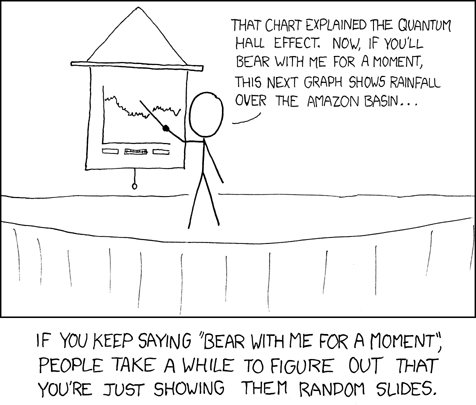 The Secret Annual Cabal, as some call it, is in Chicago, so lots of Wisconsin folks will shake off the frost and head to warmer climes.
The Secret Annual Cabal, as some call it, is in Chicago, so lots of Wisconsin folks will shake off the frost and head to warmer climes.
Tuesday, January 01, 2008
The perils of naming: Conglomerate Blog
 A while back I considered the story of how the Conglomerate Blog came by its name, wondered if it just didn't work on several levels. Now, a pro has weighed in, Nancy Friedman, and given pretty compelling arguments against it. What's interesting, of course, is the way she lays out "the art of naming", which …
requires a broader perspective, one that includes etymology and meaning but also reaches out to consider allusion, association, emotional resonance, and ear appeal.That's an appealing way to think about making up names. It's far more sophisticated than how most of us have gone through the process of naming bands, sports teams, whatever, but it's good.
Oh yeah, I think she's also right that Peppercorn was the most promising option they laid out and you wonder where "further exploration in that direction" might have led.
Go Badgers!
Image from here.
Subscribe to:
Posts (Atom)