Let me get this straight: The President of these United States opens a new baseball season and a new baseball park in the city that's the seat of our government, and he gets booed? Maybe people are paying attention.
Go Brew Crew!
Monday, March 31, 2008


Sunday, March 30, 2008
Simpsons linguistics
I know that Heidi Harley will get to this, but St. Patrick's Day and thus her Simpsons linguistics special is a long ways off …
Just now, on the Simpsons, Lisa just had this exchange with Marge:
Just now, on the Simpsons, Lisa just had this exchange with Marge:
L: Martha Graham danced well into her 70s.Of course they used intonation instead of brackets, but you get the point. A generally brilliant show, besides.
M: Did you mean 'she [danced well] into her 70s', or 'she danced [well into her 70s]'.
The subjective tense
 Today's Safire column relies on what's now probably his most common formula: playing with some phrase in current political language. The focus is on Clinton's kitchen-sink strategy, and includes a long parenthetical on Ferraro's famously controversial statement:
“If Obama was a white man, he would not be in this position.” (Some of my readers took umbrage at this, too: “Get this,” Sam Pakenham-Walsh, member of the Nitpickers League, said in an e-mail message, “we no longer use the subjective tense! Has all our education been for naught?” Because Ferraro’s statement posed a condition contrary to fact, her “if Obama was a white man” should have been were. Neither campaign demanded a correction.)If the Nitpickers League cares about standards, Mr. Pakenham-Walsh's membership card is in grave danger. If you google "subjective tense" you get mostly the expected thing, namely people using tense when they appear to mean mood, while simultaneously using subjective when they mean subjunctive. Some of these come from folks like Mr. P-W, that is from card-carrying peevologists. Hilariously, Safire let this go through. (The Log has had entire strings about the related issue of the 'passive tense' but I don't see mention of 'subjective tense' over there on a quick glance.)
You can also find tense used for case, so that we is a 'subjective tense' pronoun, while I guess us is in the 'objective tense'. So, tense doesn't just mean 'some category of verbal inflection' but 'some grammar thing'. If you pursue this, you can find 'plural tense' and such too. Talk about semantic bleaching!
I should note, though, that the phrase 'subjective tense' does get used in linguistics, if not widely. In her 1989 paper "On the Rise of Epistemic Meanings in English: An Example of Subjectification in Semantic Change" (Language 65.31-55), Elizabeth Closs Traugott uses the term for getting at meanings in English that are "dependent for their interpretation on knowledge of speaker time" (1989:40). Her examples are from the development of future tense auxiliaries.
Image from here.
Saturday, March 29, 2008
Historical linguistics on NPR
 Wow, two straight pieces this morning on NPR about historical linguistics.
The first is an interview with lexicographer Sol Steinmetz about his new book, Semantic Antics. (Many will know him from his Yiddish and English: A century of Yiddish in America.) It sounds and looks like a set of striking word histories (the specialization of girl to female children was one example discussed), and it might be a fun read for non-linguist language fans.
I don't want to get into any serious theoretical discussions, but note that understanding changes in meaning has posed a stout challenge. General work in 'grammaticalization' as well as more focused efforts like Eve Sweetser's From etymology to pragmatics represent one approach, while Benjamin Fortson’s chapter in the Handbook of Historical Linguistics, called ‘An approach to semantic change’, will feel more comfortable to many historical linguists.
The second story (I don't see a link yet at npr.org) started with talking about the last speaker of Mutsun, a southern California language of the Costanoan family, with a little about the famous linguist and ethnographer J.P. Harrington (see this website for good background on him). But then the piece turns out to be about an opera about the last speaker.
Illustration from here. (I didn't know there was an International Association of Young Linguists.)
Friday, March 28, 2008
Mongerous morphology in the Onion
The Onion has a good piece this week, here, called:
But the Onion loves derivational productivity at a deeper level than that:
Fearmongers, Warmongers Gather For Annual Mongering ConferenceThey get hatemongering in there too, of course, and close with a note about "next week's fish- and whoremongering conference in El Paso, TX." There's a good set of in part newer terms (let's not touch where or whether to use a hyphen ), like rumor-mongering, hope-mongering, disease-mongering, word-mongering, etc. Google around a little and you'll find doom-mongering, monger-mongering, and so much more.
But the Onion loves derivational productivity at a deeper level than that:
… fearmonger Gerald Sachs mongered. "Of course, with the current political and social climate, the main question is whether next year will be anywhere near as mongerly."Go Onion.
Thursday, March 27, 2008
'to misspeak'
An alert reader has passed this article about what it means 'to misspeak'. Anonymous already pointed out on the last post that Clinton's "millions of words a day" statement included what Anon read as a tautology:
I'm pretty sick of this whole controversy, like everybody I've talked to. The Bosnian tall tale barely looks relevant to Clinton's big claims about having real executive experience: Being in a plane making a corkscrew landing under sniper fire wouldn't in and of itself make you qualified for much. I imagine she misremembered and exaggerated, which is pretty dumb. But I'm more worried about McCain's repeated 'misstatements' about Iran. Those are directly relevant to his understanding of the biggest foreign policy issue of the decade.
Can we move on now?
note the screaming tautology: If I misspoke it was a misstatement.If 'to misspeak' has come to mean 'to lie' but 'misstatement' hasn't followed that change in meaning, I guess it's not a tautology. Yeah, right.
I'm pretty sick of this whole controversy, like everybody I've talked to. The Bosnian tall tale barely looks relevant to Clinton's big claims about having real executive experience: Being in a plane making a corkscrew landing under sniper fire wouldn't in and of itself make you qualified for much. I imagine she misremembered and exaggerated, which is pretty dumb. But I'm more worried about McCain's repeated 'misstatements' about Iran. Those are directly relevant to his understanding of the biggest foreign policy issue of the decade.
Can we move on now?
Tuesday, March 25, 2008
New frontiers in the science of language: "Millions of words a day"
 Gee, maybe we don't have enough language blogging going on. Last night, I heard Hillary Clinton, in her efforts to untangle herself from the Tuzla mess, say this (quoting from here, which matches my recollection):
I think that, a minor blip, you know, if I said something that, you know, I say a lot of things – millions of words a day – so if I misspoke, that was just a misstatement.Now, I've waited almost 24 hours before posting on this, figuring the big dogs over at the Log would jump on it as a logical follow-up to Mark Liberman'sexcellent posts last year about Brizendine on gender differences. These included claims how women were alleged to speak much more than men. The whole 'talkativeness' thread over there was relevant, but this post gives this Brizendine claim about gender and words-per-day:
A woman uses about 20,000 words per day while a man uses about 7,000.If Senator Clinton was being accurate in her self-assessment (and we linguists know that this can be a problem on occasion), and if the plural is just barely right (i.e., if she uses 2,000,000 wpd [= words per day]), she is speaking as much as 100 women at Brizendine's rate. More impressively, that comes to 286 man-wpd.
Seriously, I think this resolves the question of the empirical basis of Brizendine's work: Most or even all other females can speak exactly as many words as men on a daily basis. Brizendine's sample happened to include Clinton, and Brizendine failed to exclude her as an outlier, which skewed the numbers to this degree. Looks to me like a sample size of 150 per gender would get you about this result: 149 women uttering 7,000 wpd + Clinton's 2,000,000 would yield 20,287 wpd. That would be one solid sample, you'd think, save for the outlier. Wonder what the standard deviation came to for the other 149?
Wow. But I like the sentiment in the image (from here) better.
Monday, March 24, 2008
Another accent quiz
Finally, back to the truly trivial! (Comments continue to come in on opacity, and that may mean more serious talk in the future, but … .) Here's yet another on-line American accent quiz.
They're using some pretty reasonable questions, to the extent there is a 'reasonable' here. But note this:
They're using some pretty reasonable questions, to the extent there is a 'reasonable' here. But note this:
7. Do you think the word "on" rhymes with "dawn" or with "don"?There's a widespread fourth option they don't note: For some Southerners — and it's VERY salient to people here in the Upper Midwest — on rhymes with Doan, so with tense long /o:/ rather than either of what people think of as the low/back pair. They've got tons for Southern in other parts of the quiz, so maybe they skipped it.
- dawn
- don
- Well, I don't think don and dawn sound any different in the first place so on would obviously rhyme with both
Sunday, March 23, 2008
Representing non-standard English in the press
In her "Questions for …" piece in today's NYT Magazine, Deborah Solomon interviews John Hagee. He's the preacher whose endorsement McCain sought, and who has been quoted as calling the Catholic Church "the great whore" and proclaiming that Hurricane Katrina was "God's judgment" on a sinful city of New Orleans, etc. (See here, or poke around for his interviews.) But I don't want to talk about his politics;* I want to talk about his language, and in particular how it's being represented in this piece. Look at this, with Deborah Solomon's questions in blue and his responses in red:
My question is if he style-/code-switched here or if the NYT (or Solomon?) chose to represent this line this way. In the videos of him on YouTube, he seems to pretty consistently use the velar nasal in -ing (that is, he doesn't 'drop his g's'), and he often doesn't flap t (so, he says the t in atom like you would in atomic, not rhyming the word with Adam), and so on. Maybe he switched for dramatic effect?
*Actually, I'd talk about his politics and those of Rod Parsley (see here) as well, but it's too depressing: Both Hagee and Parsley have said things that strike many people as truly outrageous, and McCain has been eagerly seeking their approval.
What about your observation in a recent book that “most readers will be shocked by the clear record of history linking Adolf Hitler and the Roman Catholic Church in a conspiracy to exterminate the Jews”? What I was trying to express was the fact that Christian anti-Semitism — both Catholic and Protestant — contributed to an environment in which Nazi racial anti-Semitism could flourish.Look at the difference in language between those two quotes. The first doesn't exactly sound like he was burning up the thesaurus or anything, but it's syntactically complex and standard, even formal, English. The second, however, is written without the unstressed initial syllable of because and has distinctly non-standard subject-verb agreement. In fact, that's the only sentence in the interview that's like that. There is something that strikes me as regional ("our church is not hard against the gay people" — that use of hard sounds southern to me), but nothing else that looks like it would get a red mark from a copy editor in this particular context.
But why bring all of that up now? ’Cause most of the world don’t know it. Christians don’t know it at all.
My question is if he style-/code-switched here or if the NYT (or Solomon?) chose to represent this line this way. In the videos of him on YouTube, he seems to pretty consistently use the velar nasal in -ing (that is, he doesn't 'drop his g's'), and he often doesn't flap t (so, he says the t in atom like you would in atomic, not rhyming the word with Adam), and so on. Maybe he switched for dramatic effect?
*Actually, I'd talk about his politics and those of Rod Parsley (see here) as well, but it's too depressing: Both Hagee and Parsley have said things that strike many people as truly outrageous, and McCain has been eagerly seeking their approval.
Saturday, March 22, 2008

Opacity
 A couple of days back, someone commented on the post about Zombie Feynman, where I mentioned that folks have compared Optimality Theory in phonology with String Theory in physics. This led me to mention opacity, bringing this question:
How pervasive is opacity really? (I'm not trying to be obnoxious, I really want to know!) I'm still a newbie (i.e. lowly grad student), but every time I hear someone talk about opacity, they mention the same Hebrew examples.First, if your question doesn’t start with ‘yo, asshole’ or ‘as every schoolboy knows’, I figure it doesn’t count as obnoxious. (And we live by the energy of grad students precisely because they almost always really want to know answers.)
OK, starting with some background for non-linguists. Opacity is a name for patterns that are not 'surface true'. Following Kiparsky's formulation, take this kind of process:
A → B/C__DThat is, some sound 'A' becomes 'B' when it appears between 'C' and 'D'. It's opaque if you do get A in this environment or if you get B for some other reason. This was long captured by using ordered rules. (McCarthy, in his Thematic Guide, aptly says that serial derivation allows us to "state temporary truths".) Here are two examples from Greg Iverson's "Rule Ordering", Handbook of Phonological Theory:
First, Canadian Raising for one variety of Canadian English (following Joos 1952) interacts with flapping in a crucial way:
- Raising: /ay, aw/ centralize to [əy, əw] before voiceless consonants (not voiced).
- Flapping: /t/ merges with /d/ between vowels to what we can characterize as [d].
Second, in Icelandic, the word for 'package' is böggli, from /bagg+ul+i/. The /u/ triggers umlaut (/a/ becomes [ö]) but it is then deleted, leaving its 'trace' on the final form. Here, it looks like you don't have the environment for umlaut, but you do.
And opacity is pervasive in human language. Derivations and Constraints in Phonology, ed. by Iggy Roca explores a set of examples from Dutch, Berber, Polish, Yokuts and so on, in addition to the now-famous Hebrew spirantization examples Idsardi treats there.
That answers the reader's direct question, but consider why this matters: In any monostratal theory (one without stages of derivation), getting these interactions is a huge problem. This isn't the place to run through them, but some readers will be familiar with sympathy theory, comparative markedness, and so on. I heard one person sum it up this way a few years ago:
Opacity is ubiquitous in human language, and earlier theories of phonology could deal with it easily. It's hard to see why those advantages have been abandoned for an approach that can't handle opacity without lots of gymnastics, if at all, for benefits that don't look all that great.Those gymnastics remind some people of String Theory, I think.
Finally, I beg forgiveness for polluting the consistently low level of discussion here with a moment of theoretical linguistic seriousness, but I promise we'll return to the gutter faster than a 16-pound ball hurled by a hyperactive, sugar-high kid at a bowling alley birthday party.
Image from here.
Friday, March 21, 2008


Thursday, March 20, 2008
The Onion: "Black Guy Asks Nation For Change"
 I'm no big fan of puns, generally speaking. But if you can find one this good and keep it going for a whole freakin' article, you've got my attention. The full article is here, but here are a couple of excerpts:
CHICAGO—According to witnesses, a loud black man approached a crowd of some 4,000 strangers in downtown Chicago Tuesday and made repeated demands for change.I gotta eat dinner now, so don't have time to unpack this, but it's just brilliant in playing with stereotypes AND punning.
"The time for change is now," said the black guy, yelling at everyone within earshot for 20 straight minutes, practically begging America for change. "The need for change is stronger and more urgent than ever before. And only you — the people standing here today, and indeed all the people of this great nation — only you can deliver this change." …
After his initial requests for change, the black man rambled nonstop on a variety of unrelated topics, calling for affordable health care, demanding that the government immediately begin withdrawing troops from Iraq, and proposing a $75 billion economic stimulus plan to create new jobs. …
Those who encountered the black man Tuesday said he engaged in erratic behavior, including pointing at random people in the crowd and desperately saying he needs their help, going up to complete strangers and hugging them, and angrily claiming that he is not looking for just a little bit of change, but rather a great deal of change, and that he wants it "right now." …
"I'll be honest, when that black guy said he would 'stop at nothing' to get change, it kind of scared me," local mechanic Phil Nighbert said. "Just leave me alone."
The Onion is good.
And a post on opacity is coming!
Wednesday, March 19, 2008
Barista pronunciation?
 Just heard a bit about that chain that is the McDonalds of the coffee world on CNN radio news where the announcer pronounced the now-common word barista with lax [ɪ] rather than tense [i] (so that the middle part of the word sounds like wrist rather than having the vowel in Reese). I've never heard this before. I'm wondering if this is a sign of the phonological integration of the word into English.
Image from here.

Tuesday, March 18, 2008
Cartoonal perfection: Zombie Feynman
We'll get back to linguistics, and soon, but this is one brilliant cartoon,* on so many levels.
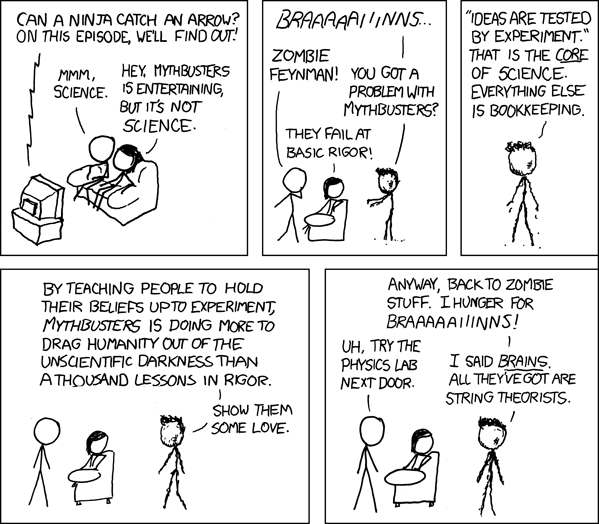 A colleague recently said that Optimality Theory is the String Theory of our field, so maybe we are already back to linguistics … . In the meantime, I bow before the genius of xkcd.
* Of course you need to go to here for the rollover text.
A colleague recently said that Optimality Theory is the String Theory of our field, so maybe we are already back to linguistics … . In the meantime, I bow before the genius of xkcd.* Of course you need to go to here for the rollover text.
Science and beer
 Check out this story on science and beer drinking. Here's the punchline of Carol Kaesuk Yoon's Science Times piece about research done by an enthusiastic beer drinker (and professional ornithologist) from the Czech Republic:
According to the study, published in February in Oikos, a highly respected scientific journal, the more beer a scientist drinks, the less likely the scientist is to publish a paper or to have a paper cited by another researcher, a measure of a paper’s quality and importance.The piece doesn't go very far in exploring what's actually going on here:
The results were not, however, a matter of a few scientists having had too many brews to be able to stumble back to the lab. Publication did not simply drop off among the heaviest drinkers. Instead, scientific performance steadily declined with increasing beer consumption across the board, from scientists who primly sip at two or three beers over a year to the sort who average knocking back more than two a day.
More important, as Dr. Grim pointed out, the study documents a correlation between beer drinking and scientific performance without explaining any correlation. That leaves open the possibility that it is not beer drinking that causes poor scientific performance, but just the opposite.Yup, it's leading to the drown-your-sorrows scenario. Now, our library subscription doesn't allow electronic access to the current year's of Oikos (an ecology journal) so I can't read the full piece right now, but here's the ref, in case you're luckier or heading to the library:
Grim, Tomáš. 2008. A possible role of social activity to explain differences in publication output among ecologists. Oikos 117, 3. 321-480.The title already suggests what most readers will have jumped to by now: This could easily be a real correlation, but a very indirect one. The NYT article aims to sell papers, so plays up the basically impossible view that beer drinking causes scientists to be less successful or that the lack of success causes more beer drinking. We have precious little understanding of the broader correlates of beer drinking and of scientific success. "Social activity" is a natural link to look into … more/less time in the lab, for example, likely correlates with both beer consumption and scientific success.
My thirst doesn't begin to compare with Grim's, but his sentiments sound pretty good:
In spite of his study, Dr. Grim, who said he would on occasion enjoy more than 12 beers in a night, is not on a campaign to decrease beer drinking among scientists. Why not? His answer: “I like it.”Mostly, I'm eager to hear what the Beer Drinking Scientists have to say about this.* I hope Grim gets an honorary membership or something.
*Granted, that blog hasn't had a post in almost a year, but surely they'll shake off the cobwebs and respond to this news.
Monday, March 17, 2008
How to have a really happy St Patrick's Day
Wednesday, March 12, 2008
Woe is we!
Correct speech doesn't always sound right.That's the headline that ran over this week's Barbara Wallraff's Word Court. Some honest speaker of English writes in with questions about how to avoid sounding "ignorant or affected" and gets told (I kid you not) "If everybody else jumped off a cliff …".
The judge volunteers a discussion of the merits of "Who can you trust?" and "woe is me" ("sound good") versus "Whom can you trust?" and "woe is I" ("are correct"). She uses the me form as an example of her efforts not to go "overboard with grammatical correctness". And she directly calls woe is me "ungrammatical".
Sigh. She's clearly assuming that the copula here is the old "=" sign and doing the "it is I" thing peevologists love so much. But this is an old dative form, and like other such forms you often get it with "to" or "unto" in there. I'm not exactly a Bible-reading kind of guy, but check out this comparison (from here):
New American Standard Bible (©1995)Almost exactly a year ago Jan Freeman talked about this very phrase, here. Since Jan is one of the handful of well known language columnists in our country and since Woe is I is the title of a popular book on usage, you'd figure the Judge would have gotten THIS memo, at least. Let's quote Jan here:
For if I preach the gospel, I have nothing to boast of, for I am under compulsion; for woe is me if I do not preach the gospel.
King James Bible
For though I preach the gospel, I have nothing to glory of: for necessity is laid upon me; yea, woe is unto me, if I preach not the gospel!
woe is me has nothing to do with the predicate nominative. Woe is I is not "technically correct," and that is not just "a matter of opinion." "Woe is me" has been good English not merely "for generations" but (linguistically speaking) forever.Who can you trust? Once again, you're overturned on appeal, Judge.
Pop quiz: The fundamentals of our science
No googling now! Who wrote these words?
Discussion of the fundamentals of our science seems to consist one half of obvious truisms, and one half of metaphysics; this is characteristic of matters whch form no real part of a subject … .
The strongification movement
 A set of Wisconsin students have announced to me and probably others that they're starting a movement to make English weak verbs strong. They're calling this strongification (a word which shows up on google once for verbs) or, alternatively, verbal fortition.
Now, I'm not hearing them change their actual usage yet, but on Wednesday, one of them said basically this before class started:
I heard somebody say fitted for the past tense of fit. I was thinking, you know, fat would sound so much better.That actually does kind of work.
Image of Charles Atlas from here.

Monkeys talking, again
 Awwww, language coverage by the BBC. This time, it's putty-nosed monkeys in Nigeria. And the argument is that they are combining relatively few sounds in different ways to convey distinct meanings. These messages include systematic elements: who's talking, what they saw, and whether they "intend to travel".
The report's too sparse for me to say much more — how many sounds are we talking, and how systematically are they combined, etc. But don't monkeys recognize the voices of other monkeys in the group?
Hat tip to Elliott.
Tuesday, March 11, 2008
Names in the news: "A theory of names"
 … No, I'm not going near THAT story, where even the names are too easily made into part of the story line.
But the NYT ran a story this morning that quoted Cleveland Kent Evans, past president of the American Name Society. The piece, as you can see, is about whether having odd names does you psychological damaged later in life. First, a person note: Verbs are good, active, healthy, so I have no personal stake in this. That's unlike Emma Royd, Garage Empty, Please Cope, Lotta Beers and Major Slaughter, all named in the piece. Apparently a lot of these folks, though, are proud of their distinctive names.
There's of course no real "theory of names" as the headline promises, but whatevs.
Image from here, in case you're not happy with YOUR name.
Monday, March 10, 2008
"Personal responsibility toy"

This image (from here) is as funny as the issue behind it is scary. (It's about efforts in Congress to revive the Consumer Product Safety Commission which is virtually dead right now.)
Saturday, March 08, 2008
A big advance in comparative linguistics?
 Some tricks for manipulating human behavior are so easy that you feel bad using them (or maybe not). Getting a lot of traditionally-oriented historical linguists' blood pressure way up into the zone where hospital monitors start beeping and blinking has long been no mean feat: Even if you're not a historical linguist, just start talking about any "long range" proposal for genetic affiliation of language families in an earnest tone. Long range proposals are those for 'deep' family connections among languages beyond those that are clearly established — for example going beyond Indo-European to connect it with various other families as 'Nostratic', connecting almost all American languages in 'Amerind', or connecting Basque with anything.
Sure, your old-school historical linguist might start by gently explaining to you why Nostratic is an intriguing idea but not yet proven by the high standards of the comparative method, or why evidence for seeing Basque as related to any other language is flimsy and flawed, but if you hang with it for a while and take the notion seriously, and you can rattle them deep down in their hearts.
In fact, it used to be a first-order faux pas to even raise the issue except as a joke. Happily, a newer generation has been open to these ideas, and numerous Indo-Europeanists have given serious attention to examining evidence for Nostratic and hardly in a dismissive way. While such people aren't buying Nostratic wholesale, it's being taken more seriously than it was 20 years ago, certainly. (A connection of some sort between Indo-European and Uralic, which includes Finno-Ugric, looks pretty appealing to a lot of scholars.)
One of the links that inspires tremendous interest, for obvious reasons, is the possible connection between languages of the Americas and those of Siberia (or beyond in Asia). For a while now, people have been talking about very promising work on this topic by Ed Vajda of Western Washington University, who works on the Ket language of Siberia, and a group of scholars who work on Na-Dene languages (a family which stretches from Alaska to the southwestern US). The story has now broken of strong evidence for a connection, presented at a conference in Alaska — see here for the LinguistList version and here for a newspaper account. A genetic connection between a language spoken along the Yenesei River and Tlingit, Navajo, and others is huge news.
You can see the evidence for yourself here. I am not particularly qualified to evaluate it, but the list of scholars who have reviewed this stuff and spoken positively is an impressive one, including some old school historical and comparative linguists.
This could be a big moment happening here.
Friday, March 07, 2008
Transformative
 For almost a week, I've been pondering Safire's column from last week. No, I'm not going to take him to task, even though he misses a point about how English works today, in the mouths of some of its best speakers:
Obama said, “What I said was is that Ronald Reagan was a transformative political figure because he was able to get Democrats to vote against their economic interests.” (In his curious “was is,” Obama’s juxtaposition of both past and present tenses of the verb “to be” may have been a subtle, implicit reminder of the former president’s unforgettable “it depends upon what the meaning of the word ‘is’ is.” Or the eloquent candidate may have simply misspoken.)That construction — and variants of it — are widely used today, including by Bush. It's not some high verbal art, not a Clinton reference, and no misspeaking. This "reduplicative copula" gets used in topicalization, and was the subject of a nice article carrying that name by Michael Shapiro & Michael Haley in American Speech (Vol. 77, No. 3, Fall 2002). They quote Bush as using almost the same form, in fact:
What I’ve said is is that . . .And they give another example from Hillary Clinton, and one with "was is" (and one with "are is" from Bush) and so in, rightly saying that it's "a widespread feature of contemporary speech (if absent from written English)." They say that that is obligatory, and conclude:
In the grammar of speakers who habitually utter (but probably would not write) what looks like a reduplicative copula, subordinator that in nominal dependent clauses after topic words plus is has changed from the simplex that to the complex is that. This development has the effect of expressing (diagrammatizing) the difference in syntactic function between demonstrative and complementizer versions of the same pronoun as a difference in morphological form, which is then its explanation (its teleological raison d’être).But Safire does get in a graph on theoretical linguistics:
The embrace of the word by political junkies has people in the language dodge wondering, What is this going to do to “transformational grammar”? That’s the monicker given to the revolutionary study by Noam Chomsky a half-century ago of the way the brain’s predisposition to language expresses itself. As the grammarian Robert Funk explains, T.G., as it is known to linguistic insiders, holds that “meaning is generated in the deep structure and then transformed into a variety of surface structures (sentences we actually speak).” As I get it, the transformationalists are figuring out why children acquire their native language so quickly and spontaneously. Syntax is not dictated by mavens laying down rules; it’s issued with the newborn brain itself, along with the capacity to soar, inspire or inflame as well as to argue about the details of usage.I think most of us today talk about generative rather than transformational grammar, but hey …
If you don't know the band whose album cover is pictured here, you should. What it was was good music.
Wednesday, March 05, 2008
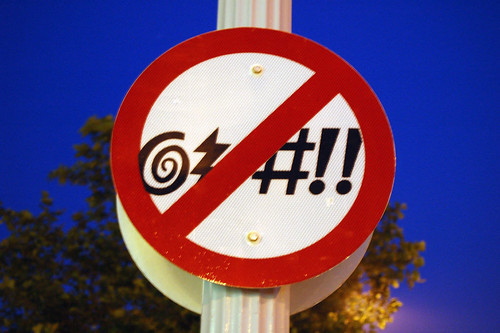
No cuss weekend
 One of the most regular readers of this blog (maybe the most, as far as I know) passed this tidbit along:
Just saw that South Pasadena just declared the weekend or something like that 'no cuss weekend' in hopes that people will clean up their speech. The move was started by a boy in school. Bottom up language prescription.Damn that, I say. Who knows, maybe the kid will grow up to become a sociolinguist or something. Ya just gotta freakin' hope.
Misc.
 So there, I have now let National Grammar Day pass without comment. I made a point of using a lot of center-embedding yesterday, though, and marked past tense of all strong verbs by string reversal instead of ablaut.
It was a rough day in Wisconsin. Folks are reeling over Brett Favre's retirement from the Packers, and kinda of at a loss to think of his backup, Aaron Rodgers, at the helm. Still, Joe reports that Favre wasn't even mentioned during his trip to the barber yesterday — it was all politics, weather and politics.
More seriously, Gary Gygax, creator of the Dungeons and Dragons (and other games), passed away in Lake Geneva, southeast of here. I never played D&D and know it mostly from jokes about it, and hearing fans talk about it.
Image from here.

Monday, March 03, 2008
PYUtativ, Keith
Oh. My. God. I. am. so. prescriptive. But Keith Olbermann just said puTAtive, not once but twice.
But I checked it, and did like this note from the online etymology dictionary, "At first esp. in putative marriage, one which, though legally invalid, was contracted in good faith by at least one party." I hate when that happens!
But I checked it, and did like this note from the online etymology dictionary, "At first esp. in putative marriage, one which, though legally invalid, was contracted in good faith by at least one party." I hate when that happens!
lol cat gone bad?
Another brilliant lol cat from the folks at I can has cheezburger: Like one of the reader's sez:
 Like one of the reader's sez:
what happened?!?!?! gives us teh newz!
Sunday, March 02, 2008
The horse, the wheel, and language
The NYT Book Review today has a very positive review of David Anthony's new book with the above title, by Cristine Kenneally. It sounds like it's arguing the familiar positions that the Indo-Europeans came from the steppes of southern Ukraine and Russia, and spread in large part due to the advantages of being horsemen.
On some other points, though, I'm not sure what to make of things:
If anybody knows the book, I'd be eager to hear what you think of it.
On some other points, though, I'm not sure what to make of things:
Anthony also describes a world in which spoken poetry was the only medium, one that helped spread Proto-Indo-European through what he calls “elite recruitment.” It wasn’t enough for the newcomers to assume a dominant position: in order for their language to be picked up, they also had to offer the local population attractive opportunities to participate in their language culture — a process that continues today, incidentally, with the spread of English as a prestige language.I'm curious what kind of evidence you'd use to argue this for the early spread of IE into, say, western and northern Europe.
If anybody knows the book, I'd be eager to hear what you think of it.
Drunkorexia
Few parts of a newspaper interest me less than any section that has "fashion" or "style" in its title, but I didn't flip past this in today's NYT on "compounding" eating disorders with other dangerous behaviors. The opening list contains these disturbing, if not instantly transparent, terms:
The blends above all refer to potentially fatal health problems (and we have blends that are negative in meaning — smog, stagflation) but it seems like a lot of blending in English is commercial or playful, like in Lewis Carroll or the celebrity names you can see here. Using blends here not only makes these terms distinctly non-clinical sounding, but it also feels awkward given concerns about glamorizing eating disorders (like here), not to mention that we surely don't want to do anything that sounds like it trivializes them.
Manorexia. Orthorexia. Diabulimia.If this was a GRE question, I guess you'd say that the second is not like the others morphologically. The initial element of the first item is not from manic (as I first wondered) but rather man — it's male anorexia. The second uses a familiar prefix, and it's a fixation on eating healthy food, according to this description, a disorder unto itself, not directly compounded with anorexia. And the third is about diabetics who avoid insulin because it can cause weight gain but apparently doesn't involve purging. More immediately obvious in meaning is drunkorexia, mentioned in the subtitle and discussed at length in the article.
The blends above all refer to potentially fatal health problems (and we have blends that are negative in meaning — smog, stagflation) but it seems like a lot of blending in English is commercial or playful, like in Lewis Carroll or the celebrity names you can see here. Using blends here not only makes these terms distinctly non-clinical sounding, but it also feels awkward given concerns about glamorizing eating disorders (like here), not to mention that we surely don't want to do anything that sounds like it trivializes them.
Subscribe to:
Posts (Atom)