Saturday, May 31, 2008

Eskimo words for uterus


Just a little goofy post to lighten things up on this blog. I came across something that has me beyond baffled. So I saw that there was a youtube video on the famous Eskimo words for snow. I thought, hey, that could be good for class, so I watched it. It goes along just fine until about 1:45, when they decide to explain what morphemes are. So they choose the obvious English word: uterus. UTERUS?!?!?!? Complete with a little silhouette of the relevant part of a woman's body and reproductive organs and an illustration of an IUD... HUH??? Not to be a Wisconsin goody two-shoes, but I find that WEIRD.

So that gives me an opening (ahem) to tell you about the best word I ever coined. You know what state a woman is in after a hysterectomy? A state of uteruslessness. Is that not a beautiful word? Thank you.

Morale boost: The new chancellor

My yesterday was a long string of meetings with people from a bunch of different departments. It's amazing how optimistic folks are, excited even in some cases, about the new chancellor. If one of her first goals is to get morale moving in the right direction, she's already making good progress. The local paper seems to think so too (here).

Friday, May 30, 2008

Challenge IV: The big picture

No, the picture doesn't mean what you think. Just hold on a second.

"Finish what you start." That’s what the old men always told us when I was little. I feel compelled to check off Challenge IV in this Quixotic quest:
4. The benefits of OT over SPE “don’t look all that great”.
This one triggered the first nastiness, the quip that it “requires a lot of (willful) ignorance of a huge amount of important work”.

As far as I know, everyone, even outsiders to the theory wars like me, agrees that phonology in the late 1980s needed major reworking, and everyone agrees that constraint-based work has provided real insights. Of the list that Eric gives, conspiracies stand out as the big example for me.

But the complaint you can hear from people who've grown disillusioned with OT (or never accepted it) is that a huge amount of the work in the framework has tended to theory-internal tinkering, rather than research aimed at more general progress on how sounds work. The failure to deal adequately with opacity, for such people, is symptomatic of that. I've been surprised at how many people say such things. One of the best-known phonologists around has apparently bemoaned the failure of OT to produce “deep descriptions of languages”. And others (though not all) have the sense — again, this is reporting something I've heard — that while OT works well for higher-level prosodic stuff, like reduplication, it stumbles too often on issues of segmental phonology that traditional approaches handled easily. So, I think every non-OTer I know sees OT as having brought valuable discussion and progress, but the question of just how much has remained virtually untouched.

Now we get to the image above: Many of us outsiders smelled a troubling air of triumphalism in OT's salad days. I remember vividly hearing young phonologists — people who had and probably still have contributed little or nothing to the field — mocking Kiparsky for pursuing stratal OT.

But we are finally seeing a change. It's good to see Eric sounding so positive about Kiparsky's and Bermúdez-Otero's stratal work (see Challenge I). McCarthy's embrace of Harmonic Serialism will be a positive move to many. Eric's own Phonology piece grapples directly with comparing traditional approaches to opacity with OT approaches, acknowledging some strengths of the former. Maybe we're seeing some rapprochement, and with it more discussion of the grounding of phonological theory, instead of talking-heads-style yelling and posturing. The shocking part, of course, is how rare this has been of late — or so it seems to me. Hell, if it continues, I might do a little phonology some day.

Anyway, I'll post again later to clear up some lingering questions.


Challenge IV
Frankly, this one’s a real puzzler to me. In my view, it requires a lot of (willful) ignorance of a huge amount of important work in the 70s and 80s to think that OT doesn’t make significant progress in many areas (duplication, conspiracies, top-down and bottom-up effects, the emergence of the unmarked, …) where SPE essentially foundered. Yes, one significant consequence of all this progress was at the very least a re-evaluation of the ubiquity, diversity, and explanatory analysis of opacity — and this re-evaluation has led to a lot of interesting work and new developments. Some of it may involve what some consider to be “lots of gymnastics”, but as I’ve noted above, similar (and well-accepted) developments in SPE are arguably no different in this regard.

Thursday, May 29, 2008

lol cat: Scrabble edition

Much like with opacity, I keep swearing I'll never post about lol cats again, but I keep doing it. This pic — sent along from G.T. (who gets the ht) via J.S. — is at least relevant to dialectology, sociolinguistics and language change …


Yes, I'll return to finish up the opacity deal, although I'm starting to feel a lot like the Tommy Lee Jones character, Sheriff Ed Tom Bell, at the end of No Country for Old Men: Tired of all the bloodshed and unable to understand the level of violence around me. (And I can't believe I missed that Eric's DEE comment was specifically about phonological patterns.)

Wednesday, May 28, 2008

Opacity, part III: What's 'easy'?

After a hiatus to take care of other business and read his recent Phonology paper, here are a few notes on Eric's third challenge (again full text at the bottom of the post):
3. SPE(-and-subsequent-developments) “could deal with [opacity] easily”.
Eric adds, in a comment on the last post:
The point of that is to say that derived environment effects are cases of opacity that can't be easily handled by rule ordering alone.
The person I originally paraphrased had given simple opacity examples, like Canadian Raising. But we can expand the notion to include derived environment effects (DEE). And they do go beyond what's directly predicted and handled automatically by rule ordering alone. I'm not sure that changes much from part II: Classic opacity from the interaction of postlexical rules is predicted by and falls out automatically from generative phonology. By contrast, Baković (2007:220) quotes McCarthy on this:
Unless further refinements are introduced, OT cannot contend successfully with any non-surface-apparent generalizations, nor with a reside of non-surface-true-generalizations.
But are these mere 'refinements'? Simple constraint ranking as a way of getting optimal forms is one thing, while allowing conjunction among constraints (like other similar refinements) vastly changes and complicates OT's basic mechanics. Some old-school linguists who are waiting for the theory bus to turn the corner are left scratching their heads as to why OT crucially relies on gymnastic moves precisely where one shouldn't.

In traditional phonology, it's when we get to how morphology interacts with phonology, as in prototypical DEE, that we need additional tools. You need nothing fancy to handle purely phonological opacity, but you might where phonology and morphology meet.

Having read "A revised typology of opaque generalizations", I see why Eric got so bent over a quip that opacity is easy in earlier models and hard for OT: His article aims to debunk precisely this view. It's a balanced account, where everybody has trouble with some types of opacity and can handle others. Still, the problems he hangs around the neck of traditional models are quite different from those OT faces (above). Eric concedes that Vaux's non-OT analysis of New Julka Armenian is "technically true" (p. 246), but Vaux "presents no specific arguments for this ordering analysis, empirical or otherwise". Vaux's ordering produces the right output, while the reverse ordering does not. It's not that a traditional analysis won't work, but that Eric doesn't find it sufficiently motivated?

Eric was right that I was going to skirt Challenge III, and I appreciate him prodding me. As hinted at above, I wonder if he isn't onto something about how phonology-morphology interactions appear more contortion-prone than plain phonology. When students gripe about the drivel they claim to get from their phonology or morphology profs (apologies to the peerage), often it is over such resultant interactions (or what happens to newbie sounds trying to squat on derivational territory occupied by old sounds at stem's edge). But what's odd about the phon-morph relation is that students often take a different approach from paid phonologists: They're content to load the lexicon, a Third Way of the Declarative Phonology sort. Correct me on this, not being a phonologist and all, but serial models of sound systems seem not to miss cross-lexicon generalizations brought about by loading the lexicon nor to create unnecessary problems by restructuring the nature of constraint evaluation.

With those questions tossed out there and with my flame retardant suit on, I'll leave this for now, but will return to Challenge IV soon, and maybe even a postscript after that. I'm just trying to figure this stuff out.

Challenge III:
3. SPE(-and-subsequent-developments) “could deal with [opacity] easily”.
Although it is conveniently hardly ever talked about in this way, ‘derived environment effects’ are precisely cases of opacity that cannot be “dealt with easily” in SPE, by which I mean that rule ordering on its own won’t do the trick. Consider the classic Finnish assibilation case (whether or not you believe it): t → s / __i, but “only in derived environments”. Let’s stick to phonologically-derived environments here: assibilation does not apply to underlying /ti…/, because no part of the structural description of assibilation is derived; assibilation does apply to /…te/, because there is another rule raising word-final /e/ to [i], which means that this part of the structural description of assibilation is derived by raising. (So: /ti…/ → [ti…], but /…te/ → |…ti| → […si].)

Several things to note here. First, this is a case of opacity of Kiparsky’s (1973) “Type (i)”: assibilation is not surface-true, because there are surface strings of the kind that match the structural description of assibilation (to wit, [ti…]). Second, although many examples of non-surface-truth can be accounted for with counterfeeding rule ordering, this kind of case cannot, which is why some separate principle(s) responsible for derived environment effects are necessary — hence my conclusion that SPE does not, in fact, “deal with [opacity] easily” in the way Mr. Verb’s summer-upper and many others claim. Third, how does the distinction between ‘derived’ and ‘non-derived’ require any less “gymnastics” than the one between ‘new’ and ‘old’ markedness constraint violations, the basic idea behind comparative markedness? I’d really like to know.
Image from here.

Holy moly! Chancellor Biddy Martin!

Word came down a little while ago: Biddy Martin is the new chancellor. Who knows what the future holds, but she was surely the best of the finalists.

Wisco lingo t-shirt …

It's what the hip kids are wearing. There may be a few left; contact one of the Linguistics Student Organization folks if you want one, or drop me a line and I'll pass on the message.

HT for the image to Monica.

UW news: all minor

The big announcement on the new UW-Madison chancellor should be coming down soon, maybe today, but in the meantime, here's other UW news:
  • The scariest of the chancellor finalists, Tim Mulcahy, has withdrawn.
  • The CapTimes has a story on UW brain drain, focusing on superstar Law prof Alta Charo (hey, she's been on CNN roughly a zillion times), who turned down a 45K raise at Berkeley to stay here.
  • The proposal is floating again for 'differential tuition', namely for big school-specific increases in the School of Engineering.
  • There's another political blog, Fearless Sifting, covering UW. Looks like a promising start, although many readers of this blog will disagree with the views found there. The poll for who should be the next chancellor was there yesterday but gone now. (Blank was leading and Sandefur had almost no votes, fwiw.) Check it out.

Tuesday, May 27, 2008

Bringing the Two Cultures together

Oh boy, Science Times Tuesday. I admit, I like it best when they don't have linguistics stuff, given how often they don't get that stuff right, but I always look forward to it, even with occasional disappointments.

This morning, Natalie Angier has a piece called "Curriculum Designed to Unite Art and Science." Here's a key quote:
a few scholars of thick dermis and pep-rally vigor believe that the cultural chasm can be bridged and the sciences and the humanities united into a powerful new discipline that would apply the strengths of both mindsets, the quantitative and qualitative, to a wide array of problems.
Really? Do tell. Wait, this idea sounds familiar.

First, a note on the history of ideas. The NYT piece draws on C.P. Snow's "Two Cultures" riff. He was both a physicist and a novelist, so had a foot in both worlds in some sense, as he notes at the beginning. But don't assume he was always so lovey-dovey with lit guys — the book isn't a kumbaya moment. His chapter "Intellectuals as Natural Luddites" is aimed in no small part at literary scholars. And a lot is aimed at the disconnect between academia and the real world, like the wealth and power produced by the industrial revolution.

Where were we? Oh yeah, how this sounds familiar. I've got it: Linguistics does this. I know a whole set of linguists who move freely between reading texts in dead languages and working in the phonetics lab. Most linguists have some good part of the math/logic/stat background the article portrays as desirable, are comfortable with discussions of ethnography and such since we do so much fieldwork, and we count as 'humanities' at lots of major institutions.

Another reason linguistics really should be at the center of the world.

Turkish vowels

A regular reader just sent along this link. That's a really nice way of presenting vowels, I think.

Sunday, May 25, 2008

Blogging under a pseudonym

A month ago, I promised to comment on a controversy over at scienceblogs.com about pseudonymous blogging (see especially here and here). The discussions there were about pretty weighty matters of science, including posts by the wonderfully pseudonymous DrugMonkey. But I never got around to it.

Last week, as the first volleys were being fired at this corner of cyberspace in the Opacity Wars, comments on one or two of the posts expressed outrage over pseudonymous blogging/comments, for reasons that weren't quite clear to me. But the sun was shining and the fish were biting, so I didn't have time for that either.

Then, yesterday morning, I read the NYT Magazine's piece by Emily Gould, called "Blog-Post Confidential: What I gained – and lost – by revealing my intimate life on the web". There's a lot about 'oversharing' and a lot of oversharing, as the author negotiates her life on-line.

Jesus H. Christ on a crutch, that's a lot of whoopdedoo about 'virtual personalities'.

Let's clear about my own pseudonymous status: This blog exists only because it is possible to have a layer of distance from the real person or people who actually do the writing here. (Oh, have I given away too much?) It is by design emphatically not intended to be the Log, where some of the brightest and most articulate minds in language sciences have a pretty authoritative (in a good way) blogal voice. In a way, it matters who those people are while they write about stuff they actually know about. A smart person reads everything with a skeptical eye, but the Log is about as trustworthy as the web gets. Even they, though, have a pseudonymous blogger in their line-up (Melvyn Quince).

In contrast, this blog exists just to create a chance to throw out odds and ends about language, mostly intended for people with nothing beyond a passing interest in language. This blog is a kind of anti-authority and I hope there's no oversharing in any sense. (If there is, I'll hunt it down and kill it.)

Sometimes the content is just linguistic data, but it's infinitely less focused than Jim McCawley's wonderful old "Linguistic Flea Circus" (a collection of English data that resisted and often still resist good theoretical accounts), nor ideologically loaded like the 'wild facts' that George Lakoff was said to bring to class back in the day. I don't give tremendous thought to most of what I put up, and if I did, I wouldn't post a lot of it or would rework it dramatically. (Case in point: The last post about a 'garden path' sentence might not really count as garden path to a lot of people who do syntax.) I definitely wouldn't be so brainstormy if stuff had my name on it. So, a pen name is comfortable.

A lot of our posts are about the discipline of linguistics at Wisconsin, language in Wisconsin, etc. For those things, it just feels better to have it come from a blog with a lot of local people serving as contributors: It doesn't matter who gets this stuff out, but it's good to have people know about what's happening among linguists at Wisconsin and related matters. Most of it is stuff I don't know jack about, in terms of linguistic science, but it looks like fun or potentially interesting or somehow worthwhile stuff.

Besides, the person typing these lines is not really a linguist, as many of the real linguists on campus would tell you very directly if you asked them. I don't have any kind of degree in Linguistics and the couple of courses (was it even that?) I had in Linguistics as a student were far away from almost anything that ever gets mentioned here. But maybe I'll start blogging about what I know some day. In the meantime, I am a kind of anti-authority on linguistics, or maybe more of an unhinged amateur rodeo clown on acid invading the LSA Business Meeting.

And we talk some about university and academic politics, a lot of it looking snarkier than one might be if this blog wasn't under a pen name. That stuff, I think, is stuff that needs to be said, and often badly needs to be said, and the person typing these lines regularly says more forceful things on these topics in public, but I'd just as soon not have the local papers quoting me by name and title. (And, yes, local news blogs do occasionally pick up stuff from this blog.)

Sure, we raised hell for a while with Safire and other prescriptivist baboons for their willful ignorance of the subject they earn a living from. Most people who care already understand how those guys work, but it's probably useful to have a reminder. I wouldn't mind having my name on that stuff, but it doesn't outweigh the reasons for being pseudonymous, and it could become a distraction.

One of the key bits of liberty that comes with a nom de plume is that I can report what I hear "on the street" about the field. That's a little like the gawker blogs that Gould has worked for, but much more like the uber-snarky non-news on wonkette.com. I assume enough sophistication on the part of readers to realize that this stuff really and truly is on the level of gossip — not refereed publications or conference presentations, even much more what people tell after the third beer than over a latte. This blog is to the Log as wonkette is to whatever the best newspaper in the country is.

If you find something here that has any value beyond a cheap laugh, it's yours to use (acknowledgments to Mr. Verb are welcome). But if you can't verify what you read here, I urge you not to take it too seriously. We don't. What you read here is worth what you've paid for it. At most.

Saturday, May 24, 2008

The Onion on the garden path

We'll get back to opacity, but I'm finally reading Eric's 2007 article in Phonology on the subject, so it may take a while to sand off the phonological rust. But even anonymous bloggers who try to avoid serious topics have some standards, I guess.

In the meantime, check out this Onion link:
'Wheel Of Fortune' Contestants Hit Hard As Vowel Prices Skyrocket
Cute. But I'm always a sucker for the horoscopes and there's a wrinkle this week:
Leo JULY 23 - AUGUST 22
The loss of a child is never easy, especially when the resourceful little pest keeps managing to find his way back home.
As a regular reader of this blog pointed out in conversation, it isn't a typical garden path (if it's one at all). The verb, she points out, would allow both readings more easily — if you're being followed, you can lose them — but the noun is odder. In fact, I just can't get the punny reading to work grammatically, though I laughed when I read it. And don't figure that this is a glitch — the Onion writers are good finding ways to keep you off-balance as a reader, and this is probably an example of that.

Anyway, maybe you're more comfortable with this:
Cancer JUNE 22 - JULY 22
You'll have a lot of explaining to do this week when the mathematical constant W is somehow reduced to an irrational decimal, leaving x and y unbalanced on the other side of the equation.
And, dear minions and regular readers (assuming you haven't abandoned the blog after the theory-heavy days), rest assured, I'll be back in the gutter before you know it ...

Wednesday, May 21, 2008

Diacritic humor

From the subject line, you don't need to ask, you know it's from the Onion:
Beyoncé to add three more accent marks to name
It's one of the teasers for a non-existent inside article, but I'm guessing Bèyóǹcé.

Tuesday, May 20, 2008

The Indo-European homeland, found: Not!

While Mr. V is pondering challenges about phonological theory, I've now actually read David Anthony's book, The horse, the wheel and language, which Mr. Verb mentioned earlier here. The book is, I have to say, stunningly bold. Anthony claims flatly:
it is now possible to solve the central puzzle surrounding Proto-Indo-European, namely, who spoke it, where was it [sic] spoken, and when (2007:5).
In fact, Anthony is mostly taking over the old Kurgan hypothesis — that the early Indo-Europeans were associated with the 'kurgan' burial mounds (pic from wikipedia) and came from the area north of the Black Sea — as developed by J.P. Mallory and others. Recent works on IE and historical linguistics have come to treat this as the most likely homeland, but that's far more conjecture than secure conclusion.

The alternative is more promising than Anthony makes it out to be, surely, namely that these people started out in Anatolia more like 9,000 year before the present and spread out with farming. This view is associated with Colin Renfrew, who has recently summed his view up this way: “Everybody agrees that farming came to Europe from Anatolia. So Anatolia must be the point of departure [for languages too]” (Balter 2004:1324, in Science).

Both views actually share key features, like a reliance on more nuanced ‘vectors’ of cultural spread rather than large-scale invasions or migrations. On both views powerful new technology promoted the spread of Indo-European languages, involving food production and/or transportation.

As Mallory & Adams (2006: 461-463) conclude, “The dispute here is one of degree, both temporal and spatial.” The two views are close enough now that some are asking whether they might be fundamentally compatible. Balter’s report ends with this, in the context of work by Gray & Atkinson's proposal for an early date for IE:
Because this date matches the first evidence for Kurgan occupation of the Black Sea steppes, Gray and Atkinson say, both camps could be partly right: The farmers spread PIE initially, but the Kurgans spurred the later burst of languages. “There is no need to set up the Kurgan and farming hypotheses at variance with one another,” says April McMahon, a linguist at the University of Sheffield, U.K. “But sadly, this is something that [people] have a tendency to do.”
I can post more details if readers want, but this book is not a solution to the homeland issue. Language really plays no big role in it, certainly not in any original contributions to the topic.

OT gymnastics? The challenge, pt. deux

OK, I haven't more than skimmed the comments on the earlier opacity post, and don't have time for more than a quick stab at the second challenge right now. And keep in mind that I'm not a real phonologist, so this is just amateur hour start to finish. (I have talked to a couple of professionally-trained phonologists about this.) Still, let's blindly plunge ahead to challenge no. 2:
2. OT requires “lots of gymnastics” to account for opacity, while SPE doesn’t.
The full text of the challenge is pasted in at the bottom of this post, for quick reference. Almost all of the comments that seem to have pissed people off were all paraphrases of things others had said, but the word gymnastics was actually my choice, so I should explain it. Here's part of what Merriam-Webster's 11th says about the word:
1 … b : a competitive sport in which individuals perform … acrobatic feats mostly on special apparatus …
2 : an exercise in intellectual or artistic dexterity *my earlier philosophic study had been an intellectual gymnastic — John Dewey* *mental gymnastics*
3 : a physical feat or contortion …
I guess I had parts of all those things in mind. (By the way, Dewey was talking about being inspired by Hegel's philosophy, "no mere intellectual formula".)

In terms of fundamental architecture, theories with serial derivation can very comfortably handle cases like Canadian Raising or Tiberian Hebrew spirantization, where we have interactions among post-lexical rules. The rules are benignly learned independent of each other by the child, and ordered appropriately, perhaps without the help of opacity. The resultant opacity emerges from the particular rules and the particular ordering. The rules and ordering are boorish at best, but the interaction is sophisticated at worst. (It also mirrors how language change works, as Adam Ussishkin rightly noted.) Again, precisely this kind of pattern is common in language and easily handled, even predicted by a serial rule-based model. Additional conditions on the application of rules like structure preservation and the derived environment condition seem to represent refinements of our understanding of rule application. Maybe these refinements to rule application are gymnastics as Eric suggests but there hasn't been any improvement on the phenomena of structure preservation and derived environment effects produced by OT. So it would seem that we all need to be flexible.

In contrast, sympathy theory, comparative markedness and OT-CC really feel like gymnastics — using some special apparatus, needing dexterity and requiring contortion. To many people these feel like kludges that fail to fix a fundamental part of the basic architecture: 'classic OT' seems inherently ill-suited to garden-variety opacity. As exciting as many of us found OT in its early days, and while it provided new ways to think about some of the cases that rattled phonology through especially the '80s, early versions simply had no clean way of handling opacity — which triggered the string of contortions and acrobatics mentioned earlier. At that point, a number of people feared that we were looking at a great leap backwards: Even if the new approach could address the kinds of problems that arose with, say, late Lexical Phonology, to abandon a basic kind of approach that has served us well (since, what, Panini?), some linguists felt the new approach should have an honest way of dealing with a basic phenomenon the old approach could handle.

I'm not interested in declaring who's wrong or right; I'm just trying to understand how language works. But it seems like the people I paraphrased earlier had a point, even in light of Eric's comments: You just can't really compare some things that were "at some point or other brought to bear on opacity" with wholesale reworking of a theory to handle simple opacity.

Now that I look at challenge #3, it looks like basically the same as #2, so maybe I'll skip to #4. Stay tuned!

Challenge 2:
2. OT requires “lots of gymnastics” to account for opacity, while SPE doesn’t.
But — I hear you object to what I just wrote above — by “monostratal” Mr. Verb must mean “non-serial within a lexical-phonological stratum”, and in that sense he’s basically right. John McCarthy is without a doubt the most visible proponent of OT who accepts that at least some legitimate cases of opacity are not reducible to cross-stratal interactions, and is also the one who has developed most of the proposals to amend ‘classic’ OT to accomodate such cases of opacity, in particular those that Mr. Verb specifically mentioned (sympathy theory and comparative markedness). McCarthy’s most recent proposal, OT-CC (see his book and some of his more recent papers on ROA), is likely to be viewed by critics as just so many more gymnastics (as opposed to a proposal that makes predictions that may be right or wrong).

But is SPE really any different in this regard? What about the transformational cycle, the Elsewhere Condition, structure preservation, the alternation condition, the strict cycle condition, and so on? Each of these developments within SPE was at some point or other brought to bear on opacity, whether to help account for cases of it or to constrain the power of ordered rules to generate particularly outlandish kinds of opacity (’Duke of York’ derivations and absolute neutralization being particularly well-beaten horses). I’d like to see someone explain how any these developments within SPE are not “lots of gymnastics” while some developments within OT are. (And I’m not brushing aside the interesting work done in the 80s that attempted to reduce some of the developments within SPE to others, though I don’t believe many of these attempts were particularly successful.)
Image of Contortion Girl from here. Pretty amazing contortion, I'd say.

Monday, May 19, 2008

Parallel vs serial phonology

Phonoloblog is one of my favorite linguistics blogs and a number of us around here read it. Over there, Eric has posted a pretty sharply worded "challenge" to Mr. Verb "to defend" claims from somebody else I paraphrased this way a while back in a post:
Opacity is ubiquitous in human language, and earlier theories of phonology could deal with it easily. It’s hard to see why those advantages have been abandoned for an approach that can’t handle opacity without lots of gymnastics, if at all, for benefits that don’t look all that great.
Here are the challenges:
  • OT is by definition monostratal.
  • OT requires “lots of gymnastics” to account for opacity, while SPE doesn’t.
  • SPE(-and-subsequent-developments) “could deal with [opacity] easily”.
  • The benefits of OT over SPE “don’t look all that great”.
I don't mind having a go at these challenges, even though my paraphrase truly was representing somebody else's positions as I recalled them. But first, a story (this version from here):
Farmer Jones got out of his car and while heading for his friend's door, noticed a pig with a wooden leg. His curiosity roused, he asked, "Fred, how'd that pig get him a wooden leg?"

"Well, Michael, that's a mighty special pig! A while back a wild boar attacked me while I was walking in the woods. That pig there came a runnin', went after that boar and chased him away. Saved my life!"

"And the boar tore up his leg?"

"No he was fine after that. But a bit later we had that fire. Started in the shed up against the barn. Well, that ole pig started squealin' like he was stuck, woke us up, and 'fore we got out here, the darn thing had herded the other animals out of the barn and saved 'em all!"

"So that's when he hurt his leg, huh, Fred?"

"No, Michael. He was a might winded, though. When my tractor hit a rock and rolled down the hill into the pond I was knocked clean out. When I came to, that pig had dove into the pond and dragged me out 'fore I drownded. Sure did save my life."

"And that was when he hurt his leg?"

"Oh no, he was fine. Cleaned him up, too."

"OK, Fred. So just tell me. How did he get the wooden leg?"

"Well", the farmer tells him, "A pig like that, you don't want to eat it all at once!"
This Phonoloblog post is kinda like that pig … so good you don't want to eat it all at once. Let's take the first of those four legs for now: parallelism versus serialism. Eric writes this below his list of challenges:
I’m pretty sure that it’s safe to assume that “earlier theories of phonology” refers to serial, rule-based generative phonology in the SPE-and-subsequent-developments sense, and that “any monostratal theory (one without stages of derivation)” and “an approach that can’t handle opacity without lots of gymnastics, if at all” refers to Optimality Theory. Correct me if I’m wrong.
My formulation refers not to OT but to "monostratal approaches". (I mention OT in a broader connection earlier in the post. Elsewhere on this blog I've used the term 'mainstream OT' specifically to mean monostratal OT.) Such approaches include 'classic OT', Declarative Phonology, and others; it's of course all monostratal approaches but not all OT approaches that have trouble with opacity. So, the first challenge seems to be a misunderstanding.

Eric continues with the details of Challenge 1:
1. OT is by definition monostratal.
In both published papers and (perpetually) forthcoming books, Paul Kiparsky and Ricardo Bermúdez-Otero — and many others, certainly — have developed and argued for a marriage between the basic assumption of Lexical Phonology and Morphology (that a grammar is multistratal) and the basic assumption of Optimality Theory (that an input-output mapping is defined by applying a ranked constraint hierarchy to a set of candidate outputs derived from the input). (The possibility of such a marriage was suggested, but not followed up on, in McCarthy & Prince (1993).)
It's true enough to say that stratal OT was mentioned as possible early on (including by Prince & Smolensky 1993), but it's not simply that it wasn't followed up on: A major theme in classic OT has been that serial derivation was a really bad idea, from P&S '93 up until almost the present day.* It's not hard to find places where Optimality Theorists appear to conflate parallel evaluation and OT, though, like in this quote from P&S 1993:137 [in the ROA version]:
When all of the relevant constraints are assessed in parallel, as in Optimality Theory, an entire completed parse is subject to evaluation. … [A] number of further cases of crucial parallelism are discussed in McCarthy & Prince 1993. The crux of the matter is that the grammar must determine which total analysis is wellformed— a task impeded by the use of serial algorithms to build structure step-by-step.
That's Part I, too much thinking for one day. But there's plenty more meat on this pig!

* I've always liked the index entry in McCarthy's Thematic Guide: "serial derivation, problematic", with a string of page references.

Image from here, continuing the linguistics/music connection thing.

Chancellor: Workplace rights

Here's something to consider as you write to the search committee about the next chancellor:

Subject: New Chancellor must respect democratic workplace rights
From: "Chad Alan Goldberg"
Date: Mon, May 19, 2008 3:33 am
To: chancellorsearch@bascom.wisc.edu

Dear Chancellor Search Committee members,

As a tenured faculty member at UW-Madison and a union member (UFAS, AFT Local 223), I am writing to express my dismay and outrage at remarks made by two finalists for the position of UW-Madison Chancellor.

It has come to my attention that Rebecca Blank reportedly said that unions foster "adversarial" relations and work best for workers who are "lower on the totem pole" than faculty, and that Tim Mulcahy reportedly vowed that he would oppose "faculty and academic staff organizing at all costs."

These autocratic attitudes are unacceptable. Indeed, it is precisely attitudes like these that push faculty and academic staff to join unions in the first place. To oppose the right of faculty and academic staff to organize -- a right that is enshrined in the Universal Declaration of Human Rights as well as the laws and traditions of the great state of Wisconsin -- is a situation abhorrent to democracy. I fear that if Rebecca Blank or Tim Mulcahy were to become Chancellor, it would foster disruptive conflict rather than cooperation at our university, cause irreparable harm to the reputation of UW-Madison, and make it difficult for the university to recruit and retain the best faculty and staff. In short, it is not unions that pose a threat to UW-Madison, but the aggressive union-busting advocated by these two candidates. I urge you to do the right thing now rather than foster antagonism and undermine the morale of the educators and staff on whom you depend: Tell Blank and Mulcahy that their adversarial and reactionary attitudes toward unions make them unfit for the position of UW-Madison Chancellor.

Sincerely,

Chad Alan Goldberg
Associate Professor of Sociology, University of Wisconsin-Madison
George L. Mosse Visiting Professor, Hebrew University, Israel (spring 2008)
8116B William H. Sewell Social Science Building
1180 Observatory Drive
Madison, WI 53706
Home page: http://www.ssc.wisc.edu/~cgoldber/

Chancellor search

Today's the last day to get comments to the search committee (ultimately to the regents) on the search for a new chancellor at UW-Madison. Please send your comments to chancellorsearch@bascom.wisc.edu by Monday, May 19 at 4 pm. This one matters!

If you need background, read these links:
The two inside candidates seem to support the course we're on now, from what I can tell. I had heard good things in private about Becky Blank, but she appears to have said that universities should be run like businesses. That leaves Biddy Martin, currently Provost at Cornell.

Sunday, May 18, 2008

More linguistic band names: Curse ov Dialect

If you read linguablogs, you know about the hip-hop group Linguistics as well as people who rap about linguistics (both here, for instance), and I've posted here about the album called "Northern Cities Shift". I've never mentioned the band Cunny Linguists here, but since I'm aiming to bring up my cuss-o-meter rating, it warrants passing note. (Well, that's assuming the name registers on their system.)

Now, Melbourne, Australia has brought us Curse ov Dialect, pictured here. Not sure what the curse of dialect is, but they are described as "Anglo-Indian, Pakistani, Maltese, Macedonian, and Maori" so there should be some cool language possibilities in there, though I don't see that they sing/rap in other languages.

Nice name … I gotta check out the sound.

Saturday, May 17, 2008

Sound Comparisons

Sorry for the long silence ... it's finals time and as budgets get tighter, our workload increases. (Things aren't quite like this all over ... check this out.) I was taken aback about a week before the semester started when the dean assigned me two extra courses, but you do what you gotta do. The intro to botany was kinda fun, and the refresher was nice, but the 19th c. art history seminar was a strain, frankly, and the student evaluations might be kinda harsh. Hey, they did get the IPA down solid. But grades are in and life is good again.

Happened across a nice website just now, Sound Comparisons. There's endless fun with the chance to hear a zillion varieties of English, a fair number of other languages and even some historical varieties of Germanic, with more in the pipeline. The map here just shows some of the places they've got samples from already. I really like the column on the right, where you can pick a word and directly hear the different varieties.

The value of this for making people aware of the diversity of English(es?) is great, but there's very cool science under the hood, as you can see from following the 'research' link.

This is very cool.

Sunday, May 11, 2008

Big cuts at big places

Two scary stories just in from an occasional reader of this blog: This on massive cuts in East Asian Languages and elsewhere at UC-Berkeley, and this on big but still somewhat vague cuts at Florida. I've heard and read about the Florida situation, but that Cal would cut half its East Asian offerings and lay off 13 lecturers, that's ugly.

Oh yeah, on the suggestion that faculty plow their research funds into their departments .... we've been doing that at Madison for a while.

Image from here.

Wednesday, May 07, 2008

Breaking: UW-Madison chancellor search finalists

See here for UW's announcement, with a link to the press release. Only one is currently on the UW faculty, Dean Gary Sandefur of Letters & Science, but two others have strong UW ties: Biddy Martin, Provost at Cornell, did her PhD in German lit here and Tim Mulcahy, VP for Research at Minnesota, was on the faculty and held administrative jobs here until not long ago. Rebecca Blank, recent past dean of the Gerald Ford School of Public Policy at Michigan, looks like the only one without a direct Madison connection, but she presumably understands the world we live in pretty well.

I can't really comment much on these candidates at this point, but it doesn't look like an unreasonable set to me.

Verb on! "Ba-rock" the vote

Alongside the evil press he's gotten for his name, many people have talked about the happy coincidences of Barack Obama's name. The city of Obama, Japan is wild about him, I gather. He's also popular in Germany and that's led to a positive dialect joke.*

But those don't really help him with elections here too much. More useful is the now-familiar chant "ba-rock the vote!"** This morning, after Obama's North Carolina victory, one of our contributors just passed along this, from someone in North Carolina:
The Old North State "Ba-rocks" the vote.
That's kind of nice because I've generally heard it just as an imperative but this looks like it's passing into more complete verbhood.***

*For those who know German: Sagt die Mutter zu ihren zwei Kindern: Kennt ihr amoll niewan nochba geeh und froong obama an aama laaia koo? (German: könnt ihr einmal zum Nachbarn hinüber gehen und fragen, ob er mir einen Eimer leihen kann.) Darauf die Kinder unisono: Yes, we can.

**See also the version with lit-crit parentheses: "(ba-)rock the vote".

***Yes, obscure reference to the long-forgotten notions of nouniness and verbiness intended.

Monday, May 05, 2008

Gratuitous affixation: To preference

This afternoon, I heard a very distinguished scholar at the University, someone who's held high political office and is really at the top of the academic world, say this:
I strongly preference the former solution.
He used the form twice, in fact, a bit apart within the same presentation. I don't think I know this usage, and I poked around quickly and didn't see it. (I tried both to preference and strongly preference and scrolled through a few.) But it seems like a natural analogical extension of something peevologists love to hate: to reference for to refer.

I expected morphological blocking here — if you have the word to prefer, you don't expect people to coin a morphologically complex form. A contributor to this blog, Monica, refers to this (or maybe she references this) as gratuitous affixation. I'm figuring that it's this kind of formula:
more syllables = more learned
But I haven't really thought about this.

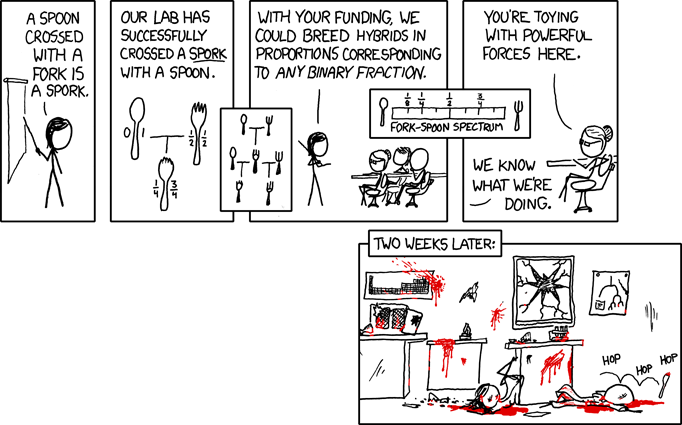
Spork blending: New frontiers

Consider the linguistic implications of this (and click on the image to see a bigger version) …

If you're not disturbed enough yet, just go to the original post and check out the roll-over.

Sunday, May 04, 2008

Simpsons academics

A tailgating party just turned into a riot over this insult on the Simpsons, yelled by football fans at fans from a rival school:
Your tenure track is highly politicized.
Whoa. Do they understand EVERYthing?