Saturday, October 31, 2009

The Halloween Provost

SiftingandWinnowing.org has remained the central forum for discussion of the Grad School / Research reorganization that's been under intense discussion here at Wisconsin in recent weeks. The latest post there is the most important contribution yet to the topic that I've seen anywhere. (To see the low-water mark in coverage, click here.)

Penned by the "Halloween Provost", the piece makes a case that has needed to be made. Namely, the provost has — and this seems bizarre to me — said at the town halls basically, 'well, if you don't like my plan, why don't you provide an alternative'. The Halloween Provost does. And it surely sounds way better than the non-Halloween Provost's to me.

The time and effort already expended on this ill-conceived and poorly defined proposal has taken us a long way down the wrong road. A lot of us fervently hope that the chancellor will take charge of things and get the discussion back on course — for instance, along the lines suggested by the Halloween Provost.

Image from here.

Thursday, October 22, 2009

Lou Dobbs available in Spanish?

OK, sure, there ARE reasons this would happen, but Lou Dobbs' show, the best known forum for anti-immigrant and pro-English vitriol, is now being broadcast in Spanish?

The irony meter on my computer is now broken beyond repair. Do you know how expensive those are?

Sunday, October 18, 2009

Wall Street Journal on collective bargaining at UW

My god. Look at this.

Wisconsin legends: slice of cheddar on your apple pie

When I moved to Wisconsin long ago, I was told repeatedly and with conviction by generally informed people that Wisconsin state law requires offering a slice of cheese with apple pie. Here's a little story debunking that. It had surely never occurred to me that people would eat cheese with apple pie until I came here, but they really do. (I've had it but feel no need to do it again.)

Image from here.

Saturday, October 17, 2009

Speech rates in the news: Intra-Scandinavian differences

There's a long tradition of interest in whether certain languages or dialects are spoken faster than others. Here's probably the classic and highly accessible reference on the topic:*

Roach, Peter. 1998. Myth 18: Some languages are spoken more quickly than others. L. Bauer & P. Trudgill (eds.), Language Myths. London: Penguin. 150–158.

Now, a set of news reports from Scandinavia are covering a dissertation by Anja Schüppert (Groningen, the Netherlands)  showing that Danes speak far faster than Swedes. (See here for a Danish report and here for a Norwegian one — and the national perspective may differ more than the language!) The dissertation apparently finds that the difference is massive, 25-40%. I haven't tracked down the book yet, and the reports aren't too explicit, so I don't know exactly what was measured or how, but that's beyond other reports of such differences that I'm aware of. One of the interesting points (noted in the Danish report) is a possible correlations with Danish children learning to speak later than Swedish children. Gotta track down this one.

HT to LA, and that's not a city in SoCal.

*Probably as part of the "don't take us too seriously" atmosphere on this blog, we don't normally plug our own scholarship but I've been part of some work on this topic too:
Jacewicz, E., R. Allen Fox & J. Salmons. 2009. Articulation rate across dialect, gender and age. Language Variation & Change 21.233-256.

The Brain's language

From here:
The Brain's Language and Its Politics - An Afternoon with George Lakoff

Friday, Oct 30 3:00p at MLK Jr. Library, San Jose,CA
"We now have a detailed theory of how ideas and language arise from the physical brain. That theory, applied to American politics, explains a great deal about contemporary political disputes."
This lecture will explore the new Neural Linguistics & how it applies to our political life.

Price: Free Age Suitability: Teens and up
Tags: politics,linguistics, brain, lakoff

"We now have a detailed theory of how ideas and language arise from the physical brain. That theory, applied to American politics, explains a great deal about contemporary political disputes."
This lecture will explore the new Neural Linguistics & how it applies to our political life.
Lecture & discussion followed by book signing.
Sponsored by Linguistic & Language Development Student Association. Funded in part by SJSU Associated Students.
I'd be plenty happy with a 'detailed theory of how ideas and language raise from the physical brain'. Application to politics is all gravy. In case anybody is in SF and happens to make this, we'd really appreciate a report. (Just to be clear: No snark intended, I would be very curious what Lakoff's current big picture looks like … these are dizzyingly big claims.)

Image from here.

Friday, October 16, 2009

Coastie update

Coastie, the term used at UW–Madison for a variety of out-of-state students (not just from areas with ocean coasts), bubbles on, it seems. There's now a wikipedia entry (here), and here's the musical, or at least the song (noted here and elsewhere in the recent local media), by Quincy & Beef:


One of the lingering questions has been the connection of 'coastie' specifically to Jewish students. I think the Wisconsin Englishes folks have pretty much decided that the connection is real, and this video seems to remove doubt about that. (That still leaves questions about the exact nature of the connection, but that's a post for another day.)

HT to TP, who is back among the living after a bout of the swine. And to ER too.

Thursday, October 15, 2009

Social networking humor

One of my favorite sources of dark humor is Despair.com. Click to enlarge.


If that's not your cup of tea, how about this:


Wednesday, October 14, 2009

Wisconsin's Grad School 'reorganization': The value of planning

We've mentioned the massive proposal for restructuring how research is administered at the University of Wisconsin – Madison (and Sifting and Winnowing remains the go-to site, but see here too). This would disconnect research admin from grad education and put the former under the provost's control A dramatic change to one of the most successful research operations in the country, and arguably the world, in higher ed.

If readers from UW have visited one of the town hall forums with the provost, you may have been struck, like so many of us, by the vague justifications and lack of examples at every turn. The question of exactly what problem this move would solve has gotten no real answer.

Normally, when something like this comes down, there's a detailed report laying out the issues with plenty of examples and arguing clearly for the new structure. In this case, there seems to be literally nothing. We can gripe about 'another taskforce' or 'one more committee', but the failure to prepare a careful and explicit case for this reorganization is just stunning. And this shoot-now, ask-later approach has shaken the confidence of many faculty and staff.

Tuesday, October 13, 2009

"Famed anarchist Chomsky"

So begins this headline from the University Observer Online (Dublin). Well, yeah, Chomsky's famed for sure, and he's an anarchist. And he's a famed anarchist, though that's not the first characterization many of us would reach for, even in a political context.

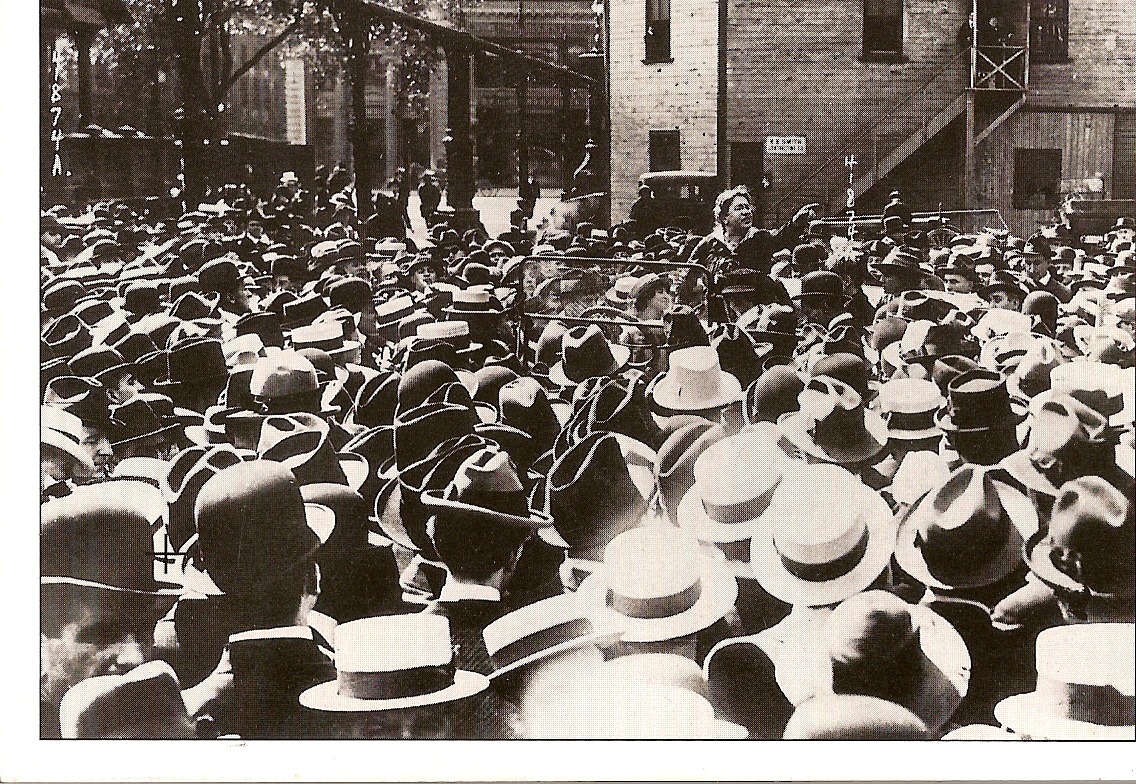
Seeing the headline set me to wondering: Who is the prototypical "famed anarchist"? Google, and you can some hits on Koroptkin, Lucy Parsons, Gertie Voss, and other historical figures you may know. By far and away the most hits are for the person in the picture (click to enlarge): Emma Goldman.

Image from here.

Sunday, October 11, 2009

Free-floating neurons: Linguistics professors and philologists say the darnedest things

It's sometimes humorous and often alarming to see how information about language and linguistics gets presented in the media — a familiar fact and one that drives much linguistic blogging, here and elsewhere.

In a piece called "We've entered linguistic tangle" for the Amarillo Globe-News, John Freivalds runs through a set of cliches, starting with good old "Press '1' for English; press '2' for Spanish" to rail against the use of languages other than English in education and the public sphere, etc. Conclusion: It's all about 'liberal guilt'.

But he actually quotes a linguist, or tries to, or claims to:
A linguistics professor once explained to me that before puberty children have "free floating neurons" in the brain. This enables them to learn numerous languages and to do so without an accent. If someone learns another language after puberty, they will always have an accent.
I'm not sure what free-floating neurons are. I checked with a cognitive science-oriented colleague who had the same reaction I did, namely that this was a mangled reference to the critical period hypothesis, with 'free-floating' referring to plasticity. In checking around, I found that Freivalds had published a similar version of this point earlier (in TranslationDirectory.com but yet earlier in a Roanoke, Va. newspaper):
Philologists tell us that we have “free-floating neurons” in our brain before puberty that enable us to learn an "infinite" number of languages.
Wow, what a tangle we've entered. Philology, in Merriam-Webster's 11th, is:
1: the study of literature and of disciplines relevant to literature or to language as used in literature
2 a: LINGUISTICS; especially: historical and comparative linguistics b: the study of human speech especially as the vehicle of literature and as a field of study that sheds light on cultural history.
It is occasionally used as a synonym for 'linguistics' and that's what we have here, the broadest of M-W's set. But please don't trust any self-identified philologist to explain cognitive science. Then we've got the free-floating neurons again. And this time it's an infinite number of languages we can learn. (I assume the quotation marks around 'infinite' are for emphasis.) Wow, a world with an infinite number of languages. Linguistics would be a serious challenge then.

It's that last point that caught my attention: What's the actual limit on how many languages a kid could acquire? Is the boundary set by how much input the little bugger could get? Even assuming poverty of stimulus, you have to have a lot of exposure to a language to learn it, at any age.

Image from here.

New word alert: to thorbjorn

OK, this one probably won't stick, but it's kinda cute. Yoni Brenner's piece in the NYT this morning puts a coinage in Obama's mouth:
You know, two months ago, when Thorbjorn Jagland announced that I had been awarded the Nobel Peace Prize, I said that I was “humbled.” Today I have several other words: “Baffled.” “Incredulous.” “Slightly-very-irritated.”

But ultimately, conventional adjectives fail to convey the powerful rush of emotions one experiences at receiving such a surprising and politically tone-deaf honor. And so I have invented a new word: it’s called “thorbjorn.” As in, “Wow, those Scandinavians completely thorbjorned my hard-earned political capital.” I know, it’s not the best name.
We could use a few new Norwegian loanwords. I mean, lutefisk works for us up here in the Upper Midwest, but ...

Saturday, October 10, 2009

Happy Cassidy Day!

Well, it's October 10 again. Frederic Cassidy was born on this day 102 years ago. As the Dictionary of American Regional English (DARE) draws close to 'Z', Cassidy's legacy and the importance of DARE are greater than ever, especially here at the University of Wisconsin.

I'm amazed at how often DARE figures in discussions of all sorts, often far from lexicography and dialectology. I picked up some Jamaican rum this week to be able to raise a glass in honor of him and the project tonight.

Friday, October 09, 2009

Verner's Law, the movie

Check this* out:


It was done by Ari Hoptman and filmed at the University of Minnesota. Hoptman is clearly a genius of grand proportions. (He also shares a favorite Old High German word with a couple folks around here, sunufatarungo.)

*One of our contributors got this from a student — now there's somebody with a future in this business.

Tip of the 19th c. Danish hat (whatever the heck they wore) to KMC (whoever the heck that may be).

Thursday, October 08, 2009

War on science over, clueless foot soldier fights on ...

Someone just passed me a message including this:
Help Save Political Science Research Funding within NSF
On October 7, Senator Tom Coburn (R-OK) proposed Amendment 2631 to the Commerce, Justice, Science, and Related Agencies Appropriations Act, 2010 (HR 2847). The amendment seeks to eliminate research funding for political science programs within the National Science Foundation (NSF). The spending bill is currently on the Senate floor. A vote on the amendment could take place today or early next week. The American Political Science Association posted an online petition, asking Senators to block the Coburn Amendment, here.
You can go here for some additional discussion. As someone unconnected to NSF funding for Political Science, I say sign the petition. Wait, change that: As a citizen of the country who thinks understanding how the system works is a good thing, I say sign the petition.

Image from here.

Wednesday, October 07, 2009

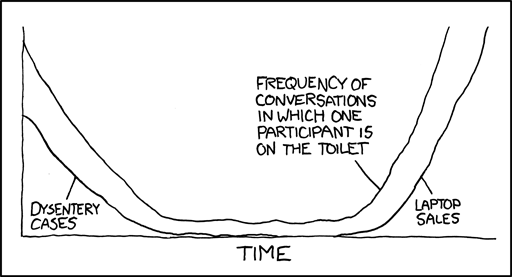
Quantitative approaches to the study of discourse, plus bonus randomness

Forgive us for constantly posting xkcd stuff, but man, it's just freakin' brilliant.


In further randomness, last night I heard a seriously inebriated reference to the classic Milwaukee punk band Die Kreuzen (click here for details). As the link shows, while the first element is quite often pronounced like English to die (rather than German [di:]) the preferred pronunciation of Kreuzen is German-like: with the diphthong of 'boy' and the produced as [ts].

The name is class punk: It's fake German — it's 'the crosses', except that the German plural would be Kreuze. I don't know if they got it from a dative plural form (which has an -n) or just took the wrong plural allomorph, but the plural is too big. The guy I couldn't help overhearing — let's call him Mr. Sloppy — was going on and on about various great shows of bygone days, including one by this band. Thing is, he called them Die Kreuzens. I know enough cases of double plural forms, but this is at least historically a triple. Whoa.

Sunday, October 04, 2009

New early runic inscription from Hogganvik, Norway: ek naudigastir


Just found out within the last hour that a very large Runic inscription has been found in Norway. It's from ca. 400 C.E. If so, that makes it a very old inscription and it's clearly one of the longest in the Elder Futhark, that is, the early form of the alphabet. The go-to source here looks like this blog (source of this picture too) for those who read Norwegian.

The inscription isn't very clear from the pictures (and Arkeologi i nord has a lot of them), but it apparently starts out eknaudigastir ... "I Naudigastir ...'. It's silly to speculate about even the meaning of the name (though I'm sorely tempted and can't stop my brain from trying). I don't think the morpheme naudi- is attested in other early inscriptions, for instance, though it's very familiar from Old Norse.

Here's hoping we'll soon know more.

A tip of the plastic horned viking helmet to RH.

Saturday, October 03, 2009

Irony, the bad kind: Freedom without walls

There's a big glossy campaign going on now from Germany celebrating the anniversary of the fall of the Berlin wall, called "Freedom without Walls". The Department of German at the University of Wisconsin has put up a huge poster on a big frame and there's a pile of trinkets, all in this garish pink and black (from here).


I first learned of the campaign when I checked my mailbox in the department and found an ink pen there. A single photo doesn't capture what I saw when I looked at it, so it's here in two, crucially ordered:


I thought it was some brutal political joke until I realized that the 'Made in China' was on the plastic wrapper.

Thursday, October 01, 2009

An old friend returns: Sifting and Winnowing is back

I haven't said much about university matters here at UW lately, but there's a ton going on. Happily, the blog Sifting and Winnowing is back up and running, here. The current posts are about the critical issue of the proposed restructuring of the Graduate School, an important part of our traditional success here in Wisconsin. If you're at UW–Madison, you should read these posts.