Tuesday, June 30, 2009

Scholarly communication: Listservs, blogs and who knows what all

Over at the Chronicle of Higher Education, Jeffrey Young has a nice piece called:
COLLEGE 2.0
Change or Die: Scholarly E-Mail Lists, Once Vibrant, Fight for Relevance
It's behind a paywall (click here if you have access), so here's the opening paragraph:
Once they were hosts to lively discussions about academic style and substance, but the time of scholarly e-mail lists has passed, meaningful posts slowing to a trickle as professors migrate to blogs, wikis, Twitter, and social networks like Facebook.
Let's start from the history. Now, I know all you young kids have only heard the stories of such halcyon days of yore, if I may use an expression common back in those times. As an early subscriber to LINGUIST, H-Net networks (for historians) and other lists, I recall it being pretty different. First, there was the issue of whether these were valuable tools or a massive waste of time since only print stuff (books, articles) counts, etc. But there was a heyday of a few years where discussion really bubbled. You could post a query to LINGUIST asking for examples of some linguistic phenomenon and quickly get a set of detailed responses (on or off the list), often from the leading specialists in the world. You could also get flamed publicly by jerks, famous or not, and those flames of course could be dead wrong.

What's happened? Well, as the article goes on to argue, specifically with LINGUIST and H-Net as examples, these folks have developed clearly defined roles in their communities. For H-Net it's the book reviews and LINGUIST is really one-stop shopping for information on languages and linguistics. Young describes LINGUIST as possibly "the largest single academic mailing list out there". Go linguists, go LINGUIST!

What gets me here is the either/or mindset of the title (and the image above) … when we get a new tool, like fMRI, it's kinda dumb to abandon all previous tools for that one. We're doing with scholarly communication what we do with our technical resources: We try to find the places they're most useful for and deploy them there.

Blogs seem better than lists for rambling thoughts and screeds, so in some sense may represent an evolution of flaming. But they are not a replacement for scholarly publishing, surely, although at least one local academic blogger is apparently arguing that line. You gotta use all the tools that make sense. Where does it stop making sense? The line for me falls just before Twitter: Over thousands of years, we've developed easier, quicker ways to record and transmit information. Clay tablets and parchments were pretty slow and expensive, printing on paper quicker and cheaper, and electronic communication even slicker. We can say as much as we need (or want, sadly) and get it out instantly.

But Twitter? From Young's piece again:
"In the last month, i unsubscribed from 4 academic lists," wrote David Silver, a professor of media studies at the University of San Francisco, abbreviating his comment to stay within Twitter's 140-character limit on all messages. "Thru other means, mostly Twitter, don't feel like i'm missing much."

"I find that I almost hate e-mail now," wrote Kimberly Gibson, an instructional designer at Our Lady of the Lake University. "It feels so slow and outdated. Thus, I'm not really reading my scholarly lists anymore."

Can you really get the info you need from 140-character chunks? That's the equivalent of a whispered comment to your neighbor at a conference talk, not scholarly discussion. Beyond chit-chat, that might make for art or humor, but to abandon lists for this? Are these folks who've also abandoned reading stuff printed on 'paper'? I know I'm missing something here, but not sure what.

Image from here, with interesting and relevant discussion of this issue from a non-academic perspective.

Monday, June 29, 2009

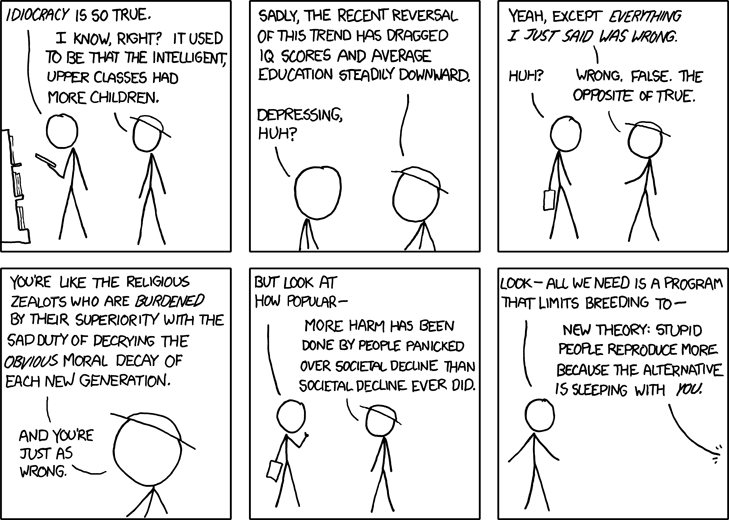
The Peevologist Idiocracy?

One of the most stunningly stupid popular narratives about language is that it's declining steadily. You know the lines: English is being destroyed by young people not using 'whom' or by them using 'like' (as in 'she was all like ...). This clearly parallels the general Decline of Civilization narrative. xkcd has this beautiful piece playing off of that by way of Idiocracy. Just look at panels 3 and 4 and substitute 'language', 'grammar', etc. for 'religious', 'moral', 'society', etc.

Thursday, June 25, 2009

RezWorld: A new tool for language learning

Mr. V's last post took us back to literally the earliest known Cherokee text written in Sequoyah's syllabary. I passed that link on to some folks, and was rewarded with a link to what's probably the newest tool for Native language learning — RezWorld. It's described "the first fully-immersive 3-D Video Game that teaches Native languages." Check out the video.

The prototype shown in the video is, as it happens, in Cherokee, and the idea is that it can be adapted not only to any language, but also the appropriate community and cultural context. It's got a nice feel to it, low-key and with humor. And yes, there is a shot of the syllabary in there.

Of course this won't magically get kids speaking their community's language instantly, but it's another tool for revitalization, and probably one that will reach some effectively. It looks pretty cool.

And you should read the story of how the project came about, here.

Wednesday, June 24, 2009

Really exciting philology: Cherokee alphabet

The NYT's Science Times can go weeks without anything very interesting for linguists and then have a few pieces at once. I was happy to see the piece yesterday on human audition, with some attention to the role that hearing may have played in the evolution of language. It's actually far more important for linguistics, as the comments from Shihab Shamma reflect. (Yes, you need to read the piece.)

But I was pleased to see a big piece on the history of the Cherokee alphabet, by John Noble Wilford. The story has been out for a while (if not in the big media that I know of) about the discovery of remarkably old carvings in a cave in Kentucky in the syllabary developed by Sequoyah for Cherokee. The best thing about the article is the on-line image by Fred Coy and Andras Nagy.

The real news is that there's a date with the carving that reads either '1808' or '1818'. Some sources, like Campbell's Handbook of Scripts and Alphabets, give a date of 1819-1820 for the script's invention, so that's been pushed back. Particularly exciting of course is the possibility that Sequoyah himself wrote this and the article lays out his connections to the area, to visiting caves while working on the syllabary, etc.

Here's a really intriguing comment from the archaeologist who made the discovery, Kenneth B. Tankersley:
He said that he was investigating possible links between the traditional glyphs and a few of the symbols in Sequoyah’s script. If a link can be established, he added, the inscription may be “our Rosetta stone, enabling us to see where prehistory meets history.”
Now, there's some exciting philology.

Friday, June 19, 2009

Pragmatics in the news: "70% of praise sarcastic" — The Onion

Literal storm clouds are gathering here in Madison (when will this end?) but it's a bright, sunshiny day for linguistic humor. First, check out this from the Onion:

Report: 70 Percent Of All Praise Sarcastic

And, yeah, they even use the phrase "linguistic researchers".

Second, for science humor that matches our current weather in southern Wisconsin, check this out. (You gotta admire the truly relentless pursuit of a lower Erdős number, eh?)

Thursday, June 18, 2009

Stupid? You want stupid? Let's talk furloughs.

Yup, we got your stupid right here, in a big steaming pile.

As I pointed out earlier, Wisconsin is going to furlough essentially all university employees for 8 days a year for the next two years. For faculty and many academic staff, it's a pure pay cut — our work loads won't change a whit, and we'll get 3-4% less pay.

The bizarre thing is that this applies also to people who earn no state money — an army of people funded on grants and gifts. UW will lose the work of many of them, the state will lose the tax on their income and — and here's your extra-crispy nugget of idiocy — we will lose a bunch of grant money. For many federal grants, budgets can be shuffled or money can be rolled over into next year. But on a whole set, PIs cannot do that. Such money, presumably, will be handed back to the federal government, private agency or donor. This isn't hypothetical; I know top-flight professionals who are funded entirely on such grants.

That's a lot of downside. Is there any actual upside?

To paraphrase Joan Hall on Whad'ya know?* last week, the people doing this are so stupid that they couldn't pour piss out of a boot if it had a hole in the toe and instructions on the heel.

*Not much.

Image from here — where there's plenty of stupid to go around.

Wednesday, June 17, 2009

FT on Alan Sugar's 'you was' — more good language journalism!?!

The Financial Times yesterday ran a piece by Michael Skapinker called
You say 'you was' and I say 'you were'
It's about Alan Sugar, appointed to be "enterprise champion" by Gordon Brown, and known to many Americans I think as the host of the British version of "The Apprentice". Sugar apparently uttered this sentence on the show:
It seems you was a prophet …
Now this guy is not merely a Brit, but a guy called "Sir" and now "Lord". Skapinker lays out the long and glorious history of second person plural was around the world, and draws heavily on a paper that just appeared:
Jenny Cheshire and Sue Fox. "Was/were variation: A perspective from London." Language Variation and Change, 21:1-38.
Skapinker goes on to give the basic sociolinguistic story of the article:

"You was" appears, too, in the south-west of England, East Anglia and in Sir Alan's native east London. The academics' study of east London threw up interesting patterns.

They looked at an outer London suburb and an inner city district. The outer London suburb was 95 per cent white. The inner London area was 44 per cent white. Children at the local schools spoke 26 languages.

In the inner London area, most of the elderly residents said "you was". The elderly outer London speakers, many with roots in the inner city, said "you were". Among the young, it was the other way around. Adolescents in outer London were more likely to say "you was" than those in the inner city.

And here is the twist. The inner city youth most likely to opt for "you were" were young Bangladeshis. Why? The Queen Mary researchers thought it might be because many arrived at school unable to speak English. They also went to schools that were almost entirely Bangladeshi, where their Anglophone teachers taught them "you were" rather than "you was".

Good, you may think. At least this generation of immigrants' children is learning to speak correctly. But there is no single standard of correct grammar. "You were" would be as much of a howler in some (non-Bangladeshi) parts of east London as "you was" would be in this newspaper.

Kudos, Michael Skapinker.

H.T. to S.M.

Sunday, June 14, 2009

A bit of good language reporting: NYT on 'millioneth word'

Having Joan Hall starring on Whad'ya know? and being featured on NPR's Weekend Edition within 24 hours was great, but it's an even better weekend in language coverage for the American media: This piece in today's NYT, appropriately called "Keeping It Real on Dictionary Row", gut pseudo-issue of English getting its millioneth word. Despite a couple of emails from readers, I've steadfastly ignored the issue, mostly because the Log has had the issue nailed from the get-go. In fact, Jennifer Schuessler, the author, gives a lot of ink to familiar figures like the Log's Geoff Nunberg and John McWhorter, as well as Grant Barrett, a leading lexicographer.

By contrast, CNN is running a comparatively weak item on the topic — it leads with the myth and takes a while to debunk it, though they do go to serious people for commentary.

You go, Gray Lady. Or however the kids would say that these days.

Saturday, June 13, 2009

DARE's Joan Hall on Whad'ya know!

Michael Feldman will be featuring Joan Hall, Chief Editor of the Dictionary of American Regional English, on Whad'Ya Know? this morning. (The url is easy to remember: http://www.notmuch.com/.) It's on at 10:00 local time, and they post the show within a day or two at notmuch.com.

The great Frederic Cassidy was on years ago, and a couple of the Wisconsin Englishes Project guys were on a few years back (audio available here).

Friday, June 12, 2009

Tina Fey on Sarah Palin's crazy voice

This was over on ADS-L, in case you missed it:


Rumor has it that a very good sociolinguist/dialectologist is working on a paper about Fey's Palin. And I've mentioned that our Wisconsin Englishes guys have an article coming soon on Palin's speech. Stay tuned.

Wisconsin Englishes podcasts resume!

After a very long hiatus, the Wisconsin Englishes Project is again posting podcasts, here.

The latest are these:
  • one with Matt Bauer on how mergers — like the Low/Back Merger, the loss of distinction between cot and caught — work in sound change. Or rather, it's maybe more about how they don't really work like people think.
  • one with Pete Morton, British folksinger, interviewed by linguist Jonathan Roper from the University of Leeds. It's brilliant, must-hear material. If you're wondering why the Wisconsin Englishes Project is doing British dialects, ask the WEP guys, not me!
Rumor has it that another set is coming soon …

Wednesday, June 10, 2009

Mixtec Radio

As a former Mixtecanist (or is it 'once a Mixtecanist, always a Mixtecanist'?), I was happy to read the article in the NYT yesterday on a radio station in Fresno that has started a show called "La Hora Mixteca" ("the Mixtec Hour").  Many things made me happy - just that there is such a show, for one.  I was also happy to read this:  "pronounced MEESE-teck" - I have been on a one-woman crusade for almost three decades now to get English speakers to say it that way instead of the hyper-foreign MEESH-teck.  (Quick explanation:  many placenames in Mexico that have an "x" in them are in fact pronounced with "sh," but this is due to the Nahuatl origin of such words, and since Mixtec isn't Nahuatl, it doesn't make sense to do the same.  Plus in Spanish the "x" in this word is an [s] - you say "mees-TECK-o" for Mixteco, so why palatalize the [s] in English???)  Well, it's been a losing battle among linguists, but it's fun to see the NYT get something right for a change.

The article did leave me wondering about one thing - Mixtec is one of those "languages" that is really a giant language family, filled with mutually unintelligble varieties misleadingly called "dialects."  It's the classic dialect continuum problem, though - there's no answer for where to draw the line for where one dialect stops and another starts.  Oh, instead of plagiarizing from my grammar of Chalcatongo Mixtec, I'll just quote:  
Ravicz (1965:40) proposes one interesting way to measure dialect boundaries in the area, días de distancia ('days of distance'):  "... A person who is two days' walk from their town can communicate easily; however, a distance of three days will hinder understanding to a certain extent.  If this person is four or five days from their town, they can hardly depend on sufficient common elements to establish communication, and Spanish will serve them better" [my translation].
So, having said all that, I wonder what dialect of Mixtec they use on la Hora Mixteca?  Are the listeners in the Fresno area from the same dialect area, so that they can just use one and be understood by everybody?  Or is a sort of standard developing that many can understand, even if it's not their native dialect?

Will keep you posted if I find out any answers.

Monday, June 08, 2009

Literary analysis and Stanley Fish

The Log seems to be headed toward a series on quantifying presidential pronominal patterns. This post is just a footnote to the latest …

It started with Fact-checking George Will, where Mark Liberman shows pretty clearly that Will is making up crap about Obama, namely that the Prez likes the first person singular pronoun, pretty clearly intended as a swipe at Our Nation's Leader. Now Stanley Fish has gone down the same path and been nailed by Liberman for the same claim. But Fish isn't taking a quick swipe at Obama in "Yes I can", he's developing (as Liberman suggests) a literary/cultural studies analysis of Obama as "uppity" and "arrogant".* Fish makes a set of references to rhetoric and writes in a style familiar from literary and cultural critics, i.e. contemporary humanities scholars. And Fish is willing to draw bold conclusions based on his analysis:
No doubt this pattern of pronouns reflects a reality.
The first problem is that the supposed empirical foundation for the analysis is flawed or missing. This, as a commenter on the Log hints, may not bother Fish, given his relationship to 'facts'. But can somebody explain what it does tell us about a speaker's attitude, intention, etc., if they use lots of first-person singular pronouns?

By the way, what's Fish, of all people, doing telling us about reality?

* Those are what strike me as Liberman's very apt terms, but you can read Fish for yourself. He talks about Obama's "self-promotion", "naked I", and compares him to "Michael Corleone, who begins the film as a young idealistic patriot, ends it by striking the pose of a Roman emperor as subordinates kiss his ring".

Image from here.

Sunday, June 07, 2009

"Gone missing" gone wild

Over on ADS-L, there's a big thread rolling about the supposed current popularity of gone/went missing.

The view of one of the loudest peevologists around — and author of a dictionary specifically for dimwits (see image) — has now appeared there:
"Gone" or "went" missing is dreadfully popular today. Everyone from reporters on "CNN" to detectives (or their writers) on "Without a Trace" now prefer it.

People are so dull-witted and impressionable that, today, in this country, the popularity of "gone" or "went missing" has soared. Words like "disappeared," "vanished," "misplaced," "stolen," "lost," "deserted," "absconded" are seldom heard today because "went missing" has less meaning, or less exact meaning, than any of them, and people, especially the media, perhaps, are afraid of expressing meaning. What's more, "went missing" sounds willful or deliberate, and, indeed, sometimes that connotation is accurate, but the child who has been kidnapped is hardly agreeable to having been so.

From "Silence, Language, & Society" by Robert Hartwell Fiske
Wow, those words are dying out because of gone/went missing? Hard to believe. And amazing that Fiske made a claim that can be checked empirically. I just ran a quick QueryGoogle word count and found this:

Now, that isn't controlled for date and it doesn't filter out references to the TV show Lost (surely 600,000,000 hits), but getting about 750 million hits for the words Fiske thinks are "seldom heard" and just over 2.5 for the marauding gone/went missing doesn't look promising.

A quick and dirty Google advanced search for the missing forms limited to the last month shows 42,700 g-hits, while disappeared is at 1,160,000 for the same period and vanished at 335,000. In both cases, the ratio of gone/went missing is lower over the last month than in the general Google search. For instance, overall, disappeared is roughly 20x more common than gone/went missing and in the last month it's almost 30x more common. Gone/went missing may be in the process of going missing.

I don't have time for a closer look right now, but it would be easy enough to run this with somewhat cleaned up data from the Corpus of Contemporary American English over the last couple of decades and see how the numbers look there. I bet it's the same as we see here.

Maybe it's not "the people" who are "dull-witted and impressionable" here.

Friday, June 05, 2009

Voynich humor

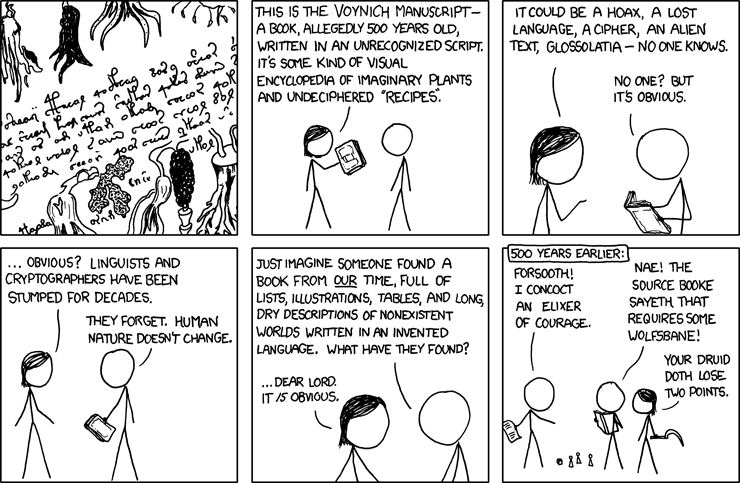
The stuff that non-linguists ask linguists when finding out what we do covers a broad span. If you're a historical linguist, like a bunch of linguists here in Madison, one tidbit you get regularly is something about the Voynich manuscript, sample page from Wikipedia Commons shown on the right (click for larger image, of course). A basic introduction can be found here, but it has shown up in Scientific American and such and the Log has posted on it occasionally.

The story is pretty simple: It's a pretty big book and pretty old (15th c. C.E.?) in an unknown script that nobody has been able to decipher. Tons of effort has gone into it to no avail. When people ask me about it, I tell them basically that — we just don't know if it's a hoax, an invented alphabet to write an Asian language or a rendering of some European language. We just don't know. This is terribly unsatisfying to people who've read about it, but that's just how it is. Your average working historical linguist might find it a mystery wrapped into an enigma. That doesn't mean they'll stop working on projects that have a good likelihood of success to toy with this.

Anyway, today's kcxd presents a new theory on the manuscript:

For once, by the way, I won't urge you to check out the rollover.

Thursday, June 04, 2009

NEH news

You've probably read by now that President Obama has nominated former Republican representative Jim Leach of Iowa, now visiting professor at Princeton, to chair the National Endowment for the Humanities. (Here's one news story, but everybody's running something, it looks like.) This matters since they do support linguistics research.

The big humanities groups are sounding positive about this (quoting Andrew Mytelka in the Chronicle of Higher Ed, which lives behind a pay wall):
The National Humanities Alliance, an advocacy group, issued a statement this afternoon that greeted Mr. Leach’s nomination with “warm enthusiasm.” In a separate statement, Robert M. Berdahl, president of the Association of American Universities, expressed “strong support” for the nomination. And Pauline Yu, president of the American Council of Learned Societies, hailed the announcement as “great news!”
There are some opportunities in this, I hope. First, any time you step into a job that was held by an ineffective person, you've got a shot to improve things, and Leach would follow Bruce Cole, a guy with a really big 'L' on his forehead. (And some people figure Lynne Cheney likes to jerk hard on that chokechain Cole wears.) Second, Leach was a founder of the Congressional Humanities Caucus, intended to protect the NEH from political attacks way back when.* So, Leach is a friend of the humanities, at least. Third, from what I know, he's somebody who has been concerned with process and ethics and that can't be bad.

It's a surprising choice: He's not a humanities person in the usual sense — best known for his work in international policy, I think. The only quote I've seen from him so far mentions 'history', not anything broader about the humanities. People do talk about him as 'scholarly', and in looking through stuff he's written, he does quote Yeats, too. Does that help?

This isn't the appointment some humanities people were expecting, but here's hoping that we'll see the NEH become a more viable agency.

* By the way, that's a bipartisan group, most recently urging (in a 'dear colleague' letter) not only increased overall funding but that NEH increase the amount of its funding that goes into peer-reviewed grants. At NSF, that's 26% of their funding; at NEH, only 16% (You can get the details on the NHA's website, here.)

Tuesday, June 02, 2009

LSA ethics statement

Members of the Linguistic Society of America will know that the LSA has been working on an ethics statement for a good while. It's out now, see here, and it's already been picked up in the media, here. As the story makes clear, part of the purpose is to educate Institutional Review Boards about ethical issues in linguistics and how they differ from other fields. A step forward, I think.

Monday, June 01, 2009

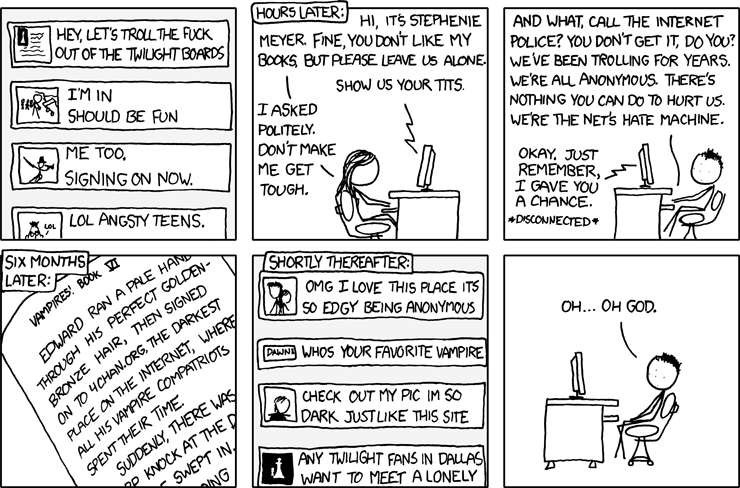
Anonymous comments

Of late, a few bloggers* I know have mentioned experiencing nastiness from anonymous comments on blogs.** We don't have that problem here, for whatever reason. To be clear, I do delete comments (on the last post, in fact), but this is essentially always because they're blogspam of one sort or another.

Still, for those who've been plagued by such demons, check this


Just saying …

*Why, in the name of simple self-interest, does the spellcheck on blogger not recognize bloggers? Or spellcheck?

**Yeah, yeah, anonymous bloggers are worse, yadda yadda. Whatevs.