Wednesday, March 24, 2010

Dead langauge graffitti: U of Chicago students trying to outgeek Wisconsin?

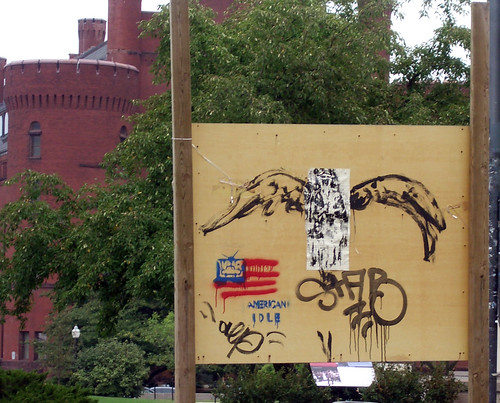
This is cool. A student at Chicago has done a book on local graffiti in the Regenstein Library:
There are still plenty of nerds at the University of Chicago. Dombrowski has come across Reg graffiti written in Arabic ("a lot of it, actually"), Chinese ("a reasonable amount"), German, Turkish, Greek, Russian and Serbian. But that's not the nerdy part, of course. The nerdy part is: the graffiti she has found scrawled in dead languages; the graffiti that use the letters of multiple dead languages; and the graffiti scrawled in hieroglyphics. As with every piece of graffiti she locates, she took a picture of the hieroglyphic graffiti. Then she brought it to an Egyptologist at the university for translation.
Translation: "We did it twice in the morning."
Wisconsin is a modest state — if fish fry and cheeseheads are big things, it's hard to have a big attitude. But come on, Madison students, the gauntlet has been thrown down! We need collections of Madison's most arcane scribblings. How much Old Church Slavonic is there in Memorial? I know there's German graffiti all around. There MUST be Gothic. (Legend has it that student used to sing the school song in Gothic.) Who can document Mayan hieroglyphs?

Image from here. It's not the best we have to offer.

Tuesday, March 23, 2010

Droppin' the bomb

The Veep with an f-bomb. Talking Points Memo posted this and it's already linked at Wonkette and elsewhere …


We can rip the audio and do some acoustic analysis if anybody cares, but I can't see this as ambiguous. Besides, I agree with Biden: This IS "a huge fuckin' deal".

Yeah, it's a barely language-related angle, but hey, it's an angle.

Sunday, March 21, 2010

Zimmer on No


The news has been out for quite a while, but this morning the concrete result is available in black and white (see graphic): Ben Zimmer is now at the helm of the NYT's On Language. As you might expect, the title allows a bow to Safire (coiner of 'nattering nabobs of negativism'). There's also a new element as a regular part of the column:
Our new language columnist will answer one reader question every other week. Send your queries to onlanguage@nytimes.com.
Hurrah.

Saturday, March 20, 2010

"Applied language studies" and linguists in language departments

Yesterday, the German and Dutch Graduate Student Association at Wisconsin brought Professor Claire Kramsch to campus as the keynote speaker at their annual conference. Kramsch is a leading applied linguist and teaches at the University of California – Berkeley. Her title managed to move beyond the usual, graphically and syntactically:
e.g., German: Language departments as privileged sites for the study of meaning
The talk itself drew a massive crowd — especially for late on Friday afternoon — and it went beyond the usual in much more fundamental ways. Various members of Team Verb have talked about the MLA report on foreign language departments (do a search of this blog, but maybe start here), which argues for language departments moving in particular beyond the old model of literature-as-the-crowning-glory. Kramsch gave a clear presentation about how instruction can be shaped toward that goal, using the hook of 'meaning'. Particularly good, I think, was her discussion of how language departments need to build strong links outside of the traditional humanities, particularly to the social sciences.

She was speaking most directly to ways to resolve the crisis in language departments, and this is badly needed. In at least a couple of language departments on our campus, there is the mentality that one literary scholar summed up to one of our contributors a couple of years ago:
This department is a literature department. It always has been a literature department and it always will be a literature department.
As it happens, the department in question has a stronger record in non-literary endeavors than in literary and has had for most of its history. The effect of such statements has been to assure non-literary colleagues that they don't belong in that department and really ought to find new homes. As the linguist who was told he didn't belong put it, this mindset will destroy the department if they don't rid themselves of it. Those literary people clearly don't want to re-orient language departments toward applied linguistics, but they are increasingly irrelevant, it seems, and Kramsch is rightly looking for a good way forward.

But Kramsch's line of argument has a far broader implication for those involved in the scientific study of language. We need a very big tent for linguistics. Linguistics, as often noted (very nicely here, for instance), should be a field of the size and importance of psychology, but sectarianism and parochialism have too often stunted our growth.

Think about this, Wisconsin linguists: Just bring together the full range of people working on language across the Madison campus. I don't mean moving them all into a single department, but just affiliating the bulk of them with a department or program, cross-listing courses, promoting student coursework across the full range, coordinating hiring
and sharing resources, etc. Almost no new resources would be needed (maybe a couple of faculty lines) to transform a large chunk of the College of Letters & Science.

There's a lot to be shoveled, but I say let's get to work.

Monday, March 15, 2010

The Halcyon Days of Cameo's Youth?

Nice "On Language" column in the NYT Magazine this past Sunday, by Ammon Shea, titled "Vocabulary Size: It's Not Everything." His first sentence reads, "Trying to convince speakers of English that they need to expand their vocabularies is one of the oldest strategies for selling word books." Then today I got a copy of 1001 Words You Need to Know and Use. (As noted by Mr. V, Oxford UP sometimes sends the minions books for review.) What I liked about that "On Lg" column was the discussion of the promises these books make, so I was curious to see what 1001 Words would promise. Well, the subtitle is "An A-Z of Effective Vocabulary," so I guess it'll make you effective. But the flier that came with it is all focused on getting a job. "So how does one ... compete in this extremely competitive current job market? For starters they can make sure they speak the same language as the people that are most successful." And then the author "takes readers through the most important vocabulary to use in job applications, presentations, CVs, proposals, essays, reports, or any situation in which one needs to be as articulate and professional as possible."

I actually have no problem with this — what the hell — it can't hurt. And it's fun to learn crazy ass new words.

Although ... I opened to a random page and my eye fell on ... "halcyon." A word I only know in the fixed phrase "the halcyon days of my youth." And I learned that "the adjective derives from the noun sense referring to a mythical bird said by ancient writers to breed in a nest floating at sea at the winter solstice, charming the wind and waves into calm." Well. Wikipedia, the source of all truth, explains it a little more thoroughly as part of the myth of Alcyone, which I won't go into, but which you can read about here. And then the coolest part of the entry for "halcyon" (in 1001 Words) is the example: "the halcyon days when profits were soaring."

So who knows. Maybe tomorrow I'll try to use "halcyon" in a memo. Take that, intransigent Deans!

Sunday, March 14, 2010

Morphology Battling Back


Morphology is making a come-back - at least, in the Linguist List subfield challenge. We have now outstripped discourse, phonetics, applied linguistics, history of linguistics, and many other fields. Just a little more and we could beat back the challenge of those johnny-come-lately upstarts, computational linguistics. If you want to help morphology prove its superiority (not to mention its autonomy), donate to the Linguist List's subfield challenge now!!! Go morphology!!!

Saturday, March 13, 2010

The Census: language and ethnicity

The local paper is running a piece this morning called:
Are you ready for the census? | ¿Está usted listo para el censo?
It starts out, appropriately enough, with a note about language:

You can pick from six languages to fill out your census form next week, and assistance will be available whether your mother tongue is Albanian, Bengali, Chinese, Dutch or any of 55 other languages.

… Almost all Wisconsin residences will receive the English version, although bilingual forms are sent to places with high concentrations of Spanish speakers.

Places where census forms are available "will be stocked with additional census forms in English, Chinese, Korean, Spanish, Russian and Vietnamese."

While the results of the census, maybe especially with regard to language, will offer real difficulties of interpretation, people interested in patterns of language use are eager to see the results. Others, though, may not welcome the process or the results.

US English actually has a link indicating that they talk about the issue of census forms in Spanish, but it doesn't really address the point very directly. It simply argues, like all of their stuff, that the government should use English and push immigrants to learn it, but it doesn't directly argue, in the sound clip I heard, that we don't need to gather data from those people who don't know English. They will surely exploit whatever results they can to argue for a need to make English the official language of the country. And right now this is, what, national priority number 8,383,094 these days?

The census is no doubt a bigger deal to the American Racists and Bigots Council (ARBC). According to America's finest news source, The Onion, has a piece in its paper edition (still available free in Madison) called this:
Racial slur development not keeping pace with mixed-race births, nation's bigots report
The ARBC's chairman, Tom Branson, says "The world is changing, and we, the hateful and ignorant of America, need to change with it." The article isn't on-line yet, but it will be. Keep an eye out for it.

While we're at it, the print edition also has a little 'weather' thing on page 1. This week's forecast plays on all the snowmageddon and snowpocalypse stuff: "Snowvalanch warning." Could we add some Homeric infixation and have a snowvamalanch?

Thursday, March 11, 2010

Not a LINGUIST list choice: Lexicography

Actually, if I could have, I would have voted for lexicography as my favorite, but it wasn't an option in the challenge. There isn't much opportunity to study it in the U.S. There is a course here and there - e.g. Univ. of Georgia, Univ. of South Dakota - and England has some courses, in a degree program or just as training. But there are organizations and societies. Check out the Dictionary Society of North America, meeting next year in Montreal. Euralex is meeting this year in Leeuwarden, the Netherlands, July 6-10. And the Fifth International Conference on Historical Lexicography and Lexicology will be held at St Anne's College, Oxford, 16-18 June 2010; the conference will mark the tenth anniversary of OED Online.

You can trace the words newly entered or newly revised in the Oxford English Dictionary under the Quarterly Updates - revisions and new words. Notes on OED's December 2009 release of new words (there should be another update this month) tells us, for example, that one of the words just entered is blogosphere - it even tells us why it was added to the Dictionary.

For us, it's all about the words.

LINGUIST list challenge

Hey, Joe, I love language change, too -- that's why my support would have to be behind sociolinguistics.

And speaking of that, check out the following (from the ACLS website):
The American Council of Learned Societies is pleased to announce the publication of the 2009 Charles Homer Haskins Prize Lecture by William Labov. Entitled “A Life of Learning: Six People I Have Learned From,” the lecture is distinctive in both form and content. Dr. Labov, professor of linguistics and director of the Linguistics Laboratory at the University of Pennsylvania, presents the voices and stories of six Americans who have enriched and transformed the English language. The lecture is presented in text with audio highlights at http://www.acls.org/publications/audio/labov/default.aspx?id=4462. An audio file of the complete lecture is also available.

In case you aren't familiar with the Haskins lectures:
Named for the first chairman of ACLS, the Charles Homer Haskins Prize Lecture has as its theme "A Life of Learning." The lecturer is asked “to reflect on a lifetime of work as a scholar and an institution builder, on the motives, the chance determinations, the satisfactions (and dissatisfactions) of the life of learning, to explore through one’s own life the larger, institutional life of scholarship.”

Labov's lecture is great.

LINGUIST list challenge ... help historical linguistics!

If you read this blog, you almost surely use the LINGUIST list too. They are celebrating their 20th anniversary of serving our field — and anybody with internet access who has any vague or passing interest in language.

More immediately, they've embarked on a big fund drive to support their operations. This year, they're doing a Linguistic Subfield Challenge. Here's the current subfield snaphot:


Me, I'm a historical guy, and therefore deeply disturbed to see that we're lagging behind both syntax (now in the lead) and language acquisition. If you love language change, or reconstruction or dead languages, please help us boost our totals. Sure, phonology's just fine and I like morphology too, but we have to win this.

Please donate! And go, historical, go!

Why do accents trump skin color?

Scientific American has published a piece on work by Katherine Kinzler and colleagues showing evidence that kids, when presented with pictures/voices of other kids, identify the ones they would like to be friends with more by accent / language (namely, speaking English 'with a native accent') than by 'race'. That's not very surprising, I'd say.

A cliche has developed around here about articles in places like Nature, Science and PNAS — a view forged by people who haven't published in any of those places, I think — that the deal is that you have to do serious (or serious-looking) science up to the very end of the article and then you can go wild with speculation about broader ramifications that are highly improbable. This is being called the "Last Five Lines" principle.

So too, it seems, here. Here's the last paragraph:
Why was accent more important than race? “Race, as a psychological category, may be relatively modern in terms of human evolution,” explains Kinzler, now at the University of Chicago. In prehistoric times, “a neighboring group might have sounded different even if they did not look different,” she says. Preference for our own race might have developed later, after the more ancient preference for our own accent. The next step is to see whether living in bilingual or multilingual countries might change this early inclination.
I would have figured that kids just generally prefer the familiar to the unfamiliar, and that socialization of even relatively young kids has clued them in about who to hang out with. If so, going for deep evolutionary explanations is a massive stretch. I guess this is less surprising from Scientific American than the big general science outlets.

The most interesting followup might be not with 'foreign' accents, but rather with regional ones. Would you get the same results with Wisconsin, Alabama, Massachusetts, and so on?

Wednesday, March 10, 2010

A brood of literarians

A contributor reported yesterday that they'd heard someone referring to literary scholars as 'literarians'. I know the word only as a term for people who are wildly enthusiastic about reading literary texts, as is presumably the intention with this blog title. (And if you click there, be sure to check out the peevology on unfriend as the Oxford UP WOTY.) That kind of love of reading is a trait that tragically few professors of literature seem to share. The exceptions are a joy, though.

But I went to OED Online to see if there was something cooler about the word. The def is just "one engaged in literary pursuits", but they give this quote:
1866 F. HALL in Reader 24 Feb. 206/2 Passing to his compatriot Sanskritists, we come upon a brood of literarians.
Nice. A brood of literarians. I like that a lot — and am curious about the context.

Speaking of peevology, I've been horribly remiss in not calling attention to Jan Freeman's new blog, Throw Grammar from the Train.* It is — do I even need to say this? — great. We've got a review of recent book, Ambrose Bierce's 'Write it Right' coming.

*I was reminded of this on a visit to Wishydig.

Thursday, March 04, 2010

Science: "just one view of the world, just another story"

The Commonwealth of Kentucky is considering legislation now that has this as its first paragraph:
Teachers, principals, and other school administrators are encouraged to create and foster an environment within public elementary and secondary schools that promotes critical thinking skills, logical analysis, and open and objective discussion of the advantages and disadvantages of scientific theories being studied.
Of course this is not about creating a generation of super-thinkers, but rather explicitly about getting kids to challenge topics "including but not limited to the study of evolution, the origins of life, global warming, and human cloning." (GRE question: which of those things isn't like the rest?) The NYT has a piece on the topic this morning, including a link to the bill. The title of this post is, in fact, from a quote in the article by Lawrence Krauss of Arizona State:
“Wherever there is a battle over evolution now,” he said, “there is a secondary battle to diminish other hot-button issues like Big Bang and, increasingly, climate change. It is all about casting doubt on the veracity of science — to say it is just one view of the world, just another story, no better or more valid than fundamentalism.”
Two points. First, let's just cut to the chase and give the big answer about the advantages and disadvantages of scientific theories in general. On the downside:


But also the upside:


Second, there's one theory that really needs extensive testing by young people, lol theory:
The theory that the internet phrase lol,meaning "laugh out loud", can be placed at any part in any sentence and make said sentence lose all credibilty and seriousness.
ex 1
Doc: We need to operate on your colon lol, you have cancer.

ex 2
Jesus: Take this all of you and eat it, it is my body, lol.

ex 3
Me: Will you marry me? Lol.
And yes, lol theory was the February 15, 2009 Urban Word of the Day. Get to work young people!

Images from here and here.

Wednesday, March 03, 2010

Forensic linguistics meets historical linguistics

The last few days have seen a lot of press about an effort to use linguistic evidence to gain new insight into a pivotal moment in Irish history, the Rebellion of 1641. I can't vouch for the info in the link ... it's hotly contested territory and well beyond my knowledge of Irish history, but any version of the story I know has thousands of people being killed.


Some links to the current project are here, here and here. The effort is being led by Barbara Fennell, a well known specialist in sociolinguistics and historical linguistics. (In fact, there's a thriving subfield called 'socio-historical linguistics', which she's part of.) They've digitized, it looks like, upwards of 20,000 pages of contemporary reports on the massacre and it sounds like a big part of the project will be doing corpus work on the material and working to get the clearest possible sense of how accurate particular reports are likely to have been. Difficult work, but could contribute to understanding events that have shaped a chunk of European history.

Image from here.