Saturday, July 31, 2010

Slab-Z: More DARE in the news

Yup, that's the range of the alphabet covered in the last volume of the Dictionary of American Regional English.

Joan Hall, who's leading the charge on to Z, has an excellent piece in the new Newsweek, which you can read here. She alludes at the end to the already-anticipated electronic version.

I'm holding my breath already.

Monday, July 26, 2010

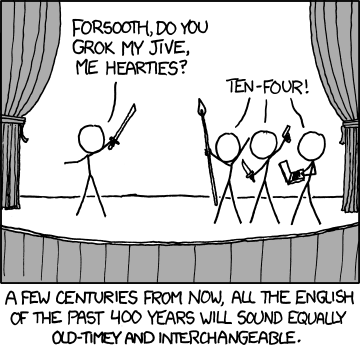
Yes!!! xkcd does language change ...


I'm not entirely sure that it'll sound equally old-timey, but the point is a fine one.

Tuesday, July 20, 2010

Decoding scripts -- automatically

This story is starting to float through the current news cycle. Regina Barzilay and her colleagues are working on automated deciphering of scripts, and just presented on it in Uppsala at the Association for Computational Linguistics. I don't see the paper on her website yet, but according to their abstract (from here):
In this paper we propose a method for the automatic decipherment of lost languages. Given a non-parallel corpus in a known related language, our model produces both alphabetic mappings and translations of words into their corresponding cognates. We employ a non-parametric Bayesian framework to simultaneously capture both low-level character mappings and high-level morphemic correspondences. This formulation enables us to encode some of the linguistic intuitions that have guided human decipherers. When applied to the ancient Semitic language Ugaritic, the model correctly maps nearly all letters to their Hebrew counterparts, and deduces the correct Hebrew cognate for over half of the Ugaritic words which have cognates in Hebrew.
See here, for a little background on the scripts.

They apparently have plans to try it next on Etruscan. That's going to be a serious challenge, but this could be cool.

Who knows, maybe the Voinych manuscript is next!

Michigan English


Check out the short article on Michigan English by Richard Bailey, posted last week. Take a gander (sorry for the pun), you'll learn something. But for cry-eye, we here in Wisconsin use some of these terms, too. Dick mentions that Wisconsinites also know what it means to shine deer. We also may eat a pasty (rhymes with nasty), paczki (pronounced like punch-key, although that pronunciation might start a debate), and bagas. But help the poor on Halloween - that's all yours, Michigan.

Picture from Myles Teddywedgers, right on State Street in Madison.

Monday, July 19, 2010

Failed linguistic humor: "sexual linguistics"

It turns out that one of the core reasons that the bloggers who make up Team Verb tend to maintain our thin veil of pseudonymy is simple: Fear of the failed joke. But take heart, fellow Verbs, things could be worse:

The Weekly World News (yes, they still exist, on-line), just ran this piece:
BRITISH ACCENT NO LONGER SEXY, STUDY FINDS
Read it and weep quietly. Or read the comments and maybe chuckle a little. Or, if you get the joke, please clue me in.

Sunday, July 11, 2010

Ben Zimmer rocks word history

Title says it all. "On Language" today is about tracing down the early history of the phrase "rock the mic."

Saturday, July 10, 2010

Science journalism and 'general science' journals

There's been occasional note here of the ups and downs of work published in places like Science and Nature. This article in the NYT addresses that issue pretty directly.

Friday, July 09, 2010

Let's have a public viewing


I was in Germany during the early days of the World Cup last month. I must admit, I was taken aback by the constant references to "public viewings." A different image came immediately to my mind, of visits to funeral homes, definitely not of a public showing of a soccer game (or other recorded video) on a large screen, usually, it seems, in an outdoor location. I obviously wasn't the only one. This article from Yahoo Deutschland, Leichenschau mit Bier und Tröte - Die fünf absurdesten Scheinanglizismen der deutschen Sprache, was sent my way today. Of the terms from English used in German (yes, the article is in German), with altered meanings, I was familiar with Beamer, Handy, and Oldtimer, but Body Bag is a new one to me. Hope it doesn't catch on.

Unable to understand

In a recent post, based on a couple of press releases, I wondered idly about recent paper on native speakers not understanding common constructions in their own languages. Thanks to Drew Smith's comment (and despite my own lack of time to search for myself), I've since read the article, published in Lingua, and talked to a few colleagues who have And the Log now has a post on it. A lot of the discussions have paralleled comments on the Mark Liberman's post on the Log: Some people, including me, are wondering about effects other than actual language ability which could trigger the responses Street and Dabrowska got -- see the Ridger's quote on the Log post. As Dr. Fnortner points out in a comment on that same post:
Whether the fault generally lies with flaws in the speaker's use of language, or in the listener's incapacity to understand, could be a research topic. The concern, shared by many here, that the illustrations, sentences, and process are off-putting and an important source of error should be examined.
After reading the article, I'm much less surprised by the findings and still figuring that other factors are at play here. But almost none of the discussion I've seen (save a couple of comments on our original post) talks about the huge implications that are being mentioned:
  • Is this really getting at a speaker's competence? (The article doesn't come down clearly on this, but see Stranded Preposition's comment on our original post.)
  • How clearly do these results actually support usage-based approaches?
  • Ultimately, does this show that grammar is really "grimmer than Chomsky claims"?
Beyond linguistics, the leap to speculation about IQ, about the 'richer' input that middle class children receive compared to working class children, and so on have been troubling to some of the people I've talked to about the paper.

Counting in Piraha


I am often baffled by Mr. V's love of XKCD - it just leaves me cold most of the time - but today's cartoon is absolutely brilliant. (HT to Nate C-K for sending it to me.)

Tuesday, July 06, 2010

"a significant proportion of native English speakers are unable to understand some basic sentences"

OK, help me again, readers. I happened to read this post on Science Daily, called:
Many English Speakers Cannot Understand Basic Grammar
So, I figured, oh, another thing about how we don't know what a 'passive' is or maybe another peevologist ranting about 'between you and I'. Wrong. Dead wrong. Science Daily basically took the story from the Northumbria University website, where they announced the breakthrough of Ewa Dabrowska, on their faculty. Here's the core of the release (save for the part about how this shows that Chomsky is wrong about all native speakers having the same basic grammar):

The project assumed that every adult native speaker of English would be able to understand the meaning of the sentence:

“The soldier was hit by the sailor.”

Dr Dabrowska and research student James Street then tested a range of adults, some of whom were postgraduate students, and others who had left school at the age of 16. All participants were asked to identify the meaning of a number of simple active and passive sentences, as well as sentences which contained the universal qualifier “every”.

As the test progressed, the two groups performed very differently. A high proportion of those who had left school at 16 began to make mistakes. Some speakers were not able to perform any better than chance, scoring no better than if they had been guessing.

Dr Dabrowska comments: “These findings are ground breaking, because for decades the theoretical and educational consensus has been solid. Regardless of educational attainment or dialect we are all supposed to be equally good at grammar, in the sense of being able to use grammatical cues to understand the meaning of sentences.

I just cannot figure out how you'd end up with a study showing that a significant number of English speakers literally cannot understand the meaning of “The soldier was hit by the sailor.” That is, I'm finding it hard to imagine a native speaker of English who doesn't get that this is something about a seaman whacking an infantryman.

Here's where I need the help: How does the study actually work? What did they do? There's no reference at all to any publication that I saw, just mention of a conference presentation.

Oh wait, I guess the story IS about people not knowing what a passive is, just not in the sense I thought!

Image from here.

Snapshot of US/Canadian English

I'm a little alarmed to see that I haven't posted yet on this project, on differences between Canadian and US English.

This is a very interesting project by Claire Bowern and Alan Munn. One of the big innovations is that they
are making recordings over the internet. (You need a mic on your computer to do it — as they point out, if you can use Skype, you can do this.)

Especially Wisconsin readers would be good to have, I imagine, given the popular perception that Wisconsinites sound 'Canadian'. Mr. V says, do it!

Sunday, July 04, 2010

World Cup: DE vs NL?


You probably know, even if you're American, the above information. Some nice surprises in there, of course, and a real surprise for me at least about how heavily European the final four turned out to be. I'm looking forward to some good soccer. You should never look ahead in these things, of course, but being a faculty member in a "German Dept" where the Netherlandic Studies part of the department has long since been large and important enough that it's a true embarrassment that the department isn't AT LEAST called "German and Dutch" or "German and Netherlandic", one possible scenario for the final obviously gets and holds my attention: What if it's a German-Dutch final, or even third place match? Talk about a loaded situation, historically and otherwise.

But consider this tidbit. One of the big Dutch soccer chants is:
 wie niet springt is een mof
That is, 'whoever doesn't jump is a mof.' Sounds a little like Wisconsin's big football chant/song/dance 'Jump around'. OK, but what's a mof? Well, Dutch has a long string of very negative words for, guess who, the Germans. This is one of them. This isn't cutesy negative, but negative negative.  For the scholarly lit on these terms, check out:
Daan, Jo. 2000. Poepen, moffen en kaaskoppen. Den Schaorpaol,21, nr. 1,blz. 21.
 Of course, there's also a dialect atlas with the regional distributions!

Keep an eye and an ear out for this one if they face each other! (I've just learned that there are more negative versions of the chant, but let's save that for later ... .)

Friday, July 02, 2010

Ünited Stätes


This week's Onion runs with the above legend across the top. In the print issue, they re-run an oldie but very goodie from 1997:
Ünited Stätes Toughens Image With Umlauts

WASHINGTON, DC—In a move designed to make the United States seem more "bad-assed and scary in a quasi-heavy-metal manner," Congress officially changed the nation's name to the Ünited Stätes of Ämerica Monday. "Much like Mötley Crüe and Motörhead, the Ünited Stätes is not to be messed with," said Sen. James Inhofe (R-OK). An upcoming redesign of the Ämerican flag will feature the new name in burnished silver wrought in a jagged, gothic font and bolted to a black background. A new national anthem is also in the works by composer Glenn Danzig, tentatively titled "Howl Of The She-Demon."
Finally, an issue I agree with Inhofe on.

Thursday, July 01, 2010

"Chomsky's Nightmare"

In a recent post, I noted ever so briefly how some of the people leading the anti-foreign language crusades in the US are tied pretty directly to the extreme right, closing with acknowledging that the connection to linguistics was pretty tenuous.

Here's a closely parallel situation in a way: The June issue of The Progressive has a big article by Matt Rothschild, the editor, called: "Chomsky's Nightmare: Is Fascism coming to America?" (excerpt available here).

Chomsky lays out here a point that people had been saying that he made in his appearance here in April (which I missed), and one he's made elsewhere, quoted here:
Ridiculing the tea party shenanigans is a serious error. [The attitudes of the tea party people] are understandable."
He talks, as so often, about the deterioration of life for the big majority of Americans or recent decades -- falling income, etc. -- while bankers suddenly get extra billions. And:
People want some answers. They are hearing answers from only one place: Fox, talk radio, and Sarah Palin.
Agreed to an extent: The rise of non-far-right voices in the media remains still very slow, but I think that Rachel Maddow and progressive radio are working hard to counter that noise.

But the bigger argument, that the US is in danger of becoming a fascist country, is a tougher sale. In fact, Rothschild devotes a lot of the article to evaluating that and arguing that it's unlikely. Agreed again. Still, I'd agree with Chris Berlet, quoted in the article, that this is "time for a conversation about it."

In particular, and here's the tie to the earlier post, it seems beyond question right now that there are major party candidates openly expressing anti-democratic views. Arizona state senator Pearce forwards Nazi emails to his supporters and a pretty conservative (from what I know) paper can say about a US Senate candidate "Armed revolt part of Sharron Angle's rhetoric", with this passage in the article, starting with a quote from her that's pretty well known now:
"In fact, Thomas Jefferson said it’s good for a country to have a revolution every 20 years. I hope that’s not where we’re going, but you know, if this Congress keeps going the way it is, people are really looking toward those Second Amendment remedies.”

Also that month, she told Reno conservative talk show host Bill Manders she hoped her opponent, U.S. Senate Majority Leader Harry Reid, would be defeated at the ballot box before the electorate resorted to more aggressive measures.
If you read the right news, you see that there are dozens of people out there saying this stuff, candidates for national and state office. These views have long been around but mostly at the margins, although hardly always (remember Jesse Helms?).

So, I don't fear that the fascists out there are actually about to take over, but we have to recognize that there's a set of people out there in power or close to power who would push as hard as they can in that direction.