Tuesday, September 28, 2010

haangina-lix! Aleut in the news!

Picked up the NYT this morning and started reading political news like this. Lisa Murkowski is apparently making a strong run now as a write-in, and she got a crowd roaring as described early on:
… invoking Native Alaskan culture, she told the crowd that the ancient Aleut language contained no word for “impossible.” It was a deft play to the state’s strong sense of identity and a direct appeal to native communities, whose support could prove crucial.
I had barely started to spew coffee from my mouth before I read the continuation:
It was also inaccurate. The word in Aleut is haangina-lix.

“It’s very clear that you can say ‘impossible,’ ” said Gary Holton, the director of the Alaska Native Language Archive. “Clearly, she wasn’t checking her facts.”

Hurrah! A random language myth (created on the fly or known cliche?) dismantled in the press. I guess the 'ancient' part was gratuitous bonus stupidity.

Map from here, the website of the Alaska Native Language Center (where Holton ultimately works).

Sunday, September 26, 2010

Where do you put your energy? Franz Kafka

The neverending and increasingly weird and famous story of Kafka's Nachlass gets the cover story in this week's NYT Magazine, and Elif Batuman tells a great story. One of the odder points, for me at least, was this:
Kafka studies now proliferate at a rate inversely proportional to that of Kafka’s own production: according to a recent estimate, a new book on his work has been published every 10 days for the past 14 years.
That's over 36 books per year, plus however many articles (and dissertations?), if it's true. And according to the article, Kafka published under 450 pages during his lifetime.

It's a luxury in the academic world that we can choose what we work on to a remarkable extent and we can get rewarded for a remarkable range of things. Kafka's one of my favorite authors, I guess, but I cannot quite understand how there's any call for this much published research on the relatively few works he published.

So many cool topics have not been touched or haven't been touched with current tools and methods, that it's mind-boggling. The number of languages and dialects that haven't been described, the number of basic historical situations we don't understand, and so on, all call out for research. Surely it's the same in literary studies. Or even practically: If you're figuring where you can make a real contribution, are the odds better with throwing another tome on that heap of Kafka studies or with staking out some new territory? Looking through some entries returned for 'Kafka' on GoogleBooks, much of what's there looks monotonous to me — I was expecting more exotic stuff.

But the bigger question is how many published books we actually need … shouldn't this stuff just be posted somewhere instead of printed on paper? I mean, come on, the Franz Kafka Blog doesn't even seem to be active. (Somebody will doubtless weigh in with more exciting electronic outlets on the topic ... .)

Friday, September 24, 2010

Frederick Jelinek

Frederick Jelinek, a pioneer in speech recognition, has passed away. The NYT has a pretty long obit, here.

Tuesday, September 21, 2010

University of Wisconsin big update

For our UW readers, two major updates.

First, the Public Representation Organization of the Faculty Senate (PROFS) is sponsoring its latest forum on how to fund public higher education in these tough bduget times. This one features Chancellor Biddy Martin, who'll discuss her plans for budget flexibilities. Word is, this will be mostly Q&A, with questions from the audience. Be there. Here's the key 411 (click to enlarge) and you can go to the PROFS website for the latest.


Second, from the good folks at Sifting and Winnowing, we learn that the UW's central administration has put out a call for proposals for an external consultant to undertake a "Benchmarking, Effectiveness, Efficiency and Flexibility Study" on campus. Last year, an effort to reorganization the entire research operation came down and faculty (and others) felt blindsided. Reaction was quick and strong, and while things worked out better than many first expected, it left many people on campus nervous about whether Wisconsin's famous tradition of shared governance was in danger. This latest move, which it sounds like happened without faculty input, seems to be setting off a new round of concern. Stay tuned.

Sunday, September 19, 2010

Sunday morning miscellany

First, if you're a non-linguist, you should check out Ben Zimmer's On Language this morning about 'chunking', or learning language (your mother tongue as a kid or another language later) by mastering phrases rather than just individual words. If you're a linguist, you should appreciate the balanced way that he presents a relatively complex bit about our field in a way that has to be nice and clear to outsiders. THIS is the kind of stuff we need to have in big media outlets about linguistics.

Second, in the NYT sports page this morning, I was surprised to see what I figured for a now-famous term defined (click image to enlarge):

Maybe only 'terrorist fist jab/bump' is famous? (For more extensive commentary on the subject and its political uses, see this post from the Log.) I'm hoping both Chicago and Dallas lose today, of course. Go Packers!

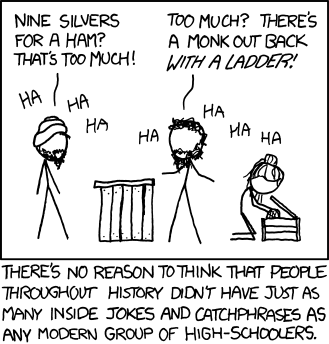
Third, I know we had just an xkcd link, but:

So, historical linguists and philologists, is that true? (And see the rollover for more.)

Friday, September 17, 2010

College football players majoring in Linguistics

According to this article in the Wall Street Journal, 11 are reported. These were starters last week in BCS schools.

My question: Where?!?! Seriously, I'd love to know.

Thursday, September 16, 2010

xkcd has said it all,

and nothing else remains to be said.

Sunday, September 12, 2010

Blobology and neurosexism

I first learned of Cordelia Fine's new book, DELUSIONS OF GENDER: How Our Minds, Society, and Neurosexism Create Difference, on the Log a while back, but have only now read a couple of reviews (and I'm not likely to read the book. But let me quote from Wray Herbert's review in the Washington Post:

About halfway through this irreverent and important book, cognitive psychologist Cordelia Fine offers a fairly technical explanation of the fMRI, a common kind of brain scan. By now, everyone is familiar with these head-shaped images, with their splashes of red and orange and green and blue. But far fewer know what those colors really mean or where they come from.

It's not as if these machines are taking color videos of the human brain in action -- not even close. In fact, these high-tech scanners are gathering data several steps removed from brain activity and even further from behavior. They are measuring the magnetic quality of hemoglobin, as a proxy for the blood oxygen being consumed in particular regions of the brain. If the measurement is different from what one would expect, scientists slap some color on that region of the map: hot, vibrant shades such as red if it's more than expected; cool, subdued tones if it's less.

Fine calls this "blobology": the science -- or art -- of creating images and then interpreting them as if they have something to do with human behavior. Her detailed explanation of brain-scanning technology is essential to her argument, as it conveys a sense of just how difficult it is to interpret such raw data. She isn't opposed to neuroscience or brain imaging; quite the opposite. But she is ardently against making authoritative interpretations of ambiguous data.
Now, heck, maybe I will read this book. Anyway, I sure like that attitude. I had heard blobology before, I'm pretty sure (and it gets a good set of g-hits). But only now does it strike me as filling a really big lexical gap in scientific vocabulary: We've got ways of referring to the gross over-interpretation of shaky evidence, but nothing nearly so catchy as blobology.

I don't know if it's Word of the Year material, yet, but I say we start using it.

Image from here.

Monday, September 06, 2010

A different kind of 'sound change' research at Wisconsin

Our local Wisconsin Week paper — the university weekly just ran a piece about some work on campus by Christian Stilp and Keith Kluender in Psychology. It appeared in PNAS recently(abstract here) and though I'd seen the piece, I suddenly realized we hadn't called attention to it here.

For the readers into speech sounds, this work aims to provide some underpinning for the notion of sonority and it also, I think, more generally focuses on a really dynamic approach to understanding sounds, how we perceive in terms of change. The image below (from the paper) will fill in some detail on what's in the abstract. Pretty cool.


I'm heading out the door but this is something that we should have a meaty post about ...

Wednesday, September 01, 2010

xkcd on stage

I almost missed this xkcd, Open Mic Night, and containing these two panels. The first one, I still can't bring myself to laugh about, but it's classic xkcd, and linguistic.

The second one, well, I confess that I didn't get it at first. Had to look it up, basically. Hey, so I'm not a programmer.

We will get back to actual linguistics soon, but we're all wound up here about the beginning of the semester …