Showing posts with label Linguistics: The profession. Show all posts

Tuesday, April 07, 2015

LINGUIST list fund drive

A message from some of the Wisconsin linguists …

Folks,
Most of you know that LINGUIST is now doing their annual fund drive. For five years, we had the privilege of editing book reviews for LINGUIST and we know very well how much time and effort goes into producing the posts that we all rely on for job and conference announcements, book announcements and reviews, and news about the profession, along with the rich website, which brings us everything from E-MELD to their directory of linguists. 

What you may not know is how heavily and directly they rely on donations from rank and file folks around the world.It takes a committed staff to run LINGUIST. Your donations help pay for the salary of graduate student editors. We urge you to donate and keep them going. 

Onward!
Joe, Monica, Anja & Rajiv

And it does look like Wisconsin could use some help in the University challenge.


Monday, January 05, 2015

Sociolinguistic Events Calendar

Ever start something that becomes so successful you can't manage it at some point? Welcome to the lives of the people who started the Sociolinguistic Events Calendar. Dave Sayers just posted this to the Variationist List (go here to subscribe). Help these folks out if you can and become a calendariser (calendarizer?).

Hello one and all, and happy new year!
The Sociolinguistic Events Calendar (http://www.baal.org.uk/slxevents.html) is now bustling with events across the world, and has also been linked to by a number of event organisers, including NWAV: http://linguistics.utoronto.ca/nwav44/. Meanwhile the synopsis on academia.edu is apparently in the top 3% of viewed pages this month (http://academia.edu/9619924). My co-calendariser - Jonathan Kasstan - and I are overwhelmingly honoured by all this success, acclaim and esteem, which has helped us keep plugging away at it, but... we are kinda getting a little overworked with it all. Help us! We're looking to recruit volunteers to help keep this resource going, since it's not altogether clear how long we can keep going just the two of us.
We're hoping to gather a team of about 5-7, thinking that one person could cover the various calls that come up on each day of the week. The commitment per person would be about half an hour a day (plus an hour or so of initial training on how events are formatted in the calendar). The daily workload is manageable, but pretty constant - although I suppose it'll vary depending on the time of year (there probably aren't so many calls in the summer for example).
Please please get in touch if you'd like to step up to this exciting level of responsibility and celebrity :)
Dave
--Dr. Dave SayersSenior Lecturer, Dept Humanities, Sheffield Hallam University, UKHonorary Research Fellow, Arts & Humanities, Swansea University, UK (2009-2015)dave.sayers@cantab.net | http://swansea.academia.edu/DaveSayers 

Saturday, January 03, 2015

LSA special session on the Publishing Process

Pass the word ...

Next Thursday afternoon at the Portland meeting of the LSA, there will be a special session on the Publishing Process, cosponsored by the Committee of Editors of Linguistics Journals and the Committee on Student Issues and Concerns (Troy Messick, Chair). There will be brief remarks by a set of editors, but most of the event will be a chance to ask questions about publishing in linguistics journals. 

Whether you can be there or not, you can participate … via comments on the LSA's facebook page or via twitter with the hashtag #LSApubs.  Materials from the session will be posted online afterwards.


Tuesday, April 23, 2013

#lingchat

It seems pretty clear that our readers are overwhelmingly on Twitter — we've been exactly as slack about getting followers on Twitter as we have about getting people to read this little corner of the web, which is to say we've done nothing whatsoever beyond tweeting and posting occasionally.

Twitter is generally pretty entertaining and occasionally professionally interesting. For instance, over the last week, a couple of nice conferences have been basically live-tweeted.

But I haven't seen real progress on making it a more systematically useful tool. There's an effort afoot now that create a forum, #lingchat. It's just getting rolling, but could become an interesting forum.

Check it out.


Monday, May 07, 2012

A new and easy way to help LINGUIST list

Got this message from one of the LINGUIST list review editors here at the University of Wisconsin – Madison:
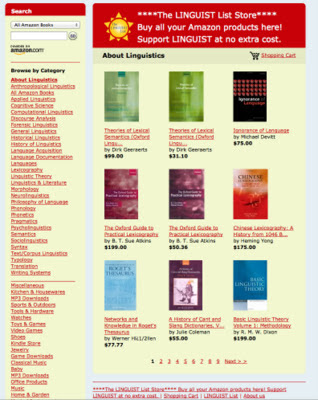
Okay, everybody, be sure to change your usual Amazon link to the one given in this Linguist List message!  Pass it on to other linguists!  http://linguistlist.org/issues/23/23-2167.html
Here's a screen shot of what you get if you go to the store. (As always, click to embiggen.)


  Sounds great to me.

Wednesday, March 07, 2012

LINGUIST List fund drive: Wisconsin MUST donate.

The LINGUIST List fund drive is on. If you read this blog, you surely read LINGUIST sometimes and it's clearly one of the most valuable resources we have, for working scholars and for the public face of our field. Wisconsin, we have a problem. Look at the Grad School challenge standings as of just now:


Notice anything? I thought so. YOUR university is not even in the picture. UW–Madison is where the LINGUIST book reviews are edited and I see LINGUIST list t-shirts all around campus. Surely we can muster a $1,000 bucks for this.

You gotta step up here, folks. Here's the link: http://linguistlist.org/.

Update, 3:40 pm: We're on the map!


Keep pushing, folks, we can win this baby.

Tuesday, November 29, 2011

LINGUIST list blog

Let's welcome a new linguablog to the blogosphere ... The LINGUIST List: Official blog of the LINGUIST list.

Wednesday, November 24, 2010

How to get rich as a linguist?

Linguist Bob Kennedy from UC-Santa Barbara is on Jeopardy and won a ton yesterday already, as reported here.

Tuesday, June 02, 2009

LSA ethics statement

Members of the Linguistic Society of America will know that the LSA has been working on an ethics statement for a good while. It's out now, see here, and it's already been picked up in the media, here. As the story makes clear, part of the purpose is to educate Institutional Review Boards about ethical issues in linguistics and how they differ from other fields. A step forward, I think.

Wednesday, April 02, 2008

The Daily Cardinal: UW acquires Chomsky in blockbuster deal

Wow, talk about big news. The Daily Cardinal, one of our two student newspapers, yesterday broke this story, reprinted in part here:
UW acquires Chomsky in blockbuster deal

In a move signifying a “win now” mindset, UW-Madison acquired aging superstar linguistics professor Noam Chomsky from M.I.T. yesterday in exchange for five professors and two draft picks.

Heading to Cambridge in the blockbuster deal will be English professor Richard Knowles, psychology professor Janet Hyde, journalism professor James Baughman, art history professor Nancy Rose Marshall and political science professor Howard Schweber.

M.I.T. will also receive the first round draft picks UW acquired last summer from U. Chicago and Princeton in the Jon Pevehouse and David Leheny trades, respectively.

Wisconsin Chancellor and General Manager John Wiley said Chomsky will propel the school into higher education’s upper tiers.

“Noam is a proven commodity who will provide us with a dominating inside presence,” Wiley said. “He immediately boosts our journal citation stats and will draw defenders away from the perimeter, freeing other professors to take the outside research grant shot.”
We all play hard every day, every minute, but just knowing the Chomp will be in there with us is a huge boost. We can do this. Let's get this party started.

Image from here. Hat tip to, well, you know who you are. And some, hmmmmm, related stories can be found here.

Monday, January 21, 2008

Drawing clear boundaries

At the Linguistic Society of America meeting just past, in the area near where the American Dialect Society met, there was a room where some random meeting was going on at the same time. Apparently we barged in so often that they had to take desperate measures, shown on the right.

One of our contributors (Monica) just sent me this pic, unfortunately taken after somebody had added the -s to the original Linguistic.

Thursday, January 03, 2008

Why everyone should study linguistics

Over on the Log yesterday, I discovered a link I should have known about … an article in the Minnesota Review called "Why everyone should study linguistics".

Stop in mid-yawn: It's by a literary scholar, Robin Sowards, a young English prof who is working on a book on Chomsky and literary theory, among other things. The piece opens with this shocking line:
All literary critics already do some kind of linguistics.
And he goes on to illustrate the point with basic grammatical analysis and interpretation of historical change in language, leading him to assert:
Linguistics is our inevitable hidden premise.
The piece really argues exactly what the title says, that literary studies needs especially 'theoretical linguistics' — generative linguistics in particular — and he illustrates it with things like processing difficulties with center-embedding.

It's a nice piece and it's impossible to disagree with the basic line of argument, although syntax folks and others may have quibbles on some points of his discussion. Certainly having every student of literature take some real linguistics would be valuable. (Many do already.) But in an undertaking like this, where full command of two fields is ultimately needed — you shouldn't trust my reading of Blake and I'll be mightily impressed to see rank-and-file lit scholars doing high-quality minimalist analyses of Shakespeare.

Regular readers know the punchline: The right way to handle this is to collaborate, start a discussion group including linguists and lit people. Over the years, I've had and heard of many discussions between linguists and lit folks about co-authoring, but have seen basically none of them come to fruition, for various reasons. Somebody like Sowards, apparently a card-carrying English lit guy who's invested a good bit in learning some linguistics, might be able to do it with some success, but for most folks, it's better to start that process of sitting down and talking to people who have the real background you need to learn.

Wednesday, January 02, 2008

Off to the Linguistic Society ...

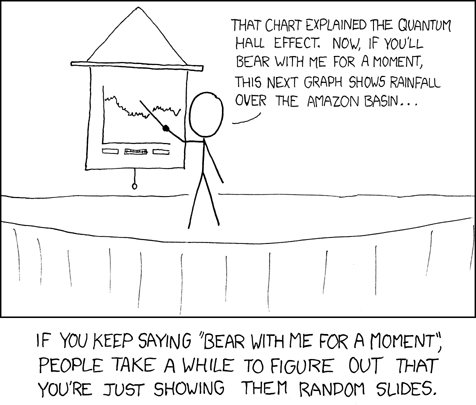
Ah, just in time for the LSA, the American Dialect Society, Society for the Study of the Indigenous Languages of the Americas, and the string of other meetings, this graphic has a key pointer on how to put together your PowerPoint:

The Secret Annual Cabal, as some call it, is in Chicago, so lots of Wisconsin folks will shake off the frost and head to warmer climes.

Thursday, December 06, 2007

The Linguistics Wars!

What year would it be if you read a new piece by George Lakoff skewering Ray Jackendoff? Try 2008, in a preprint for a book review for American Scientist, here. It's got some of that old-time religion, like this:
The time was ripe for Noam Chomsky to adapt the symbol-manipulation paradigm to linguistics. Chomsky's metaphor was simple: A sentence was a string of symbols. A language was a set of such strings. … Meaning and communication could play no role in the structure of language. The brain was irrelevant. This approach was called generative linguistics, and it continues to have adherents in many linguistics departments in the United States.
Of course, the "continues to have adherents" tells you that the 'cognitive revolution' is coming in the next paragraph. Lakoff ends on a more positive note, happily:
For a cognitive linguist like myself, reading Jackendoff's book is both painful and hopeful—painful because he keeps trying to do interesting and important intellectual work while being stuck in a paradigm that won't allow it, and hopeful because he may help the transition from a brain-ignoring symbol-manipulation paradigm to a brain-based neural theory of thought and language. I wish that other linguists, both generative and cognitive, had his scope and intellectual ambition.
It sure seems like about all of us are wrestling with this fundamental question these days, that is, how to reconcile evidence from these two long-warring traditions. And the best members of the newer generation seem to be doing it pretty collegially, at least in the circles I move in.

Wednesday, November 28, 2007

Career options for linguists

See here. Hadn't thought of that.

Friday, August 03, 2007

A sad day: The passing of W.P. Lehmann

A while back, I talked about the University of Wisconsin's remarkable tradition in linguistics, especially historical linguistics, stretching back over the last century. We've now lost a major link in that chain: Winfred P. Lehmann passed away on August 1. In addition to the LINGUIST notice, the Linguistics Research Center (LRC) at the University of Texas, which he led for decades, has posted a note, here.

Professor Lehmann earned an MA in Germanic Linguistics and a PhD in the same field here in 1941. He was one of the most prolific linguists of the 20th century and made particularly important contributions to Germanic philology and linguistics, Indo-European studies and linguistic typology — with publications running from 1940 until last year, and even this year, with his on-line Grammar of Proto-Germanic.

I believe he was the only person to serve as president of both the Linguistic Society of America and the Modern Language Association (when they included 'language' and not just literature, a day which may come again). Heavily involved since the early days in what was then known as 'machine translation', he was committed to using technological innovations, and the LRC has done significant work in web publishing, including posting classic works in historical linguistics.

His passing is a real loss, and sorely felt here in Wisconsin.

Thursday, August 02, 2007

Glottopedia

How new technology gets adopted in practice is something I'd love to know a ton more about, but it's really surprised me how variable the reaction has been to current web-based innovation. In particular, recently I've heard a couple of very senior colleagues talk about investing fair amounts of time editing wikipedia material. (Bodes well — we should have great entries if these folks are working on them!)

A few weeks back I read about the new Glottopedia project (language hat and Anggarrgoon both blogged about it), but only got around to checking it out this morning. It's being edited by a set of respected linguists (though representing a restricted range of theoretical approaches at this early stage), and it is really in its infancy — with a limited set of entries in German and English. There is, for example, not even a category for language change or historical linguistics yet.

The project has real promise, if it can gain critical mass of collaborators. Assuming it does, it'll be interesting to watch how its role evolves vis à vis the wikipedia material on linguistics and other on-line resources.

Update: I forgot to mention the LINGUIST project until Polyglot Conspiracy brought it up.

Image from here.

Monday, July 30, 2007

What do they know and how do they know it?

OK, this probably isn't going anywhere (and it's generally not nearly as serious as this issue), but it's been driving me crazy in some recent reading and I have to get it off my chest.

How can we get more basic clarity on the epistemological status of claims we read in scholarly journals? On what basis and how securely to do we know something we assert in a publication? Is it received wisdom, vague suspicion, well-documented pattern that fits a broad set of facts, etc.? Much of the peer-review process seems aimed to ferreting out fudging on this front, but I see constantly when and where it hasn't worked, especially in theoretical linguistics.

This was brought to the fore by a TPM post by Josh Marshall this morning, with this passage (the quote at the beginning is from an NYT editorial):
"Unwilling to accept [DOJ's refusal to reauthorize the program], Vice President Dick Cheney sent Mr. Gonzales and another official to Mr. Ashcroft’s hospital room to get him to approve the wiretapping."

The folks at TPMmuckraker are the ones really following this story closely. So perhaps this is a detail that has eluded me. But I was not aware that it had ever been established that Vice President Cheney ordered the visit. Speculated, rumored, sure. But I wasn't aware this had been established at all.

And yet the Times states it rather offhandedly as a fact. So what do they know?

Editorials like these are sometimes a venue where facts are stuck in which are 'known' to be true but which cannot be sourced cleanly or clearly enough to make it onto the news pages. Is that what's up here?
Good questions, right?

Friday, July 20, 2007

Quote of the week ...

From a quick conversation with an obviously frustrated colleague who has been struggling for some very long period of time to review "one of the weakest papers I've ever read" for a major journal:
Linguistic argumentation gone bad is a terrible thing.
When writing an article, I like to:
  • Build a coherent argument!
  • Present relevant data!
  • Draw conclusions!
Remember, kids: Get that manuscript into tiptop shape before you send it out!

Monday, June 18, 2007

Israel Shenker and the history of linguistics

Yesterday's NYT carried a long obit for Israel Shenker, long-time reporter for Time magazine and then the NYT. The piece mentions some of the notable folks he interviewed over the years — Borges, M.C. Escher, Groucho Marx, Picasso, I.B. Singer — and has a few choice quotes, like this from 1976:
Insurance policies may be balm for the afflicted, but they are murder on the English language.
Hard to imagine now that just a third of a century ago, insurance companies actually paid out in the case of disaster, or at least were regarded as reliable enough to to count as a "balm".

But the author, Margalit Fox, gives some play to Shenker's interest in language. By coincidence, I just looked at an old article by Shenker, called "Former Chomsky Disciplines Hurl Harsh Words at the Master" from Sept 10, 1972. It was folded inside a copy of the first edition of John Lyons' book Noam Chomsky, in the Viking series Modern Masters. It provides a contemporary account of the Generative Semantics battles probably most familiar to younger linguists (= those who didn't live through them) from Randy Allen Harris's great Linguistics Wars.