Some readers of this little corner of the cyberverse may be interested in SayWhat: The people's video dictionary. Its founder describes it as a video version of the Urban Dictionary, which seems true enough.
Would be nice to have a little info about who the speakers are, e.g. where they're from and date of the recording.
Showing posts with label good clean fun. Show all posts
Tuesday, May 19, 2015
Friday, April 18, 2014
Wisconsin words in the news
Well, now, the Appleton Post Crescent posted a quiz on Wisconsin words, here. A lot of the words are actually regional within the state and the Wisconsin born-and-bred folks I know who've taken it have scored as low as 40-60%.
The example below is the non-spoiler ... I'm guessing everybody from Wisconsin gets that one right, whether they use the term or not.
Have a go ...
The example below is the non-spoiler ... I'm guessing everybody from Wisconsin gets that one right, whether they use the term or not.
Have a go ...
Labels:
good clean fun,
Wisconsin English,
words
Sunday, November 10, 2013
Speculative Grammarian: The book
Shout it from the rooftops. Or just do like me and go stand on a street corner waving a Bible and scream it:
The Speculative Grammarian Essential Guide to Linguistics is out!We were fortunate enough to get an advance copy back in the summer, all 360 freakin' pages of it, by Trey Jones, Keith W. Slater, Bill Spruiell, Tim Pulju and David J. Peterson. That copy has been closely guarded, and passed from hand to apparently increasingly grimy hand.*
At Team Verb, we're all pretty pumped about this. Or as one colleague put it:
This goes on the new MA reading list. Hell, this IS the new MA reading list.
Given that the old reading list consisted of stuff written between the Rig Veda and Bloomfield's Menominee Grammar, it would be a step forward, but can't you imagine the prelims: please open the Essential Guide to p. 194, and let's discuss "Are Turkish and Amharic Related? Are they ever!"**
And we're not the only ones excited about it. The 'advance praise' up front contains some names:
“Ever wonder why Vikings torched scriptoria? This kind of thing.”
—E. V. Gordon
“Contains more than 100 basic words.”
—Morris Swadesh
“Same reference as linguistics; different sense.”
—Gottlob Frege
“Two uvulas down, way down!”
—Sapir and Bloomfield, At the Bookstore
Seriously, this volume has not only a real place in the field, it also continues an important tradition. I keep Studies out in left field: Defamatory essays presented to James D. McCawley (originally published in 1971 and republished, as pictured here, by Benjamins in 1992) on my desk at all times. I regularly give students the "supplementary glossary of linguistic terminology" from that. As much fun as wabiawization and haspiration are, you don't forget pheresis and apocop after you see the list. But it needed updating. The Essential Guide has six pages of "self-defining linguistic glossary" ... a bit of overlap with Studies, of course, but tons more stuff and covering a lot of the field:- It’s a cleft that this sentence is.
- Je puedo Europanto sprechen.
- I can see that eyewitness evidential myself.
- Something’s gonna undergo grammaticalization.
- The Gricean Maxim of Quantity (“Information”) did that thing the other day, with the guy from that place.
- She looked at the zeugma with suspicion and magnifying glass.
The bulk of the texts is built around subfields —sets of pieces on typology, syntax, phonetics, whatevs. Richly illustrated even. I'm guessing anybody who reads this will find plenty of nuggets that they can enjoy and use.
I literally just ordered four fresh, clean copies of it and you can too, here, for $12.99 U.S.
* To the one who spilled what was obviously Hopalicious on page 95: I know who you are and disapprove as much of you wasting good beer as defiling this book.
**Actual article on p. 194, by April May June. I think I know a guy who dated her way back when.
Labels:
education,
good clean fun,
humor,
linguistic humor
Friday, November 08, 2013
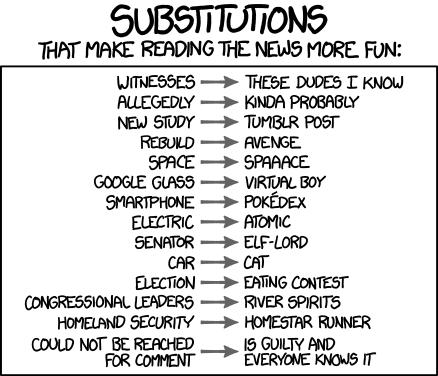
Lexical substitutions in the news
Well, better than the news, actually. In xkcd.
I already intuitively make some of these substitutions, like 'could not be reached for comment' to 'is guilty and everybody knows it' or 'new study' to 'tumblr post'.
Labels:
good clean fun,
words
Monday, May 06, 2013
Good clean fun
I've been a little surprised in the past that this blog has been nominated for awards like the one below. Don't get me wrong, it's cool and all, but we aren't really about language learning. In fact, we don't fit any category I've seen on any of those contests. If you're into it, please go vote, but until there's a category 'good clean fun', we don't stand a chance ... .
We guess, I suppose, brush up on the old amo, amas, amat and give it a shot next year, but I think we all like our amateur status.
Labels:
blogal,
good clean fun,
Inside Blogball
Saturday, May 04, 2013
HPSG Man, by the Dead Tongues
Wow.
Via Twitter, thanks to Jason Baldridge, retweeted by the one and only Ben Zimmer.
Labels:
good clean fun
Wednesday, April 17, 2013
I heart baseball
So glad that it's baseball season finally. Not just for the game - also for the wonderful announcers.Tonight's gem:
He's gonna nonchalant a ground ball.Ahhhh. I love baseball.
Labels:
Baseball,
good clean fun,
verbing
Sunday, April 14, 2013
Linguistics flowchart: What field?
This is floating around fb at the moment (yes, click to embiggen). ... I saw it first on the Studentische Tagung Sprachwissenschaft page. The poster itself is from Cascadilla, the only source a linguist needs to stay stocked with excellent posters, t-shirts, bumper stickers and gifts. This is on their CafePress link as a poster. I only today saw the 'Loose lips make bilabial trills' poster.
But somehow, the chart doesn't help me ... I want to do basically all of it.
Labels:
good clean fun,
linguistic humor
Monday, March 25, 2013
Calling multilinguals ...
Noted linguist and novelist Rosina Lippi has an intriguing request out ... here. She's got this scenario:
one character tells another character that there’s a list of about ten phrases he can say in fifty different languages or dialects of languages. She doesn’t believe him, and challenges him. The sentence she chooses (of the ones on his list) is “Why did you kill your wife?”She needs the last sentence translated into lots of dialects and languages by native speakers. Help her out.
Rosina concludes "Eventually you’ll find out what I’m doing with this." I'm dying -- figuratively, not literally -- to know she's up to here.
Labels:
good clean fun,
languages and dialects
Thursday, April 12, 2012
Meme and 'Among the new words'
Over on the American Dialect Society list, ads-l, there's been some discussion of the word 'meme'. That's enough excuse for me to call attention to the latest 'Among the new words' piece in American Speech by Ben Zimmer and Charles Carson (86.454-479).
Meme has developed a particular meaning with regard to the internet and Zimmer and Carson argue that memes have become "vehicles of linguistic dissemination". They cover a rich set of them, saying a lot of about honey badger, facebomb, facepalm, hoverhand, etc. And derp or durp or derp derp. (Just do the google image search.)
At any rate, just a chance to remind you of how rich ADS and American Speech are ... whether you're a working linguist or just language obsessed.
Meme has developed a particular meaning with regard to the internet and Zimmer and Carson argue that memes have become "vehicles of linguistic dissemination". They cover a rich set of them, saying a lot of about honey badger, facebomb, facepalm, hoverhand, etc. And derp or durp or derp derp. (Just do the google image search.)
At any rate, just a chance to remind you of how rich ADS and American Speech are ... whether you're a working linguist or just language obsessed.
Labels:
American dialects,
good clean fun,
words
Friday, February 17, 2012
"Texting Can Have A Negative Effect On Linguistics"
The article is here, but this one's all about the headline.
Labels:
good clean fun,
Linguistics in the media?
Saturday, December 17, 2011
The French having fun with their language!?!?!?
Oui, cher amis, c'est vrai ça, as they say.
Last summer, the latest edition of the classic French dictionary Le Petit Larousse contained a contest. As described briefly in the graphic here (cliquez à embigger, could we say?), they slipped in a couple of fake words, with a prize of 100,000 € — real money, for the moment at least — going to somebody who finds them.
I love the idea, fun with words in a pretty cool way. But even setting aside that our stereotypes about French views of their language are exactly stereotypes, I wouldn't have particularly expected this from Larousse, which makes it even cooler somehow.
I remain really excited about the culture of superstar lexicographers we have now in the US — Ben Zimmer on NPR just yesterday, Michael Paul Adams still a familiar name from his encounters with Colbert and his writings about slang, and Erin McKean (When somebody mentioned her name recently, a young person all but screamed 'Oh. My. God. I LOVE her.)* And the press about the new American Heritage Dictionary is cool (like this podcast, though I'm growing weary of the little thing about the end of print dictionaries.)
Oh yeah, so, I finally got around to checking the answers today ...
Last summer, the latest edition of the classic French dictionary Le Petit Larousse contained a contest. As described briefly in the graphic here (cliquez à embigger, could we say?), they slipped in a couple of fake words, with a prize of 100,000 € — real money, for the moment at least — going to somebody who finds them.
I love the idea, fun with words in a pretty cool way. But even setting aside that our stereotypes about French views of their language are exactly stereotypes, I wouldn't have particularly expected this from Larousse, which makes it even cooler somehow.
I remain really excited about the culture of superstar lexicographers we have now in the US — Ben Zimmer on NPR just yesterday, Michael Paul Adams still a familiar name from his encounters with Colbert and his writings about slang, and Erin McKean (When somebody mentioned her name recently, a young person all but screamed 'Oh. My. God. I LOVE her.)* And the press about the new American Heritage Dictionary is cool (like this podcast, though I'm growing weary of the little thing about the end of print dictionaries.)
Oh yeah, so, I finally got around to checking the answers today ...
HYPERGRIPHE
et
AU JET
et
AU JET
* Ha. Did you even notice that I didn't mention the superstar of all superstar dictionary-related things in the whole universe? Because I knew you'd think of DARE instantly anyway.
Labels:
dictionaries,
good clean fun,
words
Friday, November 18, 2011
Fun with Germanic historical linguistics ...
A normal mortal can only respond to that subject line with "fun ≠
Germanic historical linguistics", but Germanic historical linguists are
not normal, I suppose. This blog has a tradition of historical
linguistic geekery (start here and read from there). Time for an update ...
A crew of people at the Universität Tübingen in Germany have assembled a pretty remarkable set of Merkverse for learning key bits of historical phonology and morphology of German and Germanic. A Merkvers can be translated as 'mnemonic rhyme' or something, but that doesn't do it justice ... there's a long tradition going back to the earliest writings in German of these little rhymes. (The image here, from here, is of one for the Runic alphabet.)
You really have to know German to get these, but one of the things you have to do with earlier Germanic languages is learn the series of strong verbs, seven classes from ride, rode, ridden and sing, sang, sung, and so on. Here's the one for that for Old High German (there's another one for Middle High German):
And a big wag of the monk's habit to pr. (Or whatever you do with a monk's habit.)
A crew of people at the Universität Tübingen in Germany have assembled a pretty remarkable set of Merkverse for learning key bits of historical phonology and morphology of German and Germanic. A Merkvers can be translated as 'mnemonic rhyme' or something, but that doesn't do it justice ... there's a long tradition going back to the earliest writings in German of these little rhymes. (The image here, from here, is of one for the Runic alphabet.)
You really have to know German to get these, but one of the things you have to do with earlier Germanic languages is learn the series of strong verbs, seven classes from ride, rode, ridden and sing, sang, sung, and so on. Here's the one for that for Old High German (there's another one for Middle High German):
Althochdeutsche Merkwörter für die AblautreihenIf you're a student of the history of German, your life just got a little more fun.
rîtan, zîhan, solcherlei —stehen in der ersten Reih'.
liogan und ziohan —schließt die zweite Reihe an.
Willst die Reihe drei du findan, —denk an werfan und an bindan.
neman, stelan, wissen wir, —passen nur in Reihe vier.
geban wird ganz ungeniert —in der Reihe fünf notiert.
graban, slahan, dies Gewaechs —kennen wir in Reihe sechs.
haltan und der Rest, Ihr Lieben, —hat redupliziert in sieben.
(aus Osnabrück?)
And a big wag of the monk's habit to pr. (Or whatever you do with a monk's habit.)
Tuesday, November 08, 2011
Linguistics tattoos, etc.
Science Times now has an online slide show about science tattoos, here. The author of the piece, Carl Zimmer, long ago did something on linguistics tattoos, featuring a tiny glottal stop (here). A couple of years ago, a bunch of posts on lingua-blogs and elsewhere mentioned other linguistics tattoos, including an IPA vowel chart on the Log (here).The slide show reminded me, though, that I occasionally hear people talk about linguistics tattoos and other graphics associated with our field. The image here is of a bowling shirt from a bowling team that some UW–Madison grad students started some years ago, The Gutturals. It's the IPA symbol for an epiglottal plosive, a prototypical guttural. (I don't know if they got a lot of gutteral reactions, though, or even guttural reactions.)
So, a question, gentle readers: Aside from t-shirts, what's your favorite image of linguistics in a non-linguistics context?
Labels:
good clean fun,
linguistic humor?,
linguistics
Tuesday, July 12, 2011
Idiomizer
Got a message last week from Harlan Collins at www.idiomizer.com. I wasn't even aware of the project, but it looks like good clean fun, and I know a lot of our readers are polyglots … here's your chance.

Enjoy!

Enjoy!
Labels:
good clean fun,
languages
Thursday, March 11, 2010
LINGUIST list challenge ... help historical linguistics!
If you read this blog, you almost surely use the LINGUIST list too. They are celebrating their 20th anniversary of serving our field — and anybody with internet access who has any vague or passing interest in language.
More immediately, they've embarked on a big fund drive to support their operations. This year, they're doing a Linguistic Subfield Challenge. Here's the current subfield snaphot:
Me, I'm a historical guy, and therefore deeply disturbed to see that we're lagging behind both syntax (now in the lead) and language acquisition. If you love language change, or reconstruction or dead languages, please help us boost our totals. Sure, phonology's just fine and I like morphology too, but we have to win this.
Please donate! And go, historical, go!
More immediately, they've embarked on a big fund drive to support their operations. This year, they're doing a Linguistic Subfield Challenge. Here's the current subfield snaphot:
Me, I'm a historical guy, and therefore deeply disturbed to see that we're lagging behind both syntax (now in the lead) and language acquisition. If you love language change, or reconstruction or dead languages, please help us boost our totals. Sure, phonology's just fine and I like morphology too, but we have to win this.
Please donate! And go, historical, go!
Labels:
good clean fun,
Historical linguistics,
linguistics
Saturday, November 01, 2008
Eunoia
This link was passed along from A.M. via a contributor, about Christian Bök's new book which uses only one (orthographic) vowel per chapter. Of course, much like on this blog, the comments are often better than the story. The exercise calls to mind Gadsby, the novel written without using the letter 'e' Much more interesting would be prose restricted to single vowel sounds over long stretches. There's plenty of that in poetry, but is there prose like that?
Labels:
good clean fun,
Language in the media
Friday, January 11, 2008
The vowel {ee} and respectability
Random end of the week quote:[B]y all accounts, et es perfectle pesseble to have a thoroughle respectable language wethout the vowel i.
— Guy Deutscher, The Unfolding of Language, p. 13
Now, I'll leave it to you to guess at what the heck he's talking about. Better yet, go read the book — it's a fun and utterly accessible overview of many issues in language change.
But what I can't figure out is why he has pesseble for what was presumably supposed to be possible? Surely he didn't mean pissible. I can easily imagine such a word, e.g. with regard to small kidney stones ("No need for surgery, Jones, this one looks utterly pissable".) or someone who can be annoyed ("Don't push that joke too far ... Smith is pissable.") But not here.
Now, while this blog clearly isn't widely read by fans of hair bands, a couple of copy editors and related professionals do visit this corner of the internet. I'm figuring this is the kind of situation that would give you major nightmares. It's obviously not something you can spellcheck, and it takes someone who knows about how letters relate to sounds to be sure what to substitute. In fact, it's easy to imagine this getting introduced at some point in the production process.
Image from here.
But what I can't figure out is why he has pesseble for what was presumably supposed to be possible? Surely he didn't mean pissible. I can easily imagine such a word, e.g. with regard to small kidney stones ("No need for surgery, Jones, this one looks utterly pissable".) or someone who can be annoyed ("Don't push that joke too far ... Smith is pissable.") But not here.
Now, while this blog clearly isn't widely read by fans of hair bands, a couple of copy editors and related professionals do visit this corner of the internet. I'm figuring this is the kind of situation that would give you major nightmares. It's obviously not something you can spellcheck, and it takes someone who knows about how letters relate to sounds to be sure what to substitute. In fact, it's easy to imagine this getting introduced at some point in the production process.
Image from here.
Labels:
good clean fun
Tuesday, June 05, 2007
Sheepshead
Doff of the tuque to T.P. for alerting me to this post on a fine regional game. And the image is from sheepshead.org.
Labels:
good clean fun,
Upper Midwest
Subscribe to:
Posts (Atom)


