Showing posts with label words. Show all posts

Thursday, July 31, 2014

Attack of the homophones!

Delightful story in the always delightful Wonkette about a guy who got fired for writing a blog post about homophones, because it sounded too ... icky.  It kind of sounded like another word, you might say.  Of course they had to use the tired old "cunning linguist" joke, but at least with a good graphic.

I did guffaw a bit (but daintily) when I saw their picture of an illustration the firee used in his blog post:

I mean, the very first one is a really bad example!  Tell me you don't look at it and say [rɛd] ~ [rijd].  And BTW, ant ~ aunt only works for some dialects.

It's just as well he got fired.  What might he have brought up next - polysemy???

Friday, April 18, 2014

Wisconsin words in the news

Well, now, the Appleton Post Crescent posted a quiz on Wisconsin words, here. A lot of the words are actually regional within the state and the Wisconsin born-and-bred folks I know who've taken it have scored as low as 40-60%.

The example below is the non-spoiler ... I'm guessing everybody from Wisconsin gets that one right, whether they use the term or not.

Have a go ...

Wednesday, January 15, 2014

'Bakery' = 'baked goods' in Dublin!?!?

Well, at the Dublin airport at least. I changed planes there on the way to England (and then Scotland), and bought a quick cup of coffee at this place:


Anybody know offhand whether Irish English has this usage generally?

Friday, November 08, 2013

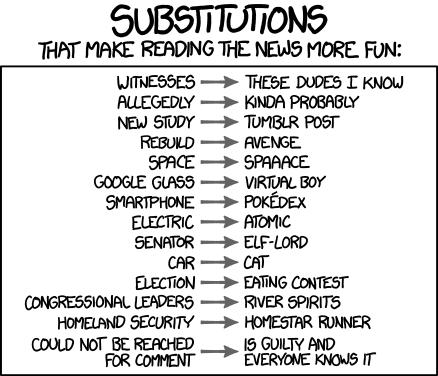
Lexical substitutions in the news

Well, better than the news, actually. In xkcd.


I already intuitively make some of these substitutions, like 'could not be reached for comment' to 'is guilty and everybody knows it' or 'new study' to 'tumblr post'.

Monday, October 28, 2013

Bakery

Luanne von Schneidemesser starts her fine chapter of Wisconsin Talk (the chapter is called 'Words used in Wisconsin') with a story of her daughter finding out, in the Pacific Northwest, that people didn't get the use of the word bakery to mean 'baked goods' rather than the place those goods are made. This is one of those terms that walks around in the open with no hint of stigma and sometimes surprisingly little awareness that it's a regional form. Stumblerette passed along this example from the local paper …


Tuesday, July 10, 2012

Truthinessology

Wow, now that is a good word. Hard to parse on a quick glance, probably, but how can you not love the study of truthiness. And is it normal in English to have another suffix after -ness?

Check out the WaPo story here. Linguistics gets only passing mention, and I'm kinda weirded out by the phrase "The college crowd says Colbert is worthy of study …". Sounds like 1950s …  getting on toward 'bobbysoxers krazy about Kolbert'.

Thursday, May 17, 2012

The decline of ain't

The Lingua Franca blog over at the Chronicle of Higher Education has a nice post from Allan Metcalf, of OK fame, on "The decline and fall of a 4-letter word". He makes a nice point:
“Ain’t” had the advantage over other four-letter words in being pure defiance or pure sincerity, not carrying any baggage of obscenity, blasphemy, or indeed any other content at all, since it is just a form of “be” or “have.”
One basic point is that it has lost its power to shock, with the key date being 1961, with the publication of Webster’s Third New International Dictionary, Unabridged.

I didn't first read "decline and fall" as being about taboo status but rather about frequency of usage. While spoken usage would be more interesting in many words, Google Ngram Viewer provides a pretty interesting data on this. Below are the images for English, American English and British English. (And, do I need to write it anymore?, click to embiggen.*)


Pretty surprising decline and fall, actually, and maybe surprisingly early, especially in American English — decades before Webster's Third, in fact. (And what the heck is going on with the late resurgence?)

But it's useful to have some kind of crude basis of comparison here, so I checked ain't versus isn't. That provides another little surprise:


The two words track very close until the beginning of the 20th century, diverge pretty sharply and then show roughly parallel paths with isn't far more common.

Anybody have a smart story for what's going on here?

* Oh yes, of course, because it's a chance to use embiggen.

Thursday, April 12, 2012

Meme and 'Among the new words'

Over on the American Dialect Society list, ads-l, there's been some discussion of the word 'meme'. That's enough excuse for me to call attention to the latest 'Among the new words' piece in American Speech by Ben Zimmer and Charles Carson (86.454-479).

Meme has developed a particular meaning with regard to the internet and Zimmer and Carson argue that memes have become "vehicles of linguistic dissemination". They cover a rich set of them, saying a lot of about honey badger, facebomb, facepalm, hoverhand, etc. And  derp or durp or derp derp. (Just do the google image search.)

At any rate, just a chance to remind you of how rich ADS and American Speech are ... whether you're a working linguist or just language obsessed.

Sunday, March 18, 2012

Language = words = spelling, etc.

When you see this headline in the Wall Street Journal, you might get nervous if you're a linguist (the WSJ piece is here and the article it discusses here:
The New Science of the Birth and Death of Words
Have physicists discovered the evolutionary laws of language in Google's library?
The punch line is that words are dying out faster than they're being created. 

The actual research article behind the journalistic story — "Statistical Laws Governing Fluctuations in Word Use from Word Birth to Word Death", by Alexander M. Petersen, Joel Tenenbaum, Shlomo Havlin, H. Eugene Stanley — is  pretty interesting in several ways. They chart stuff like how synonyms for new things get sorted out over time. For example, early on, people tended to say roentgenogram or radiogram more than xray, which eventually won out as the usual term in English. That's useful to know for people looking at language variation and change, among many others.

But the journalistic story may confirm your worries if you've had Ling 101. The title might worry you a little, in that the 'evolutionary laws of language' ≠ birth and death of new words.

But consider this:
Higher death rates for words, the authors say, are largely a matter of homogenization. The explorer William Clark (of Lewis & Clark) spelled "Sioux" 27 different ways in his journals ("Sieoux," "Seaux," "Souixx," etc.), and several of those variants would have made it into 19th-century books. Today spell-checking programs and vigilant copy editors choke off such chaotic variety much more quickly, in effect speeding up the natural selection of words.
Now, if radiogram dies out and xray carries the day, that's an interesting fact. But spelling variants? Has language changed in any meaningful sense if we stop writing Seaux?* That's not about the 'death rate' for 'words' but regularization of orthography. And the whole homogenization thing feeds the language-is-going-to-hell meme. At least it ends on a skeptical note:
In the end, words and sentences aren't atoms and molecules, even if they can be fodder for the same formulas.
True. Would be nice to have a linguist on teams like this ...

 *No.

Image from here.

Monday, February 06, 2012

On beyond Zebra!

Finally, the answer to a question I've been afraid to ask out loud ...

Congrats to DARE!

Friday, December 30, 2011

Uff da! Recall edition

The fight against the de-democraticization of Wisconsin has been filled with good, clean humor of the sort that our state is known for. Of all the buttons around (and the pics below are a few samples from the collection of one member of Team Verb who's been buying them up, like lots of people.)

But for all the regional character and humor of the protest buttons, I don't think I'd seen one with regional language on it. Thanks to D.D., though, the Mr. Verb Blogal Archives now include the specimen pictured here.

If you live in Wisconsin or the Upper Midwest generally, you know the exclamation Uff da!  (If not, Wikipedia gives the basics). It's traced to Norwegian (though there are some wrinkles there), and means (following Wikipedia) "used when something is unpleasant, uncomfortable, hurtful, annoying, sad, or irritating". Well, Governor, finally a list where you can check every box!

Monday, December 26, 2011

Old school paleo-

The American Dialect Society list (ads-l) has had a little traffic lately about the names that Ron Paul's followers have given themselves or that they've been given by others, including these:
Paulbots, Paulinists, Paulites, Paultards, Ron-Paulians, Paul[l]ination, Paulunteers
I've been wondering for a while about another terms associated with him, curiosity that was spurred by this morning's front page NYT piece about his unwillingness to distance himself from support from the extreme right. The article, by Jim Rutenberg and Serge Kovaleski, talks a fair bit about paleoconservatives and paleolibertarians. The contrast to neo-conservatives or neo-cons (and neo-liberals too, I guess) is clear and we have paleo- in lots of neutral, scientific contexts. Beyond that, it's pretty negative, it seems like. Looking around on Urban Dictionary, the uses of paleo- look mostly negative, like references to tech/IT, such as paleoadmin, defined there as:
An IT professional who has been running the same outdated systems for longer than you've been alive and who refuses to adopt more functional equipment and methods out of fear of having to do new things. Typically prefers equipment & software with the maximum amount of overhead so he can always look busy.
People probably aren't running out to label themselves that way. And I won't even try to talk about the paleo-diet thing.

The Wikipedia entry for paleoconservative describes the term as "somewhat tongue-in-cheek", but it sounds far worse than that to my ear. Sounds a little close to calling yourself a Neanderthal, but given their political views, Neanderthals should be gravely offended.

Saturday, December 17, 2011

The French having fun with their language!?!?!?

Oui, cher amis, c'est vrai ça, as they say.

Last summer, the latest edition of the classic French dictionary Le Petit Larousse contained a contest. As described briefly in the graphic here (cliquez à embigger, could we say?), they slipped in a couple of fake words, with a prize of 100,000 € — real money, for the moment at least — going to somebody who finds them.

I love the idea, fun with words in a pretty cool way. But even setting aside that our stereotypes about French views of their language are exactly stereotypes, I wouldn't have particularly expected this from Larousse, which makes it even cooler somehow.

I remain really excited about the culture of superstar lexicographers we have now in the US — Ben Zimmer on NPR just yesterday, Michael Paul Adams still a familiar name from his encounters with Colbert and his writings about slang, and Erin McKean (When somebody mentioned her name recently, a young person all but screamed 'Oh. My. God. I LOVE her.)* And the press about the new American Heritage Dictionary is cool (like this podcast, though I'm growing weary of the little thing about the end of print dictionaries.)


Oh yeah, so, I finally got around to checking the answers today ...

HYPERGRIPHE
et
AU JET

* Ha. Did you even notice that I didn't mention the superstar of all superstar dictionary-related things in the whole universe? Because I knew you'd think of DARE instantly anyway.

Wednesday, December 07, 2011

WOTY update: Winning, winner

Katy Steinmetz of Time has her 'top ten buzzwords' list for the year out now, here. Occupy is number one. (Sorry if that's a spoiler for you!) There's some utterly expected stuff, like carmageddon, haktivist and Arab Spring. All those are sure to be discussed in Portland. Man- as a prefix came up last year, but she maybe pushes beyond what was out there then.

But the piece warrants a post here for another reason: Her runner-up is winning, winner, in the new Charlie Sheen sense. It continues a kind of tradition -- I recall 'jump the shark' coming up back when -- but the surprise for me is that this candidate seems to have some passionate supporters. I don't see it winning WOTY, but maybe least likely to succeed … .

Can't wait for Portland.

Friday, November 25, 2011

WOTY

Yes, the rusty old WOTY machine has been dragged (drug?) out of the barn, cleaned off and oiled up. Oxford University Press has fired its opening salvo, squeezed middle, described here and defined as:
the section of society regarded as particularly affected by inflation, wage freezes, and cuts in public spending during a time of economic difficulty, consisting principally of those people on low or middle incomes.
The reaction from the American Dialect Society list and other Americans has been surprise, I guess. (Whatevs, my preferred current post on the OUP blog is about giving thanks for beer, here.)

I've heard and seen various suggestions already, aside from the discussions on the Log (like this). In the past, we here at Team Verb have tended to tilt at windmills on this topic (hey, peevologist is a cool word, dammit), but this year, let me play Captain Obvious:

The 2012 Word of the Year should be …

occupy.

Yes, I realize that the Global Language Monitor has made it their WOTY, which no doubt will cost it many votes at the ADS meeting. Still.

By the way, just before the WOTY festivities in Portland in early January, there will be a session about the Dictionary of American Regional English, our beloved DARE. Be there.

Image from everywhere, basically, but taken from here.

Monday, July 25, 2011

Debtpocalypse

It had to happen. See here.

Thursday, March 17, 2011

Viral spread, and of language change

Put huge numbers of people together in tight quarters, like say occupying a state capitol building, for a few weeks, toss in Wisconsin winter weather and the stress and strain of losing virtually all bargaining rights for all public workers in your state and what happens? Some evil bugs going around.

One of our crew has gotten it ... persistent hacking, more phlegm than clogs the guv's stunted conscience, etc. He passed along this email after giving it one of the common names …
OK. Capitol Cough, huh? That makes three names I have heard for the sick that has descended upon any who spent time in the Capitol: the Capitol Cough, the Capitol Plague, and the worst one yet, Rotundabola.
It's also being called the Capitol Crud and, wait for it, Scott Snot.

Do we need a reader's poll?

Sunday, February 27, 2011

The latest in word formation ... news from the front

This was once, and will be again, a blog about language. Massive political upheaval tends to upset things, though, and we're rolling with it. But the two meet sometimes: The new name for what's up at the capitol and on campus:

The Wiscy Rebellion.

Saturday, January 29, 2011

Smash mouth, every which way

With the Badger State in full collapse and the once great University of Wisconsin – Madison in grave danger, I've taken to my bed, stopped eating, thinking and blogging. Just hanging on, trying to make it to Super Bowl Sunday, like most of the state.

But Ben Zimmer's On Language column this week has pulled me back from the edge. Or at least gotten me to venture to the computer and write this post.

The topic is smash mouth, in three cool ways: Early attestation as UW student slang (meaning 'to make out'), in football usage (something the Badgers have long specialized in), and as the name of the great band, Smash Mouth.

Wow, it suddenly feels like the days are getting longer and maybe we'll make it after all. At least maybe I'll start blogging again.

Go Pack.

Sunday, January 02, 2011

Allan Metcalf's OK: The improbable story of American's greatest word

Ah, reader mail. I got this back in November:

Hey Mr. Verb,

Long time fan, first time caller. Er I mean, mailer. Just a quick question about this recent NYT Book Review article I saw.

I’ve always wondered about the etymology of OK, but find the explanation given as a misspelled abbreviation for “Oll Korrect” to be less than satisfactory. It’s so pervasive that this seems like a strange place for it to have spawned from – editor speech and/or a joke in newspapers. Do you happen to know more about this? How valid is this theory??

Thanks for any light you can shed on it!

Now I'm finally reading Metcalf's book, the subject of that review. He follows a line of argument developed by the late great Allen Walker Read, who originally traced the history. Metcalf in fact lays out in great detail just how unlikely that etymology would seem to be, but just how strong the case for it is. It's a remarkable story, but probably the key is that there was a craze, or maybe kraze I should write, of odd abbreviations and joking misspellings in the Boston Morning Post. It caught on with other papers and went viral, to really chop the story down. The same editor, Charles Gordon Greene, apparently used lots of other playful things, like O.W. for 'all right', which did NOT catch on. Word history is a weird and shaky enterprise most of the time, but this is a pretty decent looking story, from what I can see.

Metcalf goes through a pile of other stories. I highly recommend the book -- which Oxford sent to a member of Team Verb for review, by the way -- as a nice read. This is exactly the kind of book, by the way, that people who call themselves 'language lovers' should read ... it's clear and accessible and gives non-specialists, I think, a good picture of how to think about language history and language use. And Metcalf writes in a really easy style. If you've ever seen him preside over the Word of the Year discussions, you'll hear his voice as you read.