Monday, December 31, 2007

Snow berm: A word I needed!

Over at the Columnist Manifesto, Oscar Madison casually used a word for something I didn't have a word for: It's the (sometimes massive) row of snow that a plow leaves blocking your driveway. He called it a berm, and in fact 'snow berm' gets a lot of g-hits, including from municipal websites stating policies about this. People usually call the big piles along the side of the road a snow bank, but that's awkward when it's a relatively small amount. (Bank doesn't work for 6 or 8 inches of snow, only big amounts!) I had learned the phrase to be plowed in for driveways years ago, but lacked a noun for the situation.

Thanks, Oscar!

Image from this Forest Service website. (I would have happily called that a snow bank.)

Eye dialect trouble

I'm avoiding as much 'year in review' junk as humanly possible this year and looking forward to a less hectic 2008, but I still picked up the local free weekly Isthmus "So long 2007" issue. The little editorial/intro has this headline:
Buh-bye
Don't you hang for a nanosecond there before getting the right reading, namely (I hope) [bəbai]? This pronunciation seems to be associated with flight attendants, especially (from a SNL skit?). I was surprised to see Urban Dictionary with this definition:
normally used as a dismissive for a person's comments or an idea that is unwelcome or unpleasant. sometimes used after a look of disbelief.
It's not faring well — it's drawing mostly thumbs down on the reactions deal that UD has. But maybe this is how it's being used here?

Speaking of end of the year stuff, The Onion had the best ever title for a year in review issue: 2007. What the hell just happened? On a related, and more forwardlooking philosophical note, here's the Onion's Libra horoscope this week:
Your belief that God does not play dice with the universe will be tested by the discovery of a 10,000-mile-long craps table on Jupiter.
Happy new year, everybody.

Saturday, December 29, 2007

Panini

I occasionally link to wikipedia entries here, knowing full well the pitfalls of seeming to endorse a sometimes unreliable source of information. For a nearly random reason this morning, I searched for Panini, looking for a pretty trivial bit of information on Pāṇini, the Sanskrit grammarian. As someone who loves to eat and doing this at lunchtime, it crossed my mind that I'd probably get mostly hits for stuff on the pressed sandwich. Wikipedia came up near the top of the list and you kind of know you'll get one of their "disambiguation pages". But I didn't expect this much ambiguity:
Panini can refer to:
  • Pāṇini, 5th century BC Sanskrit grammarian
  • a type of Italian sandwich
  • a zoological tribe containing chimpanzees and their relatives (usually considered obsolete)
  • Panini (stickers), a brand of collectible stickers, created by the same company as Panini Comics
  • Panini Comics, a publisher of comic books and magazines
  • Giovanni Paolo Panini, an Italian artist
What, no link to the Panini Museum (classic cars)?!?!? And I didn't know about the chimps OR the stickers.

The restaurant possessive

Over on ads-l, there's been an engaging discussion of a presumably genitive -s being added to business names, starting from a post about how natural Wal-Mart's is for one person. Of course, this has been the object of study. Dennis Preston wrote about a student paper at Michigan State:
It's very common here in Michigan. It's more common when the store name is a personal name (Meiers, which is just Meier, Krogers, which is just Kroger, Penneys, which is just JC Penney) but extends to ones that are not (even Targets and K-Marts). Wal-Mart is (luckily) newer here in MI, so it was not covered in this study, which was done more that ten years ago (as a class paper and sadly not published). ... Its use, by the way, is sensitive to sex and shopping frequency at an establishment.
Here in Madison, this is a pervasive characteristic of restaurant names. We held the 17th International Conference on Historical Linguistics here in 2005 and the restaurant guide included this note, suggested by a couple of UW PhDs:
Restaurant names are regularly marked in this region by addition of an -s suffix. Almost any of the names below can be produced with a final s.
It's downright unusual to hear anything that sounds like a possible personal name, and stuff probably beyond, without the -s:
  • Porta Bella > Porta Bella's
  • Casa de Lara > Casa de Lara's
  • Himal Chuli > Himal Chuli's
  • Buraka > Buraka's
  • Kabul > Kabul's
  • El Dorado > El Dorado's
  • The Nitty Gritty > Nitty Gritty's
You don't hear it on some names ending in familiar (non-proper) nouns, and I have heard some speakers declare things like these ungrammatical:
  • Sun Porch, *Sun Porch's
  • White Horse, *White Horse's
Anybody familiar with the s spreading to forms like those?

(Modified from a post on ads-l.)

Thursday, December 27, 2007

AFT on academic freedom

The American Federation of Teachers has released a major report called Academic Freedom in the 21st-Century College and University: Academic freedom for all faculty and instructional staff. (It's available in full here.) Their definition of the key term is taken from the First Global Colloquium of University Presidents, in 2005:
At its simplest, academic freedom may be defined as the freedom to conduct research, teach, speak, and publish, subject to the norms and standards of scholarly inquiry, without interference or penalty, wherever the search for truth and understanding may lead.
That should sound pretty familiar to us here in Wisconsin. I read the document as a call to arms for all of us. Here's where they throw down the gauntlet:
Today, … the American Federation of Teachers issues this statement out of a deep sense of urgency about the status of academic freedom now and in the future. Increasingly, we see a variety of threats to the practices that support academic freedom. These include:
  • The increasingly vocational focus of higher education;
  • Loss of financial support for colleges and universities;
  • Corporate-style management practices;
  • Political attacks on faculty and instructional staff;
  • The erosion of academic staffing through the loss of full-time tenured positions and the financial and professional mistreatment of contingent faculty members.
That pretty well sums it up. These are all issues here at Wisconsin, of course, and some of them are burning bright right now. But note how it's mostly about money, always with the corporatist political angle lurking in there.

You should read the report and draw your own conclusions.

Image from here.

Wednesday, December 26, 2007

A tiny example of language change?

Yesterday, the missus was talking to a set of highly educated and sophisticated young folks — all around or under 40 — and discovered (don't ask me how) that they all knew the word louse only in the figurative sense, as applied to human beings: "a contemptible person", as Merriam-Webster's has it.

They knew the plural form lice for the little critters pictured here, but not singular louse. At least one of them (probably the youngest) went to a school where she knew a kid who had head lice, so the creature isn't foreign to them either. It seems clear that the main meaning is now the human one, but Mrs. V was a little surprised that they'd lost the old, basic meaning entirely.

It's surely the case that most Americans are utterly unaware that lousy originally meant 'louse infested', and now louse is going the same way. (M-W does have that meaning of the adjective listed first still, by the way.)

Well, hey, I did say a tiny example of language change.

Image from here.

Unquestioned authority and language

In a comment on a recent post, The Ridger asks a question that probably eats at all of us who work with language in a scientific way:
Gosh, why can't people just accept that the -ING form has five functions, including if you insist on Latin terms the gerund and the participle but also forms that Latin just doesn't have? Why is that so hard? Last month I fought for five days with a student who insisted on clinging to the terms he learned in the 1950s ... People let other fields of science advance, refine, and develop. Why must grammar remain unchanged?
That last sentence gets at something about linguistic prescriptions that a lot of people have commented on, like Deborah Cameron in Verbal Hygiene (1995:12):
Within the privileged space of the academy … where it is normally a sign of intellectual competence to broach the question ‘why?’, questioning the minutiae of linguistic conventions is a sign of incomplete or faulty socialization.
Lately, I've taken a new tack with some non-linguist colleagues in such discussions: I've tried stressing that the standard has a real role, that I try hard to use standard forms in formal writing, etc., but … [fill in standard rhetoric]. That's proven stunningly ineffective … on the next linguistic feature that comes up, discussion quickly seems to loop back around "but what's the proper word/form/structure?" Sigh.

Tuesday, December 25, 2007

Ben Zimmer on WPR

Can't believe I missed it completely, but lexicographer Ben Zimmer just appeared on Wisconsin Public Radio with Ben Merens. (He also interviewed some of the Wisconsin Englishes Project folks, just as they were getting that project up and running.) The link is here. As you'd expect at this time of year, there's lots of Word of the Year stuff plus some call-ins.

Well, we've got Chanukkah, Solstice and Festivus behind us now, and Christmas is here, so it's just Kwanzaa to go, then New Year's.

Monday, December 24, 2007

Wisconsin "ethnic dialect": Holiday update

Wisconsin Public Radio just did a piece on the book The Cheesehead Night before Christmas, by Fred Lane and Romey Wagner. (The WPR link is this, and the book is available here.) The book's a rip-roaring scream, from what they report (and see here for video). They worked every possible dialect stereotype into the text from da Pack to boots lined up "side by each" (yes, people actually say that sometimes).

Good as the story is and as much fun as a dialect humor is, the kicker is that WPR's reporter talked about this several times as Wisconsin "ethnic dialect". What we've generally seen happen over time is that ethnic features have become regional — 'come here once' may have roots in the German modal particle mal, but tons of people of many ethnic backgrounds use it in especially eastern Wisconsin. Is this a not-quite-successful reference to that past? Are Wisconsinites now forming a new ethnic group?

Whatever. I know what I want to find under the tree.

Blogal and other odds and ends

Loose ends, all positive:
  • WotY discussions are steaming along -- it's real when the NYT runs its now-annual Buzzwords piece. Grant Barrett had a huge piece yesterday, most of a page with almost another page of graphics. The piece has been talked about some elsewhere already, especially ads-l. There's no analysis of cropping or blending or anything, but it's a good and prominently placed discussion of language, which is welcome.
  • Also already talked about in bigger forums is Heidi Harley's dramatic antedating of eggnog (worked out together with an undergrad) — taking it from an earliest known date of 1825 to 1774.* She's a prominent theoretical linguist doing a little word history and I don't think anybody's underscored how healthy that kind of crosscutting is: This is somebody thinking about language and how it works in a broad way.
  • Safire — yes, him — quotes Stephen Anderson, president of the Linguistic Society of America, on the old are-ing-forms-participles-or-gerunds chestnut. He and Lindsay Whalen give Safire what for a maven must be wonderfully unsatisfying answers. Safire concludes "this needs settling" and asks for mail for input on a future column. I can hardly wait.
  • NPR's doing a week-long series on blogging this week, and Steve Innskeep used blogal this morning.
*I don't drink the stuff myself, but if I did, it might be the brand in the picture, from here.

Saturday, December 22, 2007

Great moments in lexicography: Cab Calloway edition

NPR is celebrating the 100th anniversary of the birth of Cab Calloway. I must have once known but had forgotten that, among a huge set of other accomplishments, he was a published lexicographer: The New Cab Calloway's Hepsters Dictionary: Language of Jive.

And while we're at it, happy solstice everybody!

"Special" stigma

Every once in a while, you expect a social change so long before it happens that you're eventually surprised to see it come to pass. A possible example is here. Wisconsin has a really active arts program for folks with disabilities, called, until just now, Very Special Arts Wisconsin. They've changed the name to "VSA arts Wisconsin", following the national lead, and "the letters now stand for Vision of an inclusive society, Strength of shared resources, and Access to the artistic expression that unites us all". (This explains the 'arts' tacked on.)

Martha Doherty, communications coordinator of VSA arts Wisconsin, wrote this, run under the headline "VSA arts name change removes 'special' stigma":
The continued use of the term "special" to define people with differing abilities perpetuates the myth that people with disabilities are somehow different from people without disabilities. All people are "special" in some way. Each one of us has traits that stand out, yet we can all agree that we don't want our perceived "weaknesses" to define us.
The way we talk about disability seems to have long passed beyond 'special', and the institutional change is a kind of lagging recognition of that. But is "Special Olympics" so established that it'll say on indefinitely?

Friday, December 21, 2007

"almight"

OK, it's a word kind of day, I suppose. There's a great (newish, I think) band called Jenny Lewis with the Watson Twins. In their song "The Charging Sky", a nice lyric about religion (read the whole thing here). What struck me was this:
And it's a surefire bet I'm gonna die
So I'm taking up praying on Sunday nights
And it's not that I believe in your almight
But I might as well, as insurance or bail.
My interest, for the moment, is not in this popular statement of what philosophers call "Pascal's Wager" (summarized here), but in "your almight". Is it a back formation from almighty? Would make sense, surely. In flipping through a few g-hits (hey, when did THAT word die out?), I find basically misspellings of the adjective.

"to see", verb: Because somebody has to do

You've heard it by now: Romney said "I saw my father march with Martin Luther King." Here's one summary:


Did Mitt Romney 'see' his father march with Martin Luther King?

… The American media pounced on the statement and quickly discovered that Mr Romney had been in high school at the time, more than 30 miles away from Grosse Pointe, Michigan, where the 1963 civil rights march he was referring to took place. … Mr Romney said he was an "English literature major" and he had used the verb "saw" in a figurative sense.

He told reporters: "If you look at the literature, if you look at the dictionary, the term 'saw' includes being aware of in the sense I've described. "It's a figure of speech and very familiar and it's very common. And I saw my dad march with Martin Luther King.

"I did not see it with my own eyes, but I saw him in the sense of being aware of his participation in that great effort."
I was hoping for a post on some language blog where a person knowledgeable about lexical semantics would deal with this. But I just don't see much chance that Romney's claim is true. Most importantly, I don't see anything quite like this kind of meaning in the dictionaries I've checked that would fit this context. Merriam-Webster's doesn't get much closer than "to form a mental picture of" or "visualize", as in "I can still see her as she was years ago" (paraphrase of their example).

OED gives some hilarious options for reading this:
d. To behold (visual objects) in imagination, or in a dream or vision. So to see a vision, to see a dream. Also in phr. to see things, to suffer hallucinations or false imaginings; (usu. colloq. as pres. pple.).
OK, that's not what he meant, I imagine. But the figurative uses of to see seem not to refer to specific events but things more like the opening line of Allen Ginsberg's Howl:
I saw the best minds of my generation destroyed by madness, …
It seems impossible to come up with a scenario for figure see where you are talking about a specific event where you could have been but weren't, unless it's about learning it by reading the paper or something. Yeah, to see has lots of figurative uses, and those include something like 'to be or become aware of'. But not like this. Am I missing something or is this another screaming lie by a pol? It's a question for the historians whether his father actually did march with King.

Update, Dec. 22, 3:00 pm: Well, I'll be danged: People have come forward insisting that Romney (père, not fils) did march with King. That takes some of the sting out of this.

Image from here.

Wednesday, December 19, 2007

Latin today: A better take

After Harry Mount's disappointing recent NYT op-ed piece on Latin (discussed all too gently here), it was good to see Emily Wilson's piece in Slate yesterday, "The Renaissance of Latin: Why a dead language is becoming popular". It is a review of Mount's book, actually, called Carpe Diem: Put a little Latin in your life in the U.S. edition, but Amo, Amas, Amat ... and All That in the original U.K. version. She suggests that the title change comes from the assumption that a certain set of Brits will recognize amō amās amat (say it with me now: amāmus, amātis, amant …) as part of a verb paradigm where not enough Americans would.

Wilson does a good job at laying out "the cultural place of Latin" in the U.S. (keyword: geeky) and current popular interest in the Roman Empire (keyword: collapse), before turning to a few graphs about Nicholas Ostler's just-published Ad Infinitum: A biography of Latin (Amazon's description here*). Now that sounds more like a book I want to read, for its socio-historical account of Latin.

Image is the famous Old Latin duenos inscription (from here) just because it's good to be reminded that we really don't understand everything about the Roman world.

Update, Dec. 20, 6:00 am: The WSJ also has run a review of both books, here, by Michael Poliakoff.

*The bio for Ostler there ends with this sentence: "He lives in England, in Roman Bath, on the hill where Ambrosius Aurelianus defeated the Saxons for a generation." That's wildly ungrammatical for me for aspectual reasons: to defeat is punctual and doesn't work with "for a generation." Held them off? Beat them back? Defeated them repeatedly?

Tuesday, December 18, 2007

Loose ends …

As I try to sweep up the debris of a semester that's gone way too fast, a few loose ends …

(1) The Rothenberg Report has a piece on the meteoric rise of Mike Huckabee in the Republican field, with this:
In a sense, Huckabee is the second coming of former Sen. Fred Thompson (R-Tenn.), who now seems about as relevant as a typewriter at a bloggers’ convention.
Wow, political writing with a fresh yet relevant image. Go, Stuart R.! Googling the exact string typewriter at a bloggers’ convention, I find only a set of quotes of the Rothenberg piece, including this brilliant quip at Eunomia:
That Seems Unfair To The Typewriter
A typewriter at a bloggers’ convention would at least have the advantage of being unusual and something of a curiosity. Some of the younger bloggers may have never seen one outside of a museum. I’m afraid Fred Thompson is no longer that interesting.
(2) Jack White, of the White Stripes, just now on NPR was talking about "all those words that start with r" that he doesn't like: retro, recreate, etc. Come'on, dude, let's do some morphological analysis here … they start with re-, of course.

(3) In a more consequential piece, NPR just reported that "Monkeys Estimate as Well as Humans", at least two monkeys compared to a set of Duke University undergrads. There may be blogging gold in the report, but no time to mine it now ... .

(4) John Morgridge (once CEO of Cisco) and his wife Tashia have donated 175 million dollars to help mostly low-income Wisconsin kids attend public universities and colleges in the state. We shouldn't have to rely on gifts for this, but you have to appreciate these folks stepping up like this.

(5) My post from yesterday afternoon worked its magic … the National Weather Service is calling for a high of 32º F today … and sunny. That'll help clear the streets.

Image from here.

Monday, December 17, 2007

Weather


It seems cold in Madison these days, even though we're up to 23F today. We've had a lot of snow and it seems possible that we'll have snow cover through a good chunk of the winter at least. What seems notable is how long it's been since we were above freezing. Pretty long for this early in season. See the graphic, from here. (Yes, another service provided for our state by our university.)

Conglomerate: The free market and academia

Our good friends over at Sifting and Winnowing are barely out of the starting gate and they're getting some attention. The Conglomerate Blog has posted a piece talking about S&W's take on the chancellor's (future) pay package (as well as noting our views here at Mr. V), concluding:
Attracting outside talent requires the University to acknowledge the market for university presidents. Outrageous!
Well, yeah, it is, if you're interested in advancing and disseminating knowledge. I don't know him at all,* but I'm guessing that Gordon Smith, author of the Conglomerate post, believes in the power of the free market. But raw greed is seriously overvalued today. The S&W post rightly asked whether such salaries are based on performance. I'd be very interested in seeing any plausible data showing that university presidents earning 700K+ perform better than those earning a mere 250K, for example. Certainly among rank-and-file faculty, I have watched a number of departments where not particularly outstanding professors have gotten outside offers, often from pretty weak institutions, and driven their salaries up many tens of thousands of dollars above that of more active, productive and generally valuable colleagues. The outside offer game takes a tremendous toll on these people's research and teaching — it is very time-intensive to pursue such offers, for one thing.

But enough non-linguistic content. Conglomerate has a detailed story of how they arrived at their name, here, which calls to mind Nancy Friedman's fine piece on the origins of linguistics blog names. These guys chose the name for its 'businessy' sound, among other reasons. But their sense of the term is dramatically different from my own, and probably that of many readers of this blog. For me, conglomerate has a very negative ring to it. It calls to mind the buying of companies to drive up stock prices, where people got rich off manipulating markets, not by producing goods or delivering services. I'm just making a point about word meaning here, not about what's good business practice, but a similar view of conglomerates is laid out in this wikipedia entry, and also in this post on Conglomerate Monkeyshines.

If you name your forum the Conglomerate Blog, you are pretty much obligated to endorse the CEO model for university administrators' salaries.

*It appears we do share a love of cheese, though.

Sunday, December 16, 2007

Accelerationism and its discontents

For most of a week, I've been following the story about the acceleration of human evolution, talked about here and almost everywhere else on the web. The basic point of a paper coming in PNAS is that the rate of human evolution has picked up dramatically over the last handful of millennia. This has to do with the rise of farming, increased population size, etc. The paper tackles the (to me always troubling) notion that we've stopped evolving and turns it on its head. But please don't take this one-liner summary if you haven't followed the story … read about it. The best scoop looks to me like John Hawks's blog. He's one of the authors and has already posted good comments on the acceleranistas (his term) and critiques of the piece, and promises more.

I'm trying to follow the stuff on genetics and the math used, but can't comment on those things directly. Still, I immediately wondered if this wasn't testable: Not everybody did switch to farming and saw increased population size, etc. and you should be able to contrast the presence of new alleles by that variable. (Lawrence Moran raises what I take to be the same basic point here.) Hawks (who teaches Anthro here) was quoted in one of our student papers as saying this:
We are more different genetically from people living 5,000 years ago than they were different from Neanderthals.
This isn't just a claim about disease resistance and such, but basic cognition, it sounds like. If so, whether or not we assume Neaderthals had language (see here), language would have been structurally different from what we see today. That hunch is supported by another collaborator on the project, Eric Wang, who was quoted as saying this:
Instead of saying, ‘Go straight, kill a deer, eat it,’ people have to free up their mind and be able to articulate ideas that were otherwise abstract. … It’s a different layer of selection.*
I pondered language-related angles of this for a while, but didn't get any inspiration until yesterday, when a colleague emailed with a question:
Just an aside, when was the Rigveda written and do we think that Panini's brain was different than ours? … This raises a very important question: can humans' genetics be so different (statistically speaking) in so short a time that our brains are fundamentally different than Panini's? … It seems to raise all kinds of issues about the purpose of studying 'dead' languages or saving endangered languages. Once they're gone, we can't use them as evidence for linguistic theory, just as historical relics of past cognitive function.
OK, let's say Panini — author of a brilliant grammar of Sanskrit and the envy of many linguists — lived upwards of 2,500 years ago, and that the Rig Veda was composed more like 3,500 before the present. Presumably his brain would have been a little different, and the authors of the Rig Veda probably more so. In dating Indo-European, people talk about reaching a good 5,000 years back (a date also the above quote). The claim would seem to be that IE was spoken by people with different cognitive capacity than we have today. Of course, lots of linguistic prehistory deals with dates a lot farther back.

Under this view, wouldn't early IE be structurally different from modern languages in some ways due to cognitive differences? If these guys are right, comparative and historical linguistics becomes a completely new game: By the time depth of IE, you'd have to assume language was spoken by people who were evolutionarily pretty different from us. For Nostratic and all other proposals by "long rangers", you'd have to presume dramatic differences. One way to really rile up old-school historical linguists is to claim that languages were 'simpler' in such times.

I'm really curious how this will play out.

* If this is right and it stems from what they think it does, it raises big questions about emerging differences between people who've been far less or more isolated during that time. That makes me really nervous, but I don't know what story these folks have on that and maybe it ends up less scary.

Saturday, December 15, 2007

"Pay will limit chancellor search"

"Lowest among peer universities". That's the title and subtitle from a new AP story.

The current chancellor scrapes by on not much over $320,000 per annum plus behind the scenes stuff and connections to be cashed out later. And he gave back two pay raises so I'm not trying to hammer him here.

But the thought that we might not be able to get a good replacement without doubling the salary troubles me. Look at the CEO pay in higher ed (like here) and you might wonder if somebody who demands $700,000 (the number that always gets named for top public university leaders, it seems) is really the person we want. Pushing for big executive bucks strikes me as an indication that a person might be a card-carrying member of The Problem, as opposed somebody looking for The Solution.

I'd much rather have a chancellor who says "gimme 250K and put the rest toward teaching more classes that can mean something to the people of Wisconsin — from biotech and animal science to history and local culture." Well, we can still dream, can't we?

Image from here.

Friday, December 14, 2007

The Onion does German?

America's Finest News Source, onion.com, has long played with German-language stuff. I've always assumed that about the names of the founders, the Zweibel family, which has gotta be German Zwiebel 'onion' with a little orthographic play.

So the next-to-last-item below isn't a shock:

But when you get to the horoscopes, I'm baffled by this:

Wundt, first off, presumably counts as a psychologist (a founder of the modern field, in fact) and I thought he trained in the natural sciences. (No time to check right now.) So, he's a philosopher only in a very broad sense. Is this some really smart allusion to XPhi? The rest were more prototypical philosophers, and German-language ones, I'll grant, but Heidegger was born in September of 1889, so not a "19th century" philosopher in any usual sense.

Wtf?

Locavores, in the wild!

The little w00t thing in the last post was kind of a throw-away, but I was poking at a real issue … Many of us now actually are referring to "word of the year competition season" when we say "happy holidays".

As the WotY industry has grown, it's changed. At the American Dialect Society, folks are careful (well, sorta) to sort out categories like 'most useful', while the popular press and lexicographers are all over the map with it. W00t is good since it's actually used a lot.

Locavore, by contrast, is cute and captures something good happening culturally, but it was not exactly in wide use when the competition started, certainly not in my circles. I doubt I'd ever seen it printed on paper before then, for example, though it's got a pretty good web presence. So, I was pleased to see that the NYT's op-ed page today has two articles that use the term for real, here and here, after it came up a few days ago on the paper here.

OK, back to mulling over the catastrophe of the steroid scandal ... and don't get me started on the topic of Krugman's column, just too depressing.

Image from here. And I'm not even trying to figure out what it means. It can't be good.

Thursday, December 13, 2007

W00t! MIT language learning workshop going on-line

As for w00t, that's use not mention … I know it's Merriam-Webster's 2007 Word of the Year. Nice to see l33t get that kind of attention, but it's really pretty gimmicky, I figure, for WotY. See here for some good discussion of history and use of the term. (I heard the 'we own other team' story this morning, in fact.)

The reason for using it here is not that I've reached level 17 on whatever game the kids are playing these days. Instead, it's that the video of the recent MIT workshop on "Human Simulations of Language Learning" is starting to come on line, here. The presentations address current issues in poverty of stimulus, with — so it looks — a good focus on the really fundamental importance of this debate.

Right now, only Robert Berwick and Mike Coen's opening remarks and Lila Gleitman's talk and Q&A are up, but the rest is coming. I haven't had a chance to watch it yet, but am eager to.

Wednesday, December 12, 2007

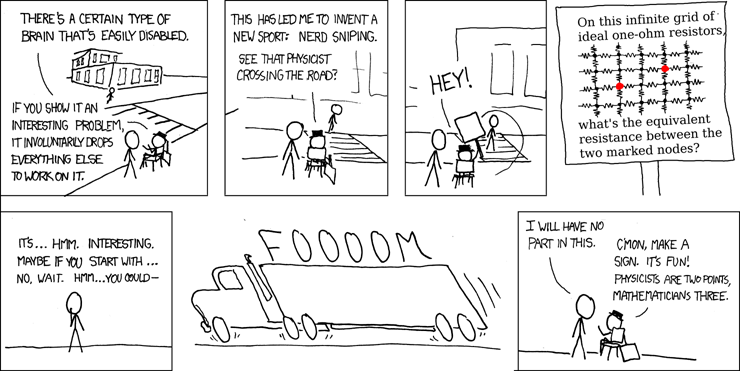
Nerd-sniping

Easy enough to make signs to snipe linguists, I fear …

Tuesday, December 11, 2007

Political codeswitching?

Was just listening to Randi Rhodes Show — which I seldom do — and she was on a tear about Oprah's speeches in support of Obama. She's slamming Oprah for "turning into a Black preacher", calling it "an act", "creepy", among other things. "It's just not the way Oprah speaks", etc.

Now, I don't actually know Oprah Winfrey personally, and never watch her show. But I gather that switching how she talks is part of who she is. Consider this chunk from a blog post giving her far more grief than Randi Rhodes on a wide range of topics:
Irritating quality number 617: Oprah's constant dialect shift. Never content to accept her crown as the voice of the goods-crazed white mother, Oprah is known to shift in between several different dialects, accents, and speech patterns during a single broadcast. A somber, intellectual tone is replaced two seconds later with a southern drawl in the midst of Paula Deen. The white Oprah will turn on a dime to morph into black Oprah without the aid of a phone booth for changing purposes.
This writer claims to do closed captioning for Oprah's show, and if that's so, has paid close attention to Oprah's speech. I take that to suggest that Oprah's repertoire does include this kind of style.

Rhodes has gone into great detail comparing this to Hillary Clinton's "pandering" with a switch to African-American tinged speech. Leaving aside the wrinkles in that story (long story short: Clinton was mostly reciting lyrics). Clinton surely doesn't speak the variety she was referencing and it's at least plausible that Oprah speaks the one she was using natively or near-natively.

John Wiley's legacy

The CapTimes has an editorial this afternoon worth reading, called Replacing John Wiley. They walk through his successes, and then, instead of falling into the 'personnel problems' trap we've seen so far, they talk frankly about his shortcomings:
The UW has a history as a great academic institution, but that legacy has been endangered in recent years by a neglect of the liberal arts tradition. Too many of the finest faculty members have moved to other schools, leaving once-great departments diminished.

Additionally, the Wisconsin Idea of a university intricately linked to the state and its people has withered as the UW has come to rely more on corporate funding for research. … There are fewer public intellectuals among the ranks of its professors. And its ideals and programs seldom seem to reflect the progressive values of a state that worked hard to make the UW one of the great institutions of higher learning.
They conclude this:
John Wiley has been an able administrator in many significant senses. But the next chancellor must take a broader view of the UW's mission and its need to reconnect with Wisconsin.
Dead on the money.

Sifting and Winnowing

As a heavy blanket of fresh snow falls here in Madison this morning, the local internets are blazing bright with news of a most welcome new forum for ideas about how to move our university forward in these difficult times. Click here to visit the new blog Sifting and Winnowing.

The creation of this blog is one of the most positive pieces of news in quite a while. There's a real need for this and I look forward to seeing it develop into a kind of digital public square for us.

The name, for our non-Wisconsin readers, comes from the famous Ely decision on academic freedom, and "sifting and winnowing" is one of the truest points of pride at the University of Wisconsin.

Image from here.

Monday, December 10, 2007

"Mitt Romney's ominous verb"

The most reliable person in the lingua-blogging world, Ben Zimmer, passed along this link when it was fresh, but I'm only now getting around to it. (I'm still not quite making enough money blogging to give up the old day job ... maybe soon.)

It's Walter Shapiro's fine piece in Slate on Romney's religion speech and here's the opening:
Reading the advance text of Mitt Romney's speech this morning on "Faith in America," I came upon a very un-American verb. (No, it is not the transitive use of "torture" or "waterboard.") The verb in question -- which is normally innocuous, but in this context is ominous -- is "require."

Here is the passage that troubles me: "Freedom requires religion just as religion requires freedom. Freedom opens the windows of the soul so that man can discover his most profound beliefs and commune with God. Freedom and religion endure together, or perish alone."
Now, I'm hard pressed to figure out why transitive torture and waterboard are more ominous than intransitive ones — the intransitive "the U.S. tortures" seems at least as bad as a version with a direct object, maybe more threatening. Beyond that, though, Shapiro is dead on the money, that the core statement ("freedom requires religion") "is historically ludicrous". And he decodes the real message, the dog whistle if we can nod toward Ben Zimmer: What Romney might have said is the far more truthful: "Republican politics and religion prosper together, or they lose elections alone."

Sunday, December 09, 2007

The experimental mentality and the armchair

One of the most thoughtful and faithful readers of this little blog (let's call them 'T') emailed even before today's NYT arrived on our snowy porch to announce a piece in the Sunday Magazine by Kwame Anthony Appiah called "The New New Philosophy". It's the kind of finely written and argued piece you hope to see in the NYT Magazine. (Yes, there's an implied contrast to a regular feature).

Appiah is sketching the world of experimental philosophy. As T notes, this discussion of a move from the armchair to the social-science interview and the hard-science lab parallels what's happened in linguistics: From an early generative world of introspective judgments about sentence structures, a lot of linguists have taken to using fMRI evidence and lots of other neuro- stuff, plenty of classic psych-type perceptual experiments and so on. T may be thinking specifically of the old divide between theoretical phonologists, once derided openly by lab folks as 'armchair linguists', and experimental phoneticians, once derided by phonologists as people 'who measure the bejesus out of everything with no interest in what it means.' The very name of the LabPhon movement — that's Laboratory Phonology, started back in the 1980s — highlights the effort to bridge precisely that divide. And it's been a tremendously productive ride, I'd say. (See here for one view of what's going on and what's at stake.)

Appiah uses the notion of the armchair, traditional symbol of the philosopher, to good effect. He concludes:
There always comes a point where the clipboards and questionnaires and M.R.I. scans have to be put aside. To sort things out, it seems, another powerful instrument is needed. Let’s see — there’s one in the corner, over there. The springs are sagging a bit, and the cushions are worn, but never mind. That armchair will do nicely.
Well, kinda. But we've got the problem illustrated just below, in a sense, and he's already made the right basic point earlier in his article:
[A]lthough experiments can illuminate philosophical arguments, they don’t settle them.
Isn't that the usual relationship between argumentation and experiments? Experiments are ways of providing data to test hypotheses we've come up with. Appiah is utterly right that experimental results have to be interpreted. But as I read his conclusion, he's saying that armchair work does settle philosophical arguments. I beg to differ: Those interpretations inevitably lead to sharper hypotheses and new rounds of experimentation. A lot of linguists are working on balancing these things today, including bridging that old phonetics/phonology gap.

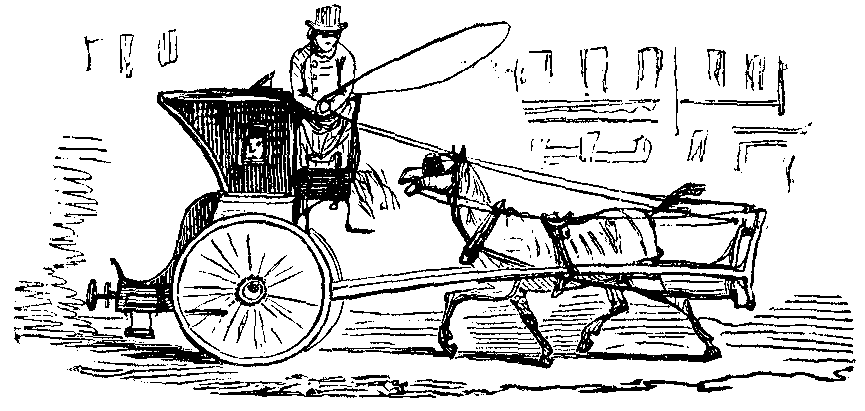
And yeah, the cart-before-the-horse metaphor definitely breaks down – it's a cycle of interactions, of course.

Image from Punch, taken from here.

Friday, December 07, 2007

Breaking news ... Wiley retirement

Chancellor Wiley to resign. See here.

Happy Repeal Day!

Forgot to note that December 5 was the 74th anniversary of the repeal of Prohibition. More here.

Winter biking

First, just for the record, freedom does not and can never "require religion".

Former Madison mayor and progressive Wisconsin icon has pissed off about everybody by complaining about winter cyclists. Here's the local paper's take, with a link to his blog. He wrote, sarcastically:
The bicyclists who braved the week's second storm should be taken out and shot.
I think you kinda blew it there, Paul. Maybe you should use emoticons or something to make your intent clearer.

Thursday, December 06, 2007

The Linguistics Wars!

What year would it be if you read a new piece by George Lakoff skewering Ray Jackendoff? Try 2008, in a preprint for a book review for American Scientist, here. It's got some of that old-time religion, like this:
The time was ripe for Noam Chomsky to adapt the symbol-manipulation paradigm to linguistics. Chomsky's metaphor was simple: A sentence was a string of symbols. A language was a set of such strings. … Meaning and communication could play no role in the structure of language. The brain was irrelevant. This approach was called generative linguistics, and it continues to have adherents in many linguistics departments in the United States.
Of course, the "continues to have adherents" tells you that the 'cognitive revolution' is coming in the next paragraph. Lakoff ends on a more positive note, happily:
For a cognitive linguist like myself, reading Jackendoff's book is both painful and hopeful—painful because he keeps trying to do interesting and important intellectual work while being stuck in a paradigm that won't allow it, and hopeful because he may help the transition from a brain-ignoring symbol-manipulation paradigm to a brain-based neural theory of thought and language. I wish that other linguists, both generative and cognitive, had his scope and intellectual ambition.
It sure seems like about all of us are wrestling with this fundamental question these days, that is, how to reconcile evidence from these two long-warring traditions. And the best members of the newer generation seem to be doing it pretty collegially, at least in the circles I move in.

Restructuring Linguistics

We noted a while back here that the University of Illinois, though unable to rid itself of its racist mascot, has been able to create a School of Literatures, Cultures and Linguistics. Now this release indicates that their Senate has …
approved a proposal to merge the Division of English as an International Language and the department of linguistics into a newly configured department of linguistics. All curricular programs will be transferred in their current forms to the new department. When the merger has received all necessary approvals, an internal committee will be established in the new department to help resolve any issues that emerge during the transition.
I've argued before that one of the things linguistics needs to more bridge-building to allied fields. This sounds like a good move to me.

Holiday blending

The "December dilemma" is pretty famous by now and it's in the news this morning. For those of us who don't practice any organized religion, it seems like there are two approaches to this time of year. There's the kind of unitarian approach — celebrate them all. (I heard someone who surely has no connection at all to Jewishness wish another such person Happy Chanukkah a couple of days ago.) As a pretty fundamentally secular person, I tend to ignore them all, save for some gift giving.

The former trend, I suppose, is embodied in some famous holiday blending. Maybe the case at hand is more of superblending, actually: Chrismahanukwanzakah, aka Chrismahanakwanzaka, Chrismahanakwanza, Chrismahanakwanzika. That seems like a limited set of options for the morphological and orthographic hurdles we're clearing here, yet if you type chrismahannukwanzakuh into google, you get
Did you mean: chrismahanukwanzakah
Yeah, exactly, that's what I meant. If you don't recall the term's history, it's originally from a commercial, Virgin Mobile from a few years ago. A quick overview is at wikipedia, here, but the real goodies, including the ads, can be seen here. It's only been mentioned a couple of times in passing on the Log, I think, where Ben Zimmer rightly noted (in a post about the short-lived holiday Abramoffukkah):
If there's such a thing as an overdetermined neologism, this is certainly an example of one.
The latter trend is only slightly less commercially defined, Festivus from Seinfeld (see here, for example). A few years ago, Wisconsin governor Jim Doyle famously bought a festivus pole (here) and a big manufacturer of them is in Milwaukee (here). OK, you're thinking, no blending here. Well, festivus is presumably a pseudo-Latin neologism, but Doyle is adept at blending, although it takes us off-topic: Wisconsin's governor has the broadest budget veto powers in the nation, so that they can strike through any parts of the budget basically. Doyle has used that creatively, slicing out parts of sentences in the budget and creating entirely new sentences with those cuts. (Don't have a good example at hand, but they exist.)

But back to our topic: Chrismahanukwanzakah is hardly the only superblend around. More on that later.

Wednesday, December 05, 2007

REAL news on immigration: Lou Dobbs on Democracy Now!

We've talked a fair bit about language and immigration lately, but not about the broader issues of anti-immigrant rhetoric. The king of that movement, if we ignore the really vile hate mongers, is Lou Dobbs. He's pursued a kind of populist line for years, with his 'war on the middle class' rhetoric, but then went over the edge with a set of increasingly bizarre and often incorrect (as far as I can tell) claims about the evils of illegal immigration. Yesterday, he did an interview on Democracy Now! with Amy Goodman, link here. No language angle, but they hold his feet to the fire on some key questions.

Hat tip to Mike, who's always on top of political news.

Tuesday, December 04, 2007

Verbing in the news: "to fyi"

You've probably been following the story of Chris Comer, who was just fired as Director of Science Curriculum for the Texas Education Agency. Her crime was forwarding an email to a list about a lecture by a leading critic of Intelligent Design, which was counted as an endorsement of evolution. It's hard to even comment on the facts here.

At the Log, Bill Poser has just posted a note on the linguistics of this outrage, noting that interpreting the forwarding of an email as an endorsement of what's in the email is, well, wrong.

But there's a little tiny linguistic point in yesterday's NYT piece, here:
“I don’t see how I took a position by F.Y.I.-ing on a lecture like I F.Y.I. on global warming or stem-cell research,” Ms. Comer said.
To fyi, or to F.Y.I. as the Times copy editors prefer, just had to be out there … it sounds like perfect bureaucratic talk ... but I don't think I'd ever heard it and I'm pretty sure I'd never seen it in print.

Monday, December 03, 2007

Latin: An ancient language suited to contemporary life?

Our culture is filled, of course, with crosscutting pressures and biases. I recently noted the WSJ's report on Basque as "an ancient language little suited to contemporary life." Today, we have the other end of that spectrum: Harry Mount, author of the recent Carpe Diem: Put a little Latin in your life, has an op-ed piece in the NYT arguing that knowledge of Latin is important, especially, apparently to "America's leaders". (He runs through a long list of presidents with credentials in it and even George W. Bush had some in prep school.)

Latin is a wonderful language — I don't know it well but was actually reading a couple of lines of it this morning, by the sheerest of coincidence. And much of Mount's argument is that people (or 'leaders') understand the past better through knowing Latin. Hard to disagree in general with the view that people should know languages and history.

Still, Mount brushes up against danger here, at the outset:
it is no coincidence that the professionalization of politics — which encourages budding politicians to think of education as mere career preparation — has occurred during an age of weak rhetoric, shifting moral values, clumsy grammar and a terror of historical references and eternal values that the Romans could teach us a thing or two about.
Or, the key phrases in the on-line Latin version:
cum rhetorica exigua, moribus infirmis, grammatica inepta et rationis historicae metu congruissse fors non est
Does Latin save us from "clumsy grammar"? He returns to the point later:
But also, learning to translate Latin into English and vice versa is a tremendous way to train the mind. I think of translating concise, precise Latin into more expansive, discursive English as like opening up a concertina; you are allowed to inject all sorts of original thought and interpretation.

As much as opening the concertina enlarges your imagination, squeezing it shut — translating English into Latin — sharpens your prose. Because Latin is a dead language, not in a constant state of flux as living languages are, there’s no wriggle room in translating. If you haven’t understood exactly what a particular word means or how a grammatical rule works, you are likely to be, not off, but just plain wrong. There’s nothing like this challenge to teach you how to navigate the reefs and whirlpools of English prose.
Don't have time to pursue it right now, but these are pretty shaky arguments. I'm not convinced that dead languages are really better here — try logic or formal semantics or even programming if you want to squeeze out the wriggle room (OK, doesn't work so well with poetry, but ...). I guess I'd prefer a world where everybody had good command of a couple of other languages, cultures, histories — Arabic, Chinese, Cherokee, and so on.

Sunday, December 02, 2007

"A dark ride"

The Wisconsin Union includes a Rathskeller — with murals done originally by German immigrant artists and a set of great local and regional beers on tap. I go to the Union often for meetings, and occasionally to grab a bite between meetings. For a while, I've noticed that the staff — who usually wear t-shirts or something identifying them as working at the Union — often have shirts that say something like …
The Rathskeller: This is a dark ride.
In the literal sense (here), it's hardly a stretch ... except that the vehicle is your feet. (Roller blading or skateboarding would be frowned on, and we park our bikes outside.) But then I wondered if there was more to it, and saw in the wikipedia entry linked above this line:
On The John Larroquette Show Larroquette's character hung a carnival sign in his office during the first episode: "This is a Dark Ride." He suggested the sign should also be posted "at the end of the birth canal."
Hmmmm. I liked the notion of the Rath as carnival ride, but the notion that the Rath is the path to your birth (as an adult, presumably — a rite of passage allusion?) would be pretty good.

If anybody knows the story or has ideas on this slogan/t-shirt, I'd love to hear from you.

Image from here.

Saturday, December 01, 2007

Morale: Gravity's gone

Reaction to the new pay raises for UW faculty has been muted in the hallways, offices and labs where I spend time these days. It's going to be 2% this year and 2% next, with an extra 1% folded in along the way, yet another year of losing ground. The smart money is on the administration folks, from the Deans' Offices on up, to get double or triple that (see here).

I'm really glad to have a good secure job, health care and retirement, but it's a blessing and a curse working here, as the bottom drops out of higher education and people have stopped asking when it'll stop. Reminds me of a lyric:
So I'll meet you at the bottom if there really is one
They always told me when you hit it you'll know it
But I've been falling so long it's like gravity's gone and I'm just floating
— "Gravity's Gone", Mike Cooley

Life as a little bloglet

A while back — back when it was hot instead of snowing — over at Wishydig, Michael Covarrubias wrote about considering something he might post about, paraphrasing slightly:*
I thought, why should I put this up? Surely once somebody mentions it on Language Log my contribution is effectively null.
Pretty much every time I publish on anything beyond the relatively safe confines of Upper Midwestern English or the politics of higher education in Wisconsin, I consider this question. (I confirmed that by scrolling through recent posts … only a few, like the one of the California psychic with an MA in Linguistics, didn't trigger this reaction.) It's just the way of the world, of course, and I'm comfortable with it, but occasionally I confess to feeling a little wistful … the Onion, subject of the last post here, was born and grew into a strapping young humor magazine here in Madison. I had an early Onion writer in class many years ago, and have other connections to the magazine I'd rather not disclose at the moment. (And again, for the record, I will neither confirm nor deny that I was the model for Jim Anchower's picture back in '64.) So, commenting about the Onion feels like writing about a little local issue. But the Onion has clearly gone national … see here. Sigh.

*I vaguely recall a similar comment, maybe at/by/on Polyglot Conspiracy or maybe on another linguablot, but can't track it down at the moment.