Showing posts with label Language and politics. Show all posts

Saturday, April 26, 2014

Eye dialect and Cliven Bundy

'Eye dialect' is using non-standard spelling to try and convey features of how somebody speaks. It's often colloquial stuff, like talkin' instead of talking, but more typically strong stuff, sociolinguistically speaking, and it's often used to represent people negatively, e.g. Sarah Palin. In fact, AP represented an Obama speech with this 'g-dropping' and there was discussion of whether that was racist, as laid out here on the Log. In that post, Mark Liberman wrote this:

"Eye dialect" in transcriptions is a questionable journalistic choice, whether the speaker is Sarah Palin, Tim Pawlenty, or Barack Obama; but it's not necessarily a racist choice, and I don't think that it was a racist choice in this case. However, there are a lot of racists out there; and many of them use eye dialect as a focus for their feelings of disgust and hat[r]ed.
The New York Times occasionally uses eye dialect, though I've never tried to track how often or exactly when. Still, I was surprised yesterday to read this story about Cliven Bundy, containing these quotes from Bundy (talking about himself):
“Cliven Bundy’s a-wondering about these people, now I’m talking about the black community, I’m a-wondering, …
It's rare to see that in contemporary print media - startling, in a way. The story continues:
He questioned whether African-Americans were “happier than they was when they was in the South in front of their homes with their chickens and their gardens and their children around them …"
Here's the clip in question with the relevant stuff starting around 1:15. Bundy speaks an emphatically non-standard English, and really does use a-prefixing and was with plural subjects, as well as negative concord ("they didn’t have nothing to do"), set for Standard sit, and so on. My immediate reaction was to wonder if this distracts from the substance. Why not write it in more standard spelling and let the content make the point?

On Saturdays, I always look forward to Charles M. Blow's editorials and today he tackles the core substance of Bundy's "fantasies" and "projections". It's not hard to devastatingly deconstruct this stuff, I suppose, but Blow lays it out nice and clean. 

Wednesday, December 04, 2013

"linguistics sleight of hand"

Another example of using 'linguistics' in a particular negative context, with a whiff of something ominous about 'linguistics'. Charles Krauthammer accuses Obama of that here:
Look, it's another linguistics sleight of hand here. The backend sounds like some, you know, obscure, curlicue in the process. It's the cash register! It's the point at which you make the purchase. And if you don't have correct information or any information you don't have a purchase, you don't have enrollment, you don't have a plan, you have a catastrophe. And everybody understands that. 
Sounds like he's accusing Obama of deception because he (or his people?) talked about the 'backend' of healthcare.gov in a misleading way. But isn't the use here consistent with what 'backend' normally means in this context? Is there some insidious word game here that I'm missing? He was using language, so it was 'linguistic' in some sense, but I'm not getting the 'sleight of hand'.

And yes, I suppose Obama can "issue all the words he wants". Much like Krauthammer. And Team Verb.

Saturday, February 02, 2013

Language and immigration

The most recent round of talk about immigration reform has again brought language and immigration to the fore, and Chris Hayes has posted an important point, here (and graphic from there, from the Migration Policy Institute and you can click to embiggen):
Most proposals would require some level of English proficiency in order to qualify for naturalization. But as the Migration Policy Institute found in a 2011 report, even seemingly small differences in the level of English proficiency required for naturalization could determine whether millions of people qualify or are left out.


At the end of 2012, Miranda Wilkerson & Joseph Salmons (the latter a member of Team Verb) published "Linguistic Marginalities: Becoming American without Learning English" in the Journal of Transnational American Studies 4.2 (available here). They show that into the 20th century, German monolinguals in Wisconsin weren't marginal in some of the obvious ways people today expect or assume. Lots of evidence shows that the people in these communities considered themselves and were American, and they conclude that "an ability to speak English has never characterized an American identity".

They're building on earlier work where they showed that up to a quarter of some communities were monolingual in 1910, a third of those people born here. And the word on the street is that there's a diss coming that shows considerably higher numbers for at least one community in eastern Wisconsin. 


Sure would be nice if people making policy got a little historical perspective on some of these issues.

Saturday, August 04, 2012

Now, THAT's a split infinitive

We're gonna be seeing a lot of stuff on language and politics in the coming months, no doubt. Check out John McWhorter's new CNN piece (here) as an example of that. He argues that talking folksy is good for candidates.

It doesn't count as folksy, for most of us at least, but politicians naturally split infinitives, like the rest of us. Romney was quoted (here) as having said this:
I've been interested in seeing that the president continues to not only in speeches but in ads say things that are patently untrue.
For me, and I split infinitives happily even in formal writing and often find non-split infinitives odd or occasionally wrong, this just doesn't work. 

Thursday, July 19, 2012

"You people"

Ann Romney's dismissive “we’ve given all you people need to know” has gone viral, I read. On Daily Kos, you get this response:
I don't know about you, but where I come from, that's called high falutin' and condescending. I wonder if her nose was in the air when she said it? No video accompanies.
Well, I'd call it much worse than that.  I can't hear the phrase 'you people' today without instantly getting racist overtones or something related. (Here, it's classist.) Good old urbandictionary.com gives the classic story of Ross Perot using a very similar phrase before the NAACP, including this:
Willie Clark, president of the N.A.A.C.P. branch in San Bernadino, Calif., said the overall tone of Mr. Perot's remarks and particularly his use of the phrase "your people" reflected how culturally out of touch he was with his audience.
The reaction to Ann Romney's comment could well be in good measure due to the fact that it reinforces the notion that she, and they, are culturally out of touch with their audience, namely the American people.

But I'm actually left wondering about the history of this phrase. It's cleared risen in written usage, according to the Ngram below, for American English (click to embiggen).


I poked around in a bunch of the early attestations and where they were ghosts (mostly where 'you' ended a sentence and 'people' started a new one), the early ones mostly look like they're just addressing some group of people. By the 1970s, you can find some, but ever there it's hardly so clear. Anybody know when the modern meaning got established?

(Image of the t-shirt from here.)

Wednesday, July 18, 2012

0ld p30p1e & l33t

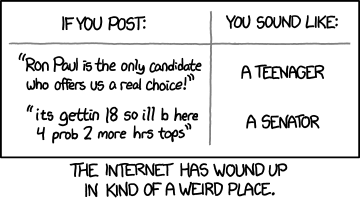
xkcd makes, as so often, a great point:

Yeah, a weird place for language use. Next time you hear somebody bitching about texting and leet speak ruining English, maybe they're a 17-year old libertarian?

But more seriously, Wonkette has a piece showing almost exactly what's in the comic. If you go here, you'll see that the speaker of the House in Michigan texted this:
“Can they get the paperwork to u and u get to me …"
And the speaker eventually got this response from a state representative (no, not a senator; that would be too perfect):
"All will then b perfect!”
Wow. (Click the link for politicians txting, stay for the stunning moral bankruptcy.)

PS: Given where a lot of Rs are at now, Paul is hardly a 'real choice'. If you want an alternative to Obama and Romney, that's probably more like Jill Stein.

Wednesday, May 30, 2012

Calling formal semanticists! I sort of semi-know for a fact …

Donald Trump opened one of his rants about Obama and birtherism this way:
 I sort of semi-know for a fact …
 The audio is here, at about 6:30.

What?  What the hell does that mean? I mean really, what. does. that. mean.? I can't do it in a truth table.

The mega-hedge of all hedges?

Friday, April 20, 2012

Crash blossom, political edition: "Wisconsin governor, indicted pol"

Various linguablogs have discussed lots of 'crash blossoms' (see here). A couple of years ago over at the Log, Geoffrey Pullum quoted Chris Waigl as defining crash blossom this way:
those train wrecks of newspaper headlines that lead us down the garden path to end up against a wall, scratching our head and wondering what on earth the subeditor might possibly have been thinking.
Yesterday we took a break from linguistics to post on the current governor of Wisconsin, Scott Walker, and a commenter noted quickly that Walker is under serious investigation and could be indicted before long. Over at Blue Cheddar, there was a crash blossom on exactly this topic, image from Blue Cheddar, of course.

Monday, April 16, 2012

More language and politics ... "he speaks French too"

We started talking about language and politics in the upcoming elections a while back (like here on the English Only leanings of the Republican presidential candidates) and our last post was about a smart point about language and national security by Russ Feingold.

But in correspondence with a regular reader (tip of the big old straw hat to Prof. R!), this video on Romney came up:


The video had made a splash back in the winter. Up to about the 50-sec. mark, it's standard attack ad stuff, but then, the hammer: "he speaks French". "Just like John Kerry".

Want evidence that he can read a prepared text in French before a rolling camera? Then check this out:


I'll leave it to you to determine whether that counts as 'speaking French', but it's depressing to even make jokes (hey, I'm an optimist) about this stuff in attack ads.

Saturday, April 14, 2012

Russ Feingold on the critical need for language learning

Russ Feingold is a Wisconsin icon. If you go around Madison, you can easily find bumper stickers that say "Russ Feingold will always be MY senator". He lost his last election to Ron Johnson (who's making news on his own, despite being generally invisible in the Senate) in the surge that brought Scott Walker to power, and he steadfastly refused to run for governor against Walker.

At any rate, I just finished reading his new book, While America Sleeps: A wake-up call for the post-9/11 era.* In the senate, Feingold worked hard on 'big picture' foreign policy issues, often on issues that the US has largely ignored, like, say, what's going on in Africa. The book reviews post-9/11 politics from his perspective and closes with a lot on what he thinks we need to be doing now. He writes (p. 258-259) about the skills and abilities we need as a nation:
To continue to play a leading role in the world, and to be safe at home, we have to develop these abilities in government, education, and the media.

Perhaps foremost among the abilities we Americans need to cultivate is the knowledge of foreign languages. I know only English and a smattering of French, so I have to admit my own failings in this area. They say that it's very hard to learn a language later in life, but if there's an experiment somewhere to see if someone approaching sixty can still become fluent in some foreign language, sign me up. A failure to learn other languages can be viewed as arrogant, possibly even rude. … But it is more urgent than that. I am convinced that it is actually a threat to our national security … .
Nicely said. He builds a really extended discussion around this and concludes, among other things (p. 261), that:
We simply need more American who are willing to make linguistic diversity an important part of their education and lives.
Yup. And, Senator, we'll be in touch the day we start looking for subjects for that experiment.

*The title plays on Churchill's While England Slept by way of JFK's senior thesis, published as "Why England Slept".

Saturday, February 25, 2012

more droppin of the g's

Mr. Verb has commented on so-called "g-dropping" by politicians a fair bit, e.g. here and here.  Just caught another reference (from the Isthmus) to our favorite down-home social marker, one which is striking for all the assumptions communicated in just one teensy little sentence:
Thompson was a hard worker and, perhaps because of his unpolished style of speech - dropping his g's and other lapses - people underestimated his intelligence.
The author speaks of course of none other than our former Governor-for-life, Tommy Thompson, now making a run for the Senate (-for-life?).  I think Tommy comes by his "lapses" honestly, though - he was doin' it back before it became trendy durin' the 2008 elections.  Just a hometown boy from Elroy, Wisconsin, doin' what comes nacheral.  It'll be interesting to see if the media picks up on this theme as his campaign gets into high gear.


Thursday, January 05, 2012

Language policy and the GOP field

Here's a piece by Lesli Maxwell in Education Week noting that current Not Romney candidate Rick Santorum (along with Newt Gingrich) favors English as 'national language'. She had a slightly earlier piece about Romney's (the Not Not Romney's?) opposition to bilingual education, here.

About all of Team Verb is in Portland for the LSA or heading out there today. Lots of good stuff, including a celebration of the Dictionary of American Regional English. We'll have some commentary on the Word of the Year festivities, I'm sure.

Sunday, November 27, 2011

Full-time proofreader sought

Apply in the governor's office or at the state GOP hq, I guess … see 'lastest' tweet below, from the party's official website.


Can't make this stuff up, folks.

'are'/'our' confusion from Scott Walker

Scott Walker may be polishing up his resume, now that the recall signature effort has likely passed the halfway mark (here) less than two weeks after it started. If so, he should use grammar check and have some folks look it over before he sends it out.

He (or somebody on his staff on his behalf) tweets regularly. Most of the stuff is utterly mundane … see the middle one in the picture here, about him being damp from the Badgers game (it was raining). And sometimes they have political barbs ... see the third one, where he refers to the White House holiday tree as a Christmas tree, as he has consistently referred to the Wisconsin one, contrary to now-normal usage.

But whoever wrote today's tweet (top one in the pic) blew it. I've seen 'are'/'our' confusion in spelling before and hear people pronounce 'our' like 'are', basically [aɹ] or [aɻ].

Linguists are always quick to stress how trivial spelling is, even in a prescriptivist/standard context, but this kind of thing can stick and take on a life of its own if it seems to confirm a view people already are inclined to hold about somebody, I guess — remember Dan Quayle and 'potatoe'?

Wednesday, October 19, 2011

More English Only in Michigan

See this story. Here's the start of the piece:

Six languages were heard spoken at Spartan Stadium last weekend during the annual football showdown between Michigan State University and the University of Michigan, state Rep. Kenneth Kurtz, R-Coldwater, said.

Those watching at home heard the game in one language — English, Kurtz noted.

"Why? Because that's the language," he said.

"We're a nation of immigrants. We've come together under one system of government, one Constitution, and that Constitution is in English," Kurtz added.
If language use today is determined by the original language of documents (or speakers? cultures?), there may be big changes coming on various fronts, but what I want to know is what six languages were spoken and how the heck Kurtz knows?


Saturday, July 16, 2011

Sincerestly

You ARE a member of the Colbert Super PAC, aren't you? Good. That means you got his latest message, declaring that this new organization 'has been hailed in the national press as everything from "legal" to "dangerous."'
There's actually no particular language angle here, really, save that he signs the letter 'sincerestly'.

Just kidding. It's classic Colbertian poety, of course, through and through. That includes a nice bit of nouning:
Donate now. Donate often. Make a difference. Make a donate.
Yes, Stephen, together, let's make a better tomorrow, tomorrow.

Sunday, April 03, 2011

Quick Wisconsin update

This is a critical week for Wisconsin and its flagship university. Here are some highlights:

Monday, 3:30, Bascom Hall 272: Faculty Senate meeting. Another Committee of the Whole discussion of the proposed public authority. Also on the agenda is the issue of the University turning over faculty emails to the Republican Party of Wisconsin. (People in the know are telling me that there was/is a strong case to be made against handing over anything.)

Monday, 5:00: From Memphis to Madison: Honor History, Make History. Rally for Statewide Day of Action in conjunction with GOTV efforts. Features performances by Michelle Shocked, other musical acts, and speeches by the Reverend Jesse Jackson and other leaders of the movement.

Tuesday: Election day. The right now controls the State Supreme by 4-3. If Kloppenburg beats Prosser, that flips it.

Tuesday, 1:00: Fight back USA teach-in, Hillel. LIVE WEBCAST: Cornel West & Frances Fox Piven (hosting) ... Jeffrey Sachs, economist, Columbia University Heather McGhee, Demos Richard Trumka, president, AFL-CIO plus activist reports on Wisconsin, teacher unions, and anti-forclosure movement.

Zombies

Yesterday was the Zombie walk again Walker. Pic from here.

Friday, March 18, 2011

Overnor Pawlenty: Is he oin roue?

An alert member of Team Verb called my attention to a passage from this piece in the New York Times about Tim Pawlenty's efforts to be everything to everybody:

The knock on Mr. Pawlenty, according to conversations with voters, is that his speeches sound sincere but do not always sizzle. At a faith forum last week in Iowa, he displayed vigor. But the next day at the Statehouse, the talk among several Republicans was that it seemed he had suddenly developed a Southern accent as he tried connecting to voters by speaking louder and with more energy.

The political blog of Radio Iowa heard it too and noted, “Pawlenty seems to be adopting a Southern accent as he talks about his record as governor.” As he spoke of the country’s challenges, he dropped the letter G, saying: “It ain’t gonna be easy. This is about plowin’ ahead and gettin’ the job done.”

The salient point here is probably the 'gentleman's ain't'. The gonna, where the going to indicates future tense, is so common that even Joe Biden used it in the VP debate with Palin. And the use of to plow adds to the folksy air. I haven't heard the audio, but I'm guessing that Pawlenty didn't actually adopt a Southern accent.

Image from reason.com.

Friday, November 05, 2010

Election footnote

It took days, but somebody finally managed to show me a real silver lining from the elections: Tim James was not elected governor of Alabama. If you need some cheering up, go to YouTube and watch some of the parodies of his ads about English in Alabama. Here's one ...


HTs to bf and jb.

Thursday, July 01, 2010

"Chomsky's Nightmare"

In a recent post, I noted ever so briefly how some of the people leading the anti-foreign language crusades in the US are tied pretty directly to the extreme right, closing with acknowledging that the connection to linguistics was pretty tenuous.

Here's a closely parallel situation in a way: The June issue of The Progressive has a big article by Matt Rothschild, the editor, called: "Chomsky's Nightmare: Is Fascism coming to America?" (excerpt available here).

Chomsky lays out here a point that people had been saying that he made in his appearance here in April (which I missed), and one he's made elsewhere, quoted here:
Ridiculing the tea party shenanigans is a serious error. [The attitudes of the tea party people] are understandable."
He talks, as so often, about the deterioration of life for the big majority of Americans or recent decades -- falling income, etc. -- while bankers suddenly get extra billions. And:
People want some answers. They are hearing answers from only one place: Fox, talk radio, and Sarah Palin.
Agreed to an extent: The rise of non-far-right voices in the media remains still very slow, but I think that Rachel Maddow and progressive radio are working hard to counter that noise.

But the bigger argument, that the US is in danger of becoming a fascist country, is a tougher sale. In fact, Rothschild devotes a lot of the article to evaluating that and arguing that it's unlikely. Agreed again. Still, I'd agree with Chris Berlet, quoted in the article, that this is "time for a conversation about it."

In particular, and here's the tie to the earlier post, it seems beyond question right now that there are major party candidates openly expressing anti-democratic views. Arizona state senator Pearce forwards Nazi emails to his supporters and a pretty conservative (from what I know) paper can say about a US Senate candidate "Armed revolt part of Sharron Angle's rhetoric", with this passage in the article, starting with a quote from her that's pretty well known now:
"In fact, Thomas Jefferson said it’s good for a country to have a revolution every 20 years. I hope that’s not where we’re going, but you know, if this Congress keeps going the way it is, people are really looking toward those Second Amendment remedies.”

Also that month, she told Reno conservative talk show host Bill Manders she hoped her opponent, U.S. Senate Majority Leader Harry Reid, would be defeated at the ballot box before the electorate resorted to more aggressive measures.
If you read the right news, you see that there are dozens of people out there saying this stuff, candidates for national and state office. These views have long been around but mostly at the margins, although hardly always (remember Jesse Helms?).

So, I don't fear that the fascists out there are actually about to take over, but we have to recognize that there's a set of people out there in power or close to power who would push as hard as they can in that direction.